A 28-year-old plague researcher died in Russia. Authorities have imposed a quarantine but deny any threat of plague, and locals are struggling to make sense of it.
Darya Shipilova, a 28-year-old employee of a plague research institute, died overnight on October 1–2 in Shelekhov, a city just outside Irkutsk. Authorities then isolated about 200 people who had been in contact with her and imposed quarantine restrictions at the hospital where she had been admitted a couple of days before her death. Around the same time, media outlets and social media users began circulating reports that she had died of pneumonic plague after contracting it at her institute. Almost immediately, however, pro-government outlets deleted these reports from their websites, and authorities began denying that plague was involved, saying Shipilova had died of pneumonia.
The news outlet People of Baikal traveled to Irkutsk and Shelekhov to investigate whether negligence could have caused Shipilova’s death and whether local residents believed there was a threat of plague. Meduza is translating its report in full.
“The smell was unbearable, really acrid,” a resident of the building, a woman around 40, tells People of Baikal. She thinks it was a strong disinfectant. Residents opened the doors to the stairwell because “you could barely breathe.”
The people who arrived told residents that “Rospotrebnadzor sent us,” referring to Russia’s consumer protection and public health agency. “We asked what happened. They told us some young woman had died from a deadly virus,” the woman told People of Baikal. “They didn’t know anything else. They said, ‘We came to work, they told us to go disinfect the place, so we came and disinfected it.’”
Residents did not yet know that their neighbor, 28-year-old Darya Shipilova, had died at Shelekhov District Hospital overnight on October 1–2. She worked at the Plague Research Institute of Siberia and the Far East. Immediately after her death, reports spread across the Irkutsk region that she had died of pneumonic plague.
Since then, the building where Darya lived has been disinfected twice more. None of the workers mentioned a “deadly virus” again. They still wore gas masks while disinfecting the building, but this time they were in white protective suits.
“The second time, a woman from their team knocked on our door and asked for water to mix the solution,” Shipilova’s neighbor recalled. “I said, ‘What are you spraying for?’ By then I knew everything [about the plague rumors]. She goes, ‘It’s for cockroaches.’ But we don’t have any cockroaches in our building. Then I see her packing her little [protective] suit into a bag. I’m like, ‘Well, that explains it.’”
‘A woman who may have died of plague’
An employee of the plague institute, speaking anonymously, told People of Baikal that Darya Shipilova developed cold symptoms at work. “She didn’t have a fever, but then she got worse and developed swelling.”
Shipilova was hospitalized on September 29 and died at Shelekhov Hospital overnight on October 1–2. Officials have not explained why she was taken there. Most likely, it was because the inpatient facility had previously been used as a COVID hospital.
Immediately after Shipilova’s death, Shelekhov Hospital was placed under quarantine. Governor Igor Kobzev said the reason was “a particularly dangerous infection.” Official statements did not mention the word “plague.”
That same day, October 2, Anna Popova, the head of Rospotrebnadzor and Russia’s chief public health officer, flew to Irkutsk. She attended an emergency meeting of the regional commission responsible for public health and epidemic prevention. Officials, doctors, and law enforcement and security personnel approved an “emergency action plan” at the meeting.
People who had been in contact with Darya were isolated and placed under medical observation. Authorities did not disclose the exact number. The television channel REN TV reported that there were about 200, but deleted its posts that same day. The people who had been in contact with Shipilova were housed in at least two hospitals in Irkutsk and Shelekhov.
People of Baikal’s sources in law enforcement and security agencies said her contacts were taken away in ambulances escorted by the Federal Security Service, or FSB.
An Irkutsk resident told People of Baikal that her friend, a nurse at Shelekhov Hospital, had been quarantined. “Everyone there was worried. The bosses were freaking out, and that means things are bad,” she said, quoting her friend.
Employees of the plague institute were isolated inside the institute itself. One employee told People of Baikal: “They quarantined 200 of us. Kept us there for three days, took swabs twice a day. But they did feed us. We slept on chairs, and those who didn’t have a spot slept on their jackets. I slept on my jacket. We didn’t sign any documents. They let us go on Sunday.”
There was no official information about what had happened to Darya. On the afternoon of October 2, Irkutsk journalist Pavel Stepanov wrote that, according to his information, Shipilova had “broken a test tube with a pneumonic plague sample in it” and “concealed what happened.” This account spread widely but has yet to be confirmed. Rumors that Darya had visited Buryatia shortly before her death also circulated online.
On Friday evening, October 2, Buryatia’s leader, Alexey Tsydenov, denied that she had visited the region. More significantly, he became the first official to mention plague, saying that the “woman who died of plague in the Irkutsk region” had not visited Buryatia. That same day, however, Tsydenov edited his post to read “a woman who may have died of plague.”
‘She was very afraid of infecting anyone’
Darya Shipilova was born and raised in Irkutsk. In high school, she decided to become a doctor. A former classmate tells People of Baikal she was “smart, honest, and responsible.” Others who spoke to the outlet, including her colleagues, also call Darya “responsible.”
“Dasha was really anxious about infecting anyone if something went wrong. You could tell from how often she disinfected her hands, even outside work,” says a colleague at the plague institute.
In the summer of 2022, Darya graduated from Irkutsk State Medical University with a degree in medical biochemistry. That same year, she joined the Irkutsk Plague Institute, where she had previously interned. She initially worked as a laboratory assistant and became a researcher a year and a half later.
Darya continued her studies, entering a residency program in clinical laboratory diagnostics. The plague institute paid for her training. Shipilova completed her residency with honors in 2024. She worked in the plague microbiology department until at least January 2025.
In the spring, Shipilova and her colleagues from the institute spoke at the annual All-Russian Congress on Infectious Diseases in Moscow. She gave a presentation titled “Studying the Antibiotic Susceptibility of Yersinia pestis from Natural Plague Foci in Siberia.”
Darya’s interests extended beyond science. At 17, she graduated from music school. In 2025, she and other institute employees took part in the “Songs of Victory” competition for employees of the regional Rospotrebnadzor office. They performed the song “Maisky vals” (“May Waltz”). A year later, Shipilova and her colleagues won the “Musical Entertainment ABC” quiz. In August 2026, Shipilova took part in drills for public health emergency rapid response teams.
“Dasha was really smart,” says an Irkutsk resident who studied in the same department as Shipilova. “Not many people from our department get jobs at the plague institute. I did an internship there. It’s a serious facility. They take everything seriously, and it’s safe.”
Darya lived in a two-story brick building in an outlying neighborhood of Irkutsk. The neighborhood is considered rough. The building is surrounded by old wooden barracks-style housing, and many of the buildings are 60 to 70 years old.
Neighbors call Shipilova “calm” and her parents, who visited their daughter often, “quiet people who don’t drink.” Darya had a dachshund in her apartment, and her father often walked it.
Darya was very close to her mother. Like her daughter, Svetlana Shipilova works in health care. Rumors have spread among Darya’s neighbors that Svetlana “couldn’t bear her daughter’s death and died of a heart attack.” That is not true: Her mother, like other family members, is still quarantined at a hospital in the city.
How pro-government outlets published and deleted reports
On October 2, the pro-government newspaper Izvestia reported that following Darya Shipilova’s death, authorities in Irkutsk had opened a criminal investigation under Part 2 of Article 236 of the Criminal Code — “Violation of public health and epidemic prevention rules resulting in a person’s death through negligence.” Izvestia soon deleted the report, along with other articles about a possible outbreak of pneumonic plague in Irkutsk.
The Kazan branch of Argumenty i Fakty deleted a report on the death of the Irkutsk laboratory assistant that it had published on October 2. The article remained in the Yandex search engine’s cache. The Kuzbass edition of Moskovsky Komsomolets deleted a report that Rospotrebnadzor had denied Irkutsk hospitals were being placed under quarantine. That article also remained in Yandex’s cache.
Government agencies also deleted information. On the morning of October 3, the Baikalsk administration recommended that residents temporarily avoid traveling to Shelekhov, citing “unofficial information” that plague had been detected there. Two hours later, city authorities deleted the post.
That same day, management at the Irkutsk Aluminum Smelter, Shelekhov’s main employer, introduced a mask requirement on its premises. “Contradictory information about the plague situation is circulating in Shelekhov,” director Artyom Fominykh said. A day later, Fominykh said in another post that “the mask requirement at IrkAZ is unrelated to the quarantine at Shelekhov Hospital” and was prompted by respiratory illnesses.
“All our employees know this isn’t the first time. We bring back mask requirements from time to time during cold and flu season,” the plant’s director wrote, urging people “not to spread rumors.”
Throughout Saturday, October 3, authorities issued no official statements. Governor Kobzev posted on his Telegram channel about a forum for young workers and a meeting with the head of Russia’s health care regulator, Roszdravnadzor. There was not a word about the suspected plague that the whole city was discussing.
Meanwhile, several municipal hospitals in Irkutsk introduced quarantines. These included City Clinical Hospitals No. 1, 3, and 10, as well as the city’s Ivano-Matreninskaya Children’s Clinical Hospital.
Irkutsk Regional Clinical Hospital stopped admitting visitors on October 3, according to a patient. “The sister of a seriously ill patient in my room used to visit her. Since Saturday, staff have been bringing everyone’s care packages up, and they brought mine right to the room. Today I went downstairs for a food delivery. They wouldn’t let the delivery driver past the security desk.”
Over the weekend, residents bought up antibiotics at pharmacies in Irkutsk and Shelekhov. “There were fights at some pharmacies on Saturday,” an employee of the plague institute tells People of Baikal. “They cleaned the pharmacies out of antibiotics! Even the really, really old ones. People were panicking because everywhere you heard the words ‘plague’ and ‘pneumonic.’”
‘Listen, the situation is completely under control’
Rospotrebnadzor did not comment officially until Sunday afternoon, October 4. The agency told TASS that the plague institute employee had suffered from “pneumonia of unknown cause.” It also said no accidents involving pathogenic microorganisms had occurred at the institute. Rospotrebnadzor did not publish any statements on its own platforms.
According to Rospotrebnadzor, institute employees had not sought medical care for infectious diseases. Among those who had been in contact with Darya, two cases of COVID-19 and two cases of rhinovirus infection were detected.
“Pneumonia of unknown cause” means that a patient had inflammation of the lungs, but doctors could not identify the specific microorganism that caused it: a bacterium, virus, or fungus. Rospotrebnadzor did not explain this in its statement or address why hundreds of people had been quarantined over pneumonia.
On the evening of October 4, Governor Kobzev repeated Rospotrebnadzor’s statement on his Telegram channel. The next day, he said that “the public health situation in Irkutsk and Shelekhov District is currently stable.”
On Monday, October 5, Kobzev said in a video statement: “Listen, the situation is completely under control. It’s unpleasant, of course, but the doctors and Rospotrebnadzor have done everything possible to make sure all of them [people who had contact with Shipilova] are under observation. Life goes on in the city, and life goes on in Shelekhov.”
That same day, Vladimir Putin’s spokesman Dmitry Peskov urged people to listen only to Rospotrebnadzor’s official statements, rather than trust rumors and speculation about plague online.
“Rospotrebnadzor is staffed by highly qualified professionals in this field. Let’s listen to their official statements,” the Kremlin spokesman said.
Residents of the Irkutsk region bought up antibiotics and protective masks over the weekend
On October 5, U.S. President Donald Trump said the United States was ready to help Russia following reports of suspected pneumonic plague. Trump said that in Russia, “they call it pneumonia.”
On October 6, the Shelekhov district administration responded to Trump’s offer. Deputy Mayor Yelena Sofyina said: “Let me answer directly. We can handle this ourselves. The situation is completely under control.”
Background
Hospitals in Irkutsk impose quarantines after an employee at an anti-plague institute dies. Russia’s public health agency says she died of pneumonia and the epidemiological situation remains ‘stable.’
The earliest known plague outbreak happened in what is now Russia 5,500 years ago. Scientists found the evidence in ancient teeth.
Plague may have resurfaced in Russia. But this isn’t the Black Death.
Google searches for ‘plague’ in Russia surge 2,800% after hospital quarantines in the Irkutsk region
‘They went into quarantine just in case’
Authorities insist there is no plague in the region and that hospitals are operating as usual, but quarantine measures remain in place. On October 5, People of Baikal learned of restrictions at a psychiatric clinic in Irkutsk. A source told the outlet it was “something like a quarantine”: “They say they introduced it just in case.” The clinic had made no official announcement of the restrictions or posted any notices. A patient learned of them from a security guard when he tried to go to a store.
The Irkutsk Perinatal Center also introduced access restrictions. Blogger Ulyana Gavryunina reported them on social media and confirmed them to People of Baikal. On October 5, she arrived for a checkup. Her mother, who accompanied her, was not allowed into the maternity hospital. Since Friday, the center has admitted only pregnant patients.
“[At the hospital] they explained that there’s still unconfirmed information about a virus that might even be worse than coronavirus, and they don’t yet know what kind of virus it is or how to handle it, with the babies being so little. That’s why they introduced the quarantine. And no one knows how long it’ll last,” Ulyana told People of Baikal.
At the entrance, staff took Ulyana’s temperature and asked her to show her tongue. They gave her two health checklists to fill out. One was titled “Checklist for a suspected particularly dangerous infection: ‘Plague.’”
The checklist asked how the pregnant patient felt, whether she had been in contact with anyone who had arrived from abroad or was ill, and whether she had a fever or a stuffy nose.
The center barred partners from attending births during the quarantine. Ulyana had chosen to pay to give birth there so she could have someone with her. Now she is considering canceling her contract and wants to give birth in Angarsk, where she lives, because in Irkutsk “things feel unsettled, it’s really inconvenient and stressful, and there’s no point anymore.” In Angarsk, “everything is calm,” both in the city and at the maternity hospital.
An employee of the Irkutsk Plague Institute believes the city’s hospitals went into quarantine “just in case.” “Our scientists are working around the clock now. Samples just keep coming in. That’s because everyone admitted to a hospital with any signs of a cold is swabbed [for plague] and tested. That goes for absolutely every hospital.”
‘There are still no final findings on her death’
The Irkutsk Plague Institute is not commenting officially. An employee does not believe Darya broke a test tube in the laboratory: “That doesn’t happen here. But even if she had broken one, you’re working in a sealed containment cabinet, in sealed protective gear. Nothing would happen at all.”
A former university classmate of Shipilova’s who interned at the plague institute agrees: “Besides the strict safety measures, everyone there gets vaccinated against plague — even students who come for internships.” The medical professional says: “I can’t even imagine what could have happened there, even in theory.”
The plague institute’s employees have now been released from quarantine. “They took swabs from everyone for three days in a row, but everyone is completely healthy. Today is a normal workday for us,” one of Shipilova’s colleagues told People of Baikal on Monday, October 5. “Things are calm.”
Speaking anonymously, she said several times that “there are still no final findings [on the causes of Darya’s death].” “Tests are still being done, and there are no results at all yet. They’re still trying to determine the cause of death. Everything will settle down in a week, when the results are ready.”
Hi, I’m Vladislav Gorin.
I’m the host of Meduza’s daily Russian-language news podcast. This summer, the Russian authorities opened a criminal case against me — not for committing a crime, but for telling the truth about Russia and its war against Ukraine.
Because the Kremlin has branded me a criminal, I can’t go home. I also can’t safely travel to countries like Turkey — even though it’s a NATO member — because I could be arrested and extradited to Russia. I can’t even renew my passport at the consulate anymore.
None of this is going to stop me. I know there are hundreds of thousands of people in Russia who don’t want this war and who still believe in freedom and democracy, and they deserve access to independent journalism. Please support Meduza so I can keep reaching them.

‘The theory that there was no outbreak is unconvincing’
A Russian physician, who asked to remain anonymous, tells People of Baikal that he sees two possible explanations for what happened. Either Darya Shipilova was indeed found to have plague (or another particularly dangerous infection), but officials “contained it and decided not to talk about it publicly.” Or authorities and doctors still do not know exactly what happened, are “conducting an epidemiological and laboratory investigation,” and fear “panic and being held responsible.”
The physician finds the theory that there was no outbreak unconvincing. “A young employee of a plague institute suddenly develops a severe infection and quickly dies. Afterward, the hospital is closed, and the institute’s employees and her relatives are isolated. And an epidemiological investigation is conducted. That doesn’t prove it was plague, but it gives journalists sufficient grounds to investigate that possibility.”
The doctor suspects that “some potentially significant epidemiological event” did occur at the plague institute. He says the internal investigation and the isolation of a large number of employees point to this. Darya may not have realized that she had been at risk of exposure. Or she may have known about an incident but underestimated its seriousness.
The physician is skeptical of Rospotrebnadzor’s statement that Shipilova’s illness was “unrelated to her work.” Definitive laboratory confirmation takes up to 10 days. That time is needed to test blood, sputum, tissue, and other samples from Shipilova’s body.
“You can’t definitively identify the pathogen in a single day after the autopsy,” the physician said.
A former university classmate of Darya Shipilova’s who interned at the plague institute and now works at an Irkutsk hospital told People of Baikal the same thing. She called Rospotrebnadzor’s official reference to “extensive laboratory testing” in Shipilova’s case “rather vague wording.”
“It all depends on the testing method. And nowhere have they said exactly which test they performed.”
‘I’ve saved patients like that, but they let my daughter die’
Darya’s mother, 64-year-old Svetlana Shipilova, was still quarantined at an Irkutsk hospital on October 5. She told the outlet Glubina that samples and swabs were being taken from her every day. “They’re testing for something, looking for something. Maybe they’re worried about some other infection, so we don’t catch COVID or something in here.”
Shipilova said that as of October 5, she still had not received an official report on her daughter’s death. “I’m waiting for something official,” she said. “Not just something in the media, but from Rospotrebnadzor. It has to be an official document.”
Svetlana says she is “having a very hard time” and does not want to “read nasty things about my child”: “I know the truth. I’m fending off stupid people I know who believed all this. The smart ones didn’t believe it, of course. Even some medical professionals don’t understand that it’s impossible to break that test tube. Even if you fling it against a wall. Only someone who doesn’t know what they’re talking about could say that. Even hypothetically, you simply can’t spill what’s inside or break the tube. They’re that well protected.”
People who knew Darya also do not believe she could have broken a test tube. “They dragged her name through the mud without even finding out what happened,” a former schoolmate says. A friend tells People of Baikal: “I can’t square this whole story with the Dasha I knew. It’s like they’re talking about someone else. Knowing how hardworking and responsible she was, it just doesn’t add up for me.”
Svetlana Shipilova calls her daughter “a hard worker”: “Such a pure, pure soul. Her boss is taking it hard because she knew Dasha and knew why she hired her. It’s really hard to get a job at the plague institute. She saw how Dasha worked when she was interning there. She realized what a pure soul she was, such a workaholic,” she says. “I’ve saved more than one patient like that, but they didn’t save my daughter. They just let my daughter die.”
Darya has not been buried, and it’s not clear when the funeral will be. “Who’s going to bury her when we’re locked up in here?” her mother says.
Darya’s neighbors are worried that “no swabs at all” have been taken from them. “The clinic has called me every day since Friday to ask how I’m feeling. They say if I develop symptoms, I have to see a doctor. But no one tells us anything — what the illness was, what’s going on at all. It’s like we don’t exist. We’re shocked they haven’t quarantined us. We’ve all been in contact with her. We probably shouldn’t be going to work. We should be staying home.”
A notice at the building’s entrance asks residents who were not home during the disinfection to call the phone numbers listed “due to a sharp increase in illness in your building.” Among them is the number for the internal medicine department at Irkutsk City Hospital No. 10.
The residents who spoke to People of Baikal’s reporters say they feel well and have no symptoms.
‘There’s no panic in Shelekhov’
There is “no panic” in Shelekhov, where Darya Shipilova died, one resident tells People of Baikal. We arrived on a weekday, after the governor’s statements that the situation was stable. Mothers were walking with their children in the city park, and teenagers were riding bicycles. In stores, the shopping center, the local café, and the park, no one was wearing a mask. A few people wore them on buses — mainly older women and children.
The local café is busy at lunchtime. The word “plague” drifts over from just one table, where two women are eating and talking quietly. Everyone else is talking about other things.
The registration area at the Shelekhov outpatient clinic is packed with visitors. The clinic is operating as usual. Receptionists sit at desks, with visitors across from them and no protective glass screens between them. The electronic appointment system malfunctions: The terminals freeze, then print out stacks of tickets, slowing down registration. Only sample collection has been suspended since October 2. A notice still hangs on the procedure room door: “No blood samples will be taken due to quarantine,” followed by five exclamation points. The receptionists do not know when collection will resume.
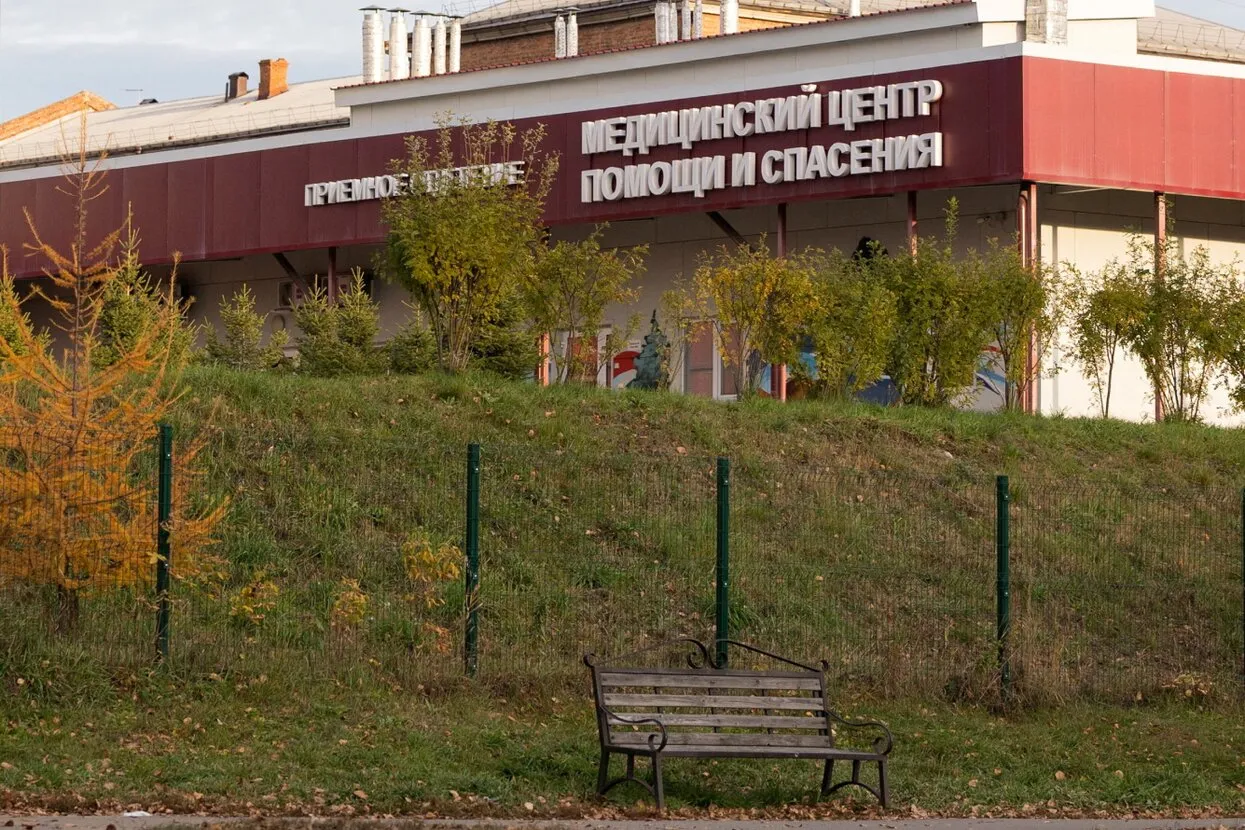
The inpatient facility, a four-story brick building on the hospital campus, is closed for now and expected to remain so until the end of the week, the receptionists say.
A colorful banner on the inpatient building reads: “Doctors serving in the special military operation,” the Kremlin’s term for the war in Ukraine.
The plastic-framed windows are open, but no patients are visible near them. The door is wide open too. A trash can on the threshold and a mop handle across the doorway are meant to stop visitors from walking in. There are no quarantine notices, only a notice about access restrictions.
A female security guard in a black uniform came out to meet us. Her only protective gear was an ordinary face mask from a pharmacy.
“Is it really plague?” the journalist asks her.
“Who’s going to tell us? We only read about it online. A particularly dangerous infection — that’s all,” she replies.
There is a pharmacy at the hospital. The journalist asks for antibiotics and says plainly: “I want to keep some at home in case of a plague epidemic.” The pharmacist is not surprised. She initially offers a drug costing 680 rubles, but then sells the cheapest one, for 100 rubles. Antibiotics are available, and there is no rush to buy them.
At a pharmacy on the other side of town, another pack of inexpensive antibiotics is sold without anyone asking for a prescription. A mask requirement notice is posted on the door, but the pharmacist is not wearing a mask. The notice has been there since 2020, she says, laughing conspiratorially: “But I didn’t wear a mask back then either.”
At the entrance to the Irkutsk Aluminum Smelter (IrkAZ), however, even the groundskeepers sweeping up leaves are wearing masks. This is Shelekhov’s main employer. Its director introduced a mask requirement on October 3, and it remains in place.
When the shift ended, all the workers filed toward the gate. All were wearing masks and took them off only once they were past the gate.
At Meduza, we are committed to transparency about our use of artificial intelligence in the newsroom. The story you’re reading was written by one of our living, breathing journalists and translated from Russian using an AI model configured to follow our strict editorial standards. This translation process is the result of extensive testing and refinements to ensure our English-language coverage is timely and accurate. A Meduza editor reviews every draft before publication.
If you find any errors in this translation, please contact us at reports@meduza.io.
To read Meduza’s exclusive content in English, please subscribe to our newsletter.
Karina Pronina, Anastasia Ivanova, Valeria Maryina, and Margo Fogel for People of Baikal
Impossible?
Not quite. A glass test tube can be damaged or broken by an impact, spilling its contents. When working with especially hazardous infectious materials, protection relies on multiple layers of biosafety measures, not the strength of a single test tube. The material is placed in a sealed primary receptacle and a sealed secondary container containing absorbent material that can retain the liquid if the primary receptacle leaks or is damaged. Laboratories also use protective equipment and procedures for handling spills or broken containers.