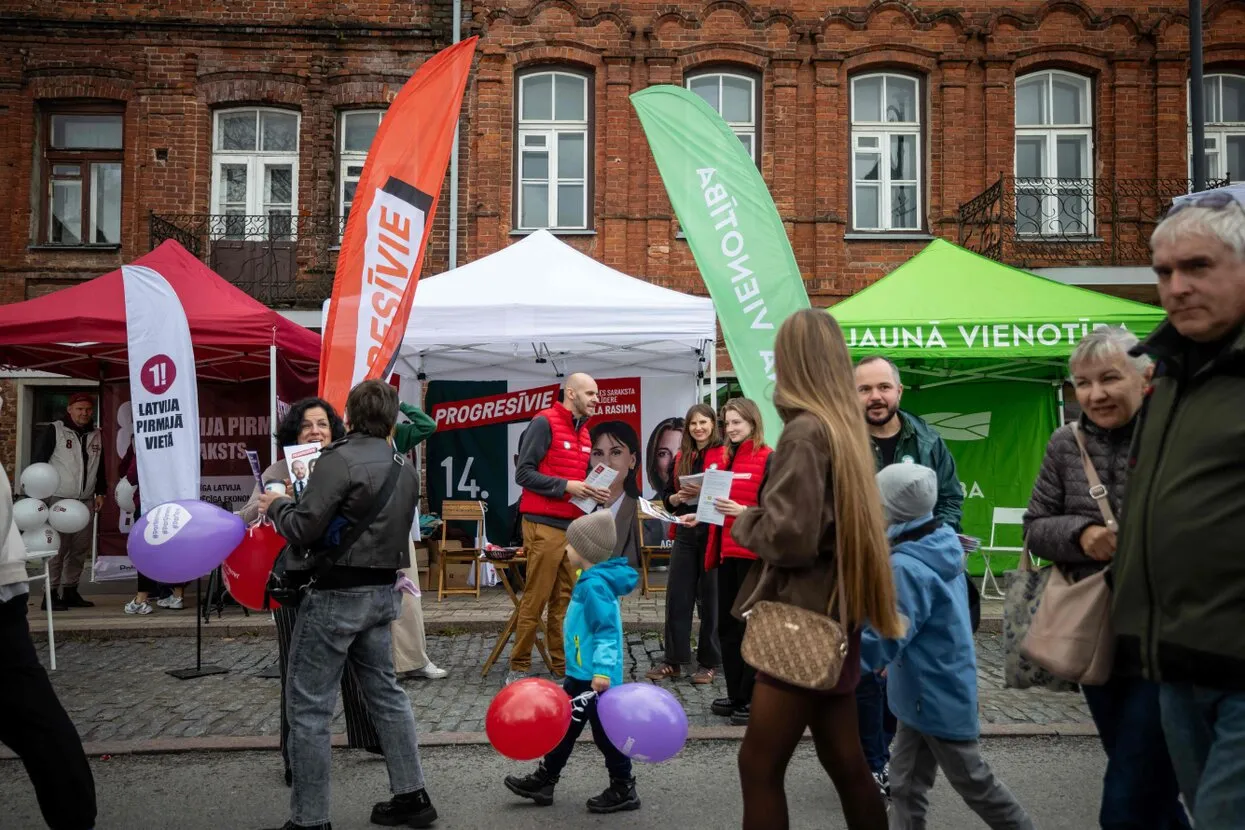
Russian-speaking Latvians who back Ukraine and value their language are heading into an election without an obvious political home
Latvia will elect its 15th Saeima, or parliament, on October 3. September polls suggest seven political groups have a chance of winning seats. Two of them — the Sovereign Power / Young Latvians alliance and Latvia First — are competing vigorously to win over voters who once supported the “Russian” parties. Their rivalry is one of the campaign’s central stories: almost 35% of Latvian citizens speak Russian at home. Polls also suggest that the traditional “Russian” parties, especially Harmony Center, remain below the 5% threshold. Writing for Meduza, Sergejs Potapkins, a political scientist and researcher at the Latvian Institute of International Affairs, traces the complicated history of Latvia’s parties that have sought to represent Russian speakers.
This article’s main takeaways
In 2018, Harmony, the main party representing Latvia’s Russian-speaking voters, finished first in the parliamentary elections with 19.8% of the vote and 23 of the 100 seats. Four years later, it failed to clear the 5% threshold and lost its place in the Saeima. Aleksejs Rosļikovs’ For Stability! party filled part of the vacuum, but by February 2026, its parliamentary faction had also broken up. Within a few years, the established system of political representation for Russian speakers had collapsed.
Ahead of the October 3, 2026, elections, the political landscape for “Russian votes” has become completely fragmented. Old names are returning to the ballot, politicians are moving between parties, and several political groups are vying for Harmony’s former electorate. Yet none has regained Harmony’s ability to unite very different people around the Russian language and the demand to protect their shared interests.
Different views, shared interests
The history of the party model relying primarily on Russian votes began long before Harmony. After Latvia regained independence in 1991, disputes over citizenship, the Russian language, and the Soviet past became the main dividing lines between parties.
The groups described as “Russian” primarily represented Russian speakers, although their leaders and voters came from many different ethnic backgrounds. Only Latvian citizens had the right to vote in parliamentary and local elections. The Russian parties also defended noncitizens, who could not themselves vote for them.
Two distinct strands of Russian-speaking politics were already taking shape in the fifth Saeima, elected in 1993. Some groups sought from the outset to work within the restored Latvian state: the Harmony for Latvia, Revival for the Economy electoral list won 13 of the 100 seats. Its leader was Jānis Jurkāns, a Popular Front activist and independent Latvia’s first foreign minister. The other strand grew out of political resistance to the restoration of Latvian statehood. Equal Rights, which won seven seats, emerged from a Supreme Council faction of the same name, most of whose members had opposed the restoration of Latvia’s independence.
Hi, I’m Katya.
I’ve been running Meduza’s crowdfunding since 2021. Today, supporting Meduza is a crime in Russia. You can be sent to prison just for donating. We’re still able to do our work thanks to thousands of our Russian readers who now live abroad. But even they’re no longer safe.
Imagine you’ve left Russia, but then your mom becomes seriously ill. It could be your last chance to see her, so of course you go home. At the border, you’re interrogated. Officers hack into your phone and search for any trace that you’ve donated to Meduza.
The Kremlin is counting on that fear, and it’s working. People are afraid to donate. I’m afraid for our supporters, because any one of them could end up in prison. And I’m afraid for Meduza. Without crowdfunding, we simply can’t continue. So if you live outside Russia and don’t have to worry that donating to Meduza could keep you from going home to your family, I’m asking for your help. Please support our work.

From the outset, Russian-speaking political representation brought together people who had only recently stood on opposite sides of the central conflict over leaving the USSR and restoring independence.
These two visions of the future of Russians in Latvia led to fragmentation in the 1995 elections for the sixth Saeima. Jurkāns’ National Harmony Party, formed a year earlier from the former alliance, argued for integrating Russian speakers. The Socialist Party’s electoral list, which included Equal Rights, presented itself as their defender and appealed to voters by defining itself in opposition to the state. Together, the parties won 11 seats, down from 20. Their position had weakened, but continuing public disputes over citizenship and language only increased demand for political representation for Russian speakers.
The response was the For Human Rights in a United Latvia alliance, known by its Russian acronym, ZaPChEL. Ahead of the 1998 elections for the seventh Saeima, the National Harmony Party, Equal Rights, and the socialists formed its core. The small Russian Party also joined. Registration problems forced the bloc to run under the National Harmony Party’s name; it won 16 seats. ZaPChEL managed to unite liberal centrists with socialists: Russian speakers’ rights proved more important than ideological differences.
A PCTVL campaign poster for the European Parliament election. Riga, 2009.
Ints Kalnins / Reuters / Scanpix / LETA
Victories without results
In the elections for the eighth Saeima, ZaPChEL finished second and won 25 seats, just one fewer than the winner. That success sharpened disagreements over whether it was possible to form a government with Alfrēds Rubiks’ socialists and Tatjana Ždanoka’s Equal Rights, which had once opposed the restoration of independence. Ethnic Latvian parties still considered ZaPChEL an unacceptable partner and refused to form a coalition with it. As a result, the National Harmony Party left ZaPChEL in 2003.
In 2005, the party became a founding member of the Harmony Center alliance. In 2010, it joined New Center and the Social Democratic Party to form Harmony. ZaPChEL later also became a single party and renamed itself the Latvian Russian Union in 2014.
Harmony inherited many of ZaPChEL’s members and much of its experience. It brought the broad alliance’s political base back together while presenting a more moderate image. It sought to move beyond being an ethnic party and become a broader social democratic party capable of forming a governing coalition and finding common ground with the ethnic Latvian majority. The Latvian Russian Union, by contrast, remained focused on defending minorities, emphasizing language, schools, noncitizens, and resistance to assimilation.
The Harmony Center alliance finished first in the 2011 elections; the reorganized Harmony party did so in 2014 and 2018. But neither the alliance nor the party ever entered the national government. Ethnic Latvian political groups formed majority coalitions without it. This was Harmony’s central tragedy — even when it won an election, it was doomed to remain in opposition.
For potential partners, disagreements over history and language remained an obstacle — above all, Harmony’s reluctance to acknowledge the Soviet occupation of Latvia explicitly and its equivocal position on recognizing Latvian as the sole official language. There was also distrust of the party’s ties to Moscow following the cooperation agreement it signed with United Russia in 2009.
That isolation created the central paradox: Harmony could explain its lack of results by saying that others were unwilling to let Russian speakers into government. But after several election cycles, questions arose about what another victory would achieve. The party won votes, secured the largest parliamentary faction, and found itself isolated again. Repeated victories brought it no closer to joining the government, and its leaders increasingly faced accusations that they were not taking power because they were comfortable remaining in opposition.
From Meduza’s archives
Why the victory in Riga mattered
Everything changed in 2009, when Harmony chairman Nils Ušakovs won power in Riga. The party could now show voters tangible results at the city level: free public transportation for pensioners and schoolchildren, free school lunches, and renovations of parks, the promenade, and public spaces. For Russian speakers, there were also symbolic gestures: the renovation of Riga’s Mikhail Chekhov Russian Theater, completed in 2010, and free Latvian-language classes for Riga residents. In 2017, Ušakovs promised that, starting in 2019, the Riga City Council would pay for students attending minority schools to take additional classes in their native languages.
But corruption scandals surrounding the city administration and internal conflicts undermined this source of support. In 2019, the regional development minister removed Ušakovs as mayor, citing failures in his oversight of local public transportation. After the snap elections in 2020, the party found itself in opposition in the capital as well.
After February 24, 2022, Harmony’s leadership condemned Russia’s full-scale invasion of Ukraine. That position alienated Kremlin supporters and tore the party apart. In the 2022 elections, Harmony finished ninth with 4.81% of the vote and failed to enter the Saeima for the first time. The result reflected accumulated internal problems, the loss of power in Riga, and the emergence of new, more radical groups seeking to represent Russian speakers.
So who’s running in the 2026 elections?
It is too early to declare that parties focused exclusively on Russians have disappeared: both Harmony Center and For Stability! are registered for the 2026 elections. Polls, however, project vote shares of 3.1% and 2.4%, respectively — well below the electoral threshold.
For Stability! is the most prominent contender for Harmony’s legacy. In the 2022 parliamentary elections, it won 6.8% of the vote and 11 seats. Its leader, Aleksejs Rosļikovs, regularly spoke about Russian being pushed out of public life. For example, during a June 2025 vote in the Saeima on a declaration about the consequences of Russification, Rosļikovs switched to Russian and shouted, “There are more of us, and Russian is our language!” He was then removed from the chamber. He built his campaign around his willingness to speak out on language issues and argued that Russia’s aggression against Ukraine was “not clear-cut.”
That radical approach, however, did not keep the party together. Lawmakers left for various reasons, and on February 18, 2026, its parliamentary faction was down to four members — fewer than the five required to maintain it. Rosļikovs ended up in Belarus in the spring, after traveling to Geneva and then to Minsk while facing charges of inciting ethnic hatred. A Riga court ordered him into custody and placed him on a wanted list. The party enters the fall elections with its parliamentary faction dissolved and its leader living abroad.
Other groups are also competing actively for Russian-speaking voters: Jūlija Stepaņenko’s Sovereign Power, running in an alliance with Young Latvians, and Ainārs Šlesers’ Latvia First. Stepaņenko defends the right to use Russian in the service sector and in business. Šlesers combines promises to revive the city’s economy with positions on issues important to Russian-speaking voters — in particular, he supports keeping Russian available as a school subject.
In the 2025 Riga City Council elections, Harmony failed to clear the 5% threshold. For Stability! won five of the 60 seats, Sovereign Power / Young Latvians won eight, and Latvia First won 13. This was another blow to Harmony’s hopes of winning back Russian votes, at least by regaining support in Riga, where the party had held a majority of the vote for almost a decade.
In the current elections, the Sovereign Power / Young Latvians alliance and Latvia First are counting on support from people disillusioned with their former representatives. If the final preelection polls prove accurate, the two could win 33 parliamentary seats between them — just under a third of the seats.
From Meduza’s archives
Why the parties can’t shake off their Kremlin ties
Another successor to ZaPChEL, the Latvian Russian Union, remained openly pro-Moscow. Its longtime leader, Tatjana Ždanoka, represented Latvia in the European Parliament from 2004 to 2024. She used her position to bring the situation of Latvia’s noncitizens to Europe’s attention and sought to have it treated as a Europe-wide problem rather than an internal Latvian matter. She proposed granting noncitizens in Latvia and Estonia the right to vote at least in municipal and European Parliament elections.
Ždanoka also cultivated ties with Russia: she attended Russian World assemblies, served on the presidium of the World Congress of Compatriots, and defended Moscow over its annexation of Crimea.
In January 2024, The Insider and its partners published an investigation based on Ždanoka’s correspondence. They reported that, for many years, she coordinated events, requested funding, and reported to people The Insider identified as officers of Russia’s Federal Security Service, the FSB. Ždanoka says she did not know her contact was affiliated with the intelligence services.
In 2024, Latvia’s State Security Service, the country’s domestic security agency, launched a criminal investigation into Ždanoka’s possible cooperation with Russian intelligence services. The investigation continues, and Ždanoka denies the allegations.
A new investigation by The Insider, published in September 2026, shows that people close to Ždanoka remain involved in Latvian politics. Latvian Russian Union co-chair Andrejs Pagors and Ždanoka’s former assistant Anna Bondere are now running for Sovereign Power / Young Latvians.
These stories make life harder for politicians who want to represent Russian-speaking citizens while distancing themselves from the Kremlin. They have to explain both their own positions and how they differ from those of people who spent decades speaking for Latvia’s Russians. Meanwhile, suspicions about individual politicians’ loyalty extend to all their former voters.
A woman holds a campaign flyer for the Latvia First party featuring its leader, Ainars Šlesers. Riga, 2026.
Ints Kalnins / Reuters / Scanpix / LETA
As this year’s elections approach, the “Russian” parties have lost their former influence. The hierarchy in which one large group could claim to represent the entire Russian-speaking community has also collapsed. Yet no new political alternative has emerged to replace them.
A pro-European, Russian-speaking Latvian citizen is caught between two unappealing sides. On one side are populist groups willing to speak to them in Russian and on their behalf, but whose rhetoric expresses resentment and justifies Russia’s aggression against Ukraine. Six in 10 voters for Latvia First / Young Latvians and four in 10 Latvia First supporters hold Ukraine or the West primarily responsible for the full-scale war.
On the other side are the parties of the ethnic Latvian majority: New Unity, the Progressives, the Union of Greens and Farmers, the United List, and the National Alliance. At various times, all have supported restrictions on Russian, including ending Russian-language public media broadcasts and removing Russian from ATMs.
Someone who supports Ukraine, sees their future in Latvia and Europe, and also values the Russian language simply has no one to vote for.
A shared language proved insufficient to build and sustain even one strong party. Any new politicians who eventually seek to represent Russian speakers will have to start the discussion about Russians’ place in Latvian society all over again.
At Meduza, we are committed to transparency about our use of artificial intelligence in the newsroom. The story you’re reading was written by one of our living, breathing journalists and translated from Russian using an AI model configured to follow our strict editorial standards. This translation process is the result of extensive testing and refinements to ensure our English-language coverage is timely and accurate. A Meduza editor reviews every draft before publication.
If you find any errors in this translation, please contact us at reports@meduza.io.
To read Meduza’s exclusive content in English, please subscribe to our newsletter.
Sergejs Potapkins
Which ones?
The United List — 22.7%, Sovereign Power/Union of Young Latvians — 14.1%, Latvia First — 13.3%, The Progressives — 10.2%, the National Alliance — 8.7%, the Union of Greens and Farmers — 6.5%, and New Unity — 6.8%.
Aleksejs Rošlikovs
A former Riga City Council and Saeima member who came out of Harmony, he co-founded Stability! with Valērijs Petrovs in 2021. The party entered the 14th Saeima with 11 seats, but its faction quickly fell apart. In 2026, Rošlikovs stepped down from the party’s leadership and, while in Minsk, became a defendant in a case over inciting national and ethnic hatred.
Noncitizens
A special category of Latvian residents who did not receive citizenship after the Soviet Union’s collapse. About 730,000 people, or roughly 29% of the population, fell into this category in 1995; by the start of 2026, that share had dropped to 8.7%, or about 160,000 people. Russians, Ukrainians, and Belarusians make up the largest groups among non-citizens.
Popular Front of Latvia
A mass political movement of the late 1980s that pushed for the restoration of Latvia’s independence. Its main opponent was Interfront, a pro-Soviet movement founded in 1989 that sought to preserve the Soviet Union.
Why were elections held so often?
The fifth Saeima was a transitional, shortened term that followed the restoration of Latvia’s independence.
Альфред Рубикс
Бывший первый секретарь ЦК Компартии Латвии, в 1995 году осужденный за попытку свержения государственной власти. После освобождения возглавлял Социалистическую партию Латвии и в 2009–2014 годах был депутатом Европарламента от «Центра согласия».
Татьяна Жданок
Одна из лидеров «Равноправия», затем ЗаПЧЕЛ и Русского союза Латвии, депутат Европарламента от Латвии в 2004–2018 и 2019–2024 годах. В 2024-м после расследования The Insider, Re:Baltica, Delfi Estonia и Expressen о предполагаемом многолетнем сотрудничестве Жданок с ФСБ Служба государственной безопасности Латвии начала уголовный процесс; сама Жданок обвинения отрицала.
What is this declaration?
The National Alliance submitted the declaration on “criminal Russification” for the Saeima’s consideration in June 2025. The document was meant to create a political and legal basis for restricting the Russian language in public spaces. The Saeima added the bill to its agenda on June 5 but sent it to committee for review, declining to adopt the declaration on an expedited basis.
Jūlija Stepaņenko
A lawyer and politician, she served as a Saeima deputy from 2014 to 2022 after being elected on Harmony’s list. She later left the faction and moved through several right-conservative and populist projects before taking over the Sovereign Power party in 2022. She was linked to the Latvia First party from 2021 to 2022 but was expelled after refusing to condemn Russia’s full-scale invasion of Ukraine.
Ainars Šlesers
A businessman and veteran of Latvian politics, he previously served as transport minister, deputy prime minister, and deputy mayor of Riga. He returned to politics in 2021 with the Latvia First party and was elected to the 14th Saeima in 2022. Since 2025, he has served on the Riga City Council as head of the Latvia First faction, the largest in the council.
Russian World Assembly
The main annual forum of the Russian World foundation, created in 2007 to promote Russian language and culture and support compatriots abroad.
World Congress of Compatriots
A forum for Russians living abroad.