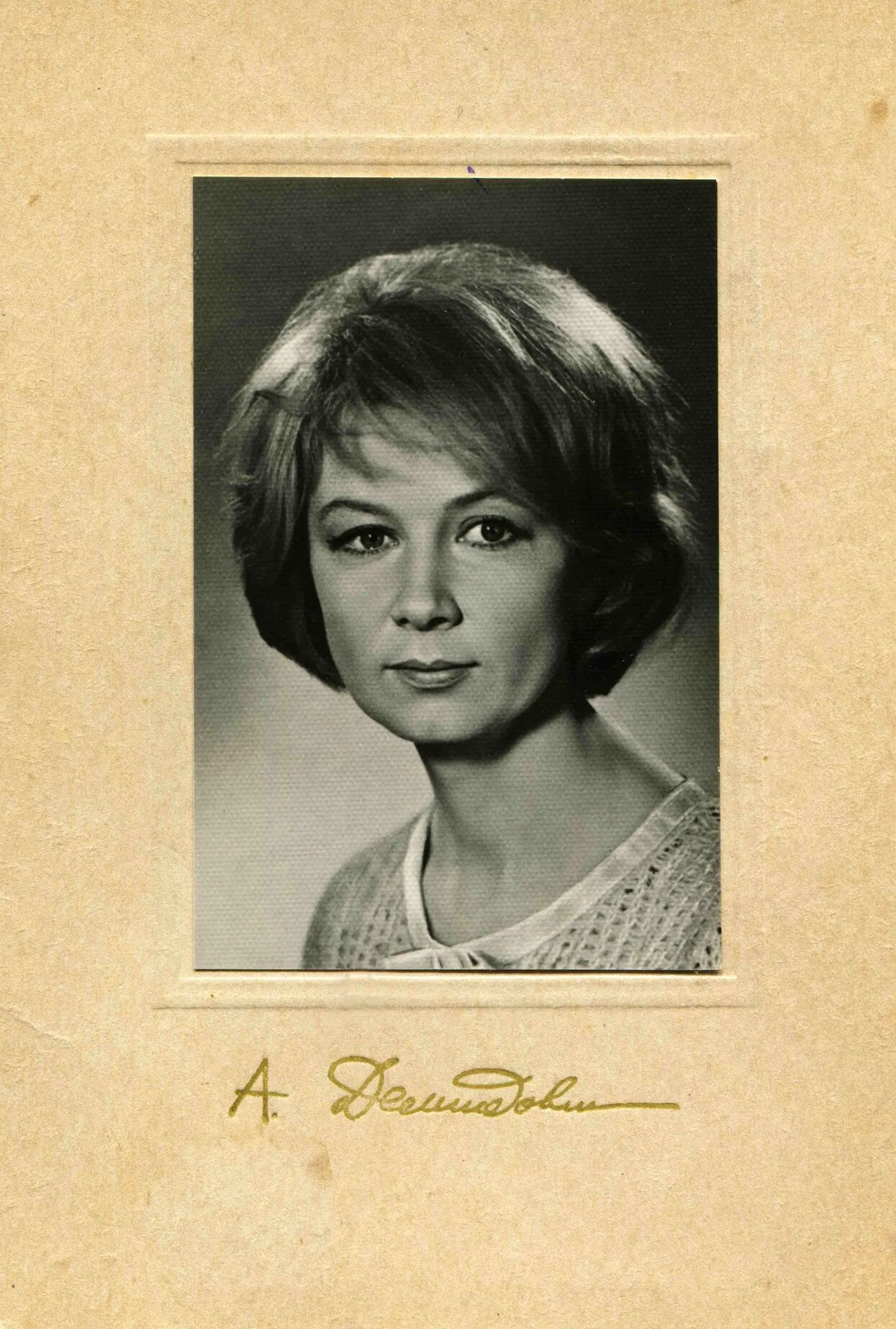
Soviet and Russian actress Alla Demidova, who turns 90 today, built a career on firsts. One of them was speaking the word ‘erection’ on a Russian stage.
Alla Demidova turned 90 on September 29. An actress, writer, and scholar of Russia’s Silver Age, she has always worked in film and theater with top-tier directors from Russia and abroad, including Andrei Tarkovsky, Kira Muratova, Yuri Lyubimov, Anatoly Efros, Roman Viktyuk, Kirill Serebrennikov, Giorgio Strehler, and Theodoros Terzopoulos. She has also brought new, sometimes radical writing to the stage, pursued literary research, and founded one of the Soviet Union’s first independent theaters. In an article for the independent journalists’ cooperative Bereg, theater critic Alla Shenderova examines how Demidova broke new ground. Meduza is publishing the article in full.
Demidova herself fits the type of Russian intellectual who is unhappy with the world around her, with society, and, above all, with herself and her own weakness, which keeps her from changing things. You can see it in almost every role she has played as a mature actress.
Other artists have even started borrowing this persona. Andrei Moguchy does so in “Kholopy” (“Serfs”), his best production to date. Playing Princess Plavutina-Plavuntsova, who voluntarily confines herself to a wheelchair rather than bow to the “hated tyrant” Paul I, actress Marina Ignatova copies Demidova’s appearance, her facial expression (a “mask” of self-dissatisfaction), and her bearing. Even the raven perched on the back of her chair is a direct reference to the now-classic film “Stakan vody” (“A Glass of Water”), in which Demidova played the Duchess of Marlborough.
To some, Demidova is a style icon, an intellectual diva. To others, she is a dry, guarded formalist. That last word needs explaining. In Russian theater, form — how a work is made — has long been set against content — what it is about. The opposition is somewhat absurd: in art, the two are hard to separate. It dates back to the mid-19th century, to the era of Mikhail Shchepkin and Vissarion Belinsky. In the 20th century, it became a campaign against “formalism” in art; under Stalin, an accusation of “formalism” could cost an artist their life.
Generations of Soviet and post-Soviet actors have remained wary of form. Demidova is an exception: an actress known for bold form, exquisitely detailed characterizations, and great daring. Throughout her career, she repeatedly tried to break new ground.
The first of her postwar generation unafraid to appear ‘intellectual’ on screen
In 1960s theater and film, intellectuals and creative figures were almost always men; women were shut out of such roles. Demidova was the first to play women like them. That kind of role became part of her repertoire after Igor Talankin’s 1966 film “Dnevnyye zvezdy” (“Daytime Stars”), in which the director took on an unusual cinematic challenge: showing how poetic images take shape in the mind. Demidova faced the same challenge playing the poet Olga Berggolts. The role placed her among intellectually engaged, spiritually searching performers — a lineage pioneered by Innokenty Smoktunovsky as Hamlet in Grigory Kozintsev’s film and as Myshkin in the Bolshoi Drama Theater’s production of “The Idiot” in Leningrad. She played similar roles as poets and scientists in “Chto takoye teoriya otnositelnosti?” (“What Is the Theory of Relativity?”) in 1964 and “Idu k tebe” (“I Come to You”) in 1971.
Alla Demidova in Dnevnye zvezdy
Georgy Ter-Ovanesov / the Russian state news agency RIA Novosti / Sputnik / Profimedia
The first to try the ‘zero position’ technique
Demidova was in the Shchukin Theater School class for which Yuri Lyubimov, then a trainee teacher, decided to stage Bertolt Brecht’s “The Good Person of Szechwan” in 1962. Two years later, that production launched the Taganka Theater. Demidova was cast as the pilot’s mother, a woman older than she was. By many accounts, Lyubimov did not much like the “clever student.” Instead of shouting with passion, she spoke quietly: by her own admission, she simply could not raise her voice naturally. In time, she turned that “shortcoming” into an asset — a distinctive “technique of not showing emotion,” as critic Mikhail Brashinsky described it. In the 2000s, Mikhail Ugarov at Theater.doc began calling a similar technique “zero position” or “nonacting.” A related style appeared in Konstantin Bogomolov’s quiet productions in the 2010s.
The first woman in the postwar Soviet era to dare to play Hamlet, a classic male role
Demidova first played the Prince of Denmark while still at theater school, at the suggestion of Anna Orochko, a legendary student of Yevgeny Vakhtangov who had once rehearsed the same role with him. Later, she nearly played Hamlet for Nikolai Okhlopkov at the Mayakovsky Theater. There is even a famous photo shoot from the 1970s — “Thinking About Hamlet” would be an apt name for it — in which Demidova, wearing a white shirt and holding a rapier, seems to be, as we might say today, “blurring gender lines.” In the Soviet Union of the 1970s, that took extraordinary nerve.
But Demidova’s connection to the Danish prince goes further. Playing Gertrude in Yuri Lyubimov’s famous “Hamlet,” she fed her “son,” Vladimir Vysotsky, his lines, which she knew by heart. In 1999, Robert Wilson saw Demidova in “The Good Person of Szechwan” and immediately invited her to perform his solo production of “Hamlet.” She declined. But perhaps Wilson’s idea helped inspire “Gamlet-urok” (“Hamlet Lesson”), a production staged for her by the Greek director Theodoros Terzopoulos in 2001.
Alexander Porokhovshchikov and Alla Demidova in Hamlet
Anatoly Garanin / RIA Novosti / Sputnik / Profimedia
“So here I am playing Hamlet — forgive me,” Demidova said in the summer of 2001 in an interview on the program “Na noch glyadya” (“Before Bedtime”), as though apologizing for her age. She was 64. In fact, it made sense: over the years, Demidova had joined the ranks of international stars for whom age was no barrier. Sarah Bernhardt, for example, continued playing male roles, including Hamlet, into her sixties and beyond.
The first to play Chekhov’s Ranevskaya not as a lady of the manor but as a woman of the Decadent era — even something of a hippie
Anatoly Efros staged “Vishnevy sad” (“The Cherry Orchard”) at Lyubimov’s Taganka Theater in 1975. It proved a turning point for many involved, including Vysotsky, who played the merchant Lopakhin. Theater critic Anatoly Smelyansky gave one of the most vivid accounts of Demidova’s Ranevskaya, observing that she played the role almost as a tragedy. When she said, “I’ll have some coffee,” it sounded like “I’ll have some poison.” Many critics, including Maya Turovskaya, remarked on this Ranevskaya’s extraordinary sexuality; Turovskaya used the term “sex appeal.”
Alla Demidova in The Cherry Orchard
Alexander Makarov / RIA Novosti / Sputnik / Profimedia
The intensity of her feelings, her irritation with her family, and her clear understanding that the estate could not be saved and that a gravely ill, unfaithful lover awaited her in Paris — all of it, combined with Demidova’s distinctive physical grace, made her Ranevskaya a woman of the Decadent era. She and the wardrobe staff came up with a flowing white dress with an embroidered neckline and a full skirt. She wore layers of necklaces over it, in keeping with 1970s bohemian fashion. The costume suggested both decadent decline and hippie style.
While preparing to play Ranevskaya, Demidova became fascinated by Art Nouveau and the Silver Age, whose history was difficult to explore in the Soviet Union of the 1970s. When she later traveled to France, she bought books of early 20th-century paintings, looking for portraits of women who might have inspired Chekhov’s Ranevskaya.
The first to perform Anna Akhmatova’s ‘Requiem’ in public, followed by her ‘Poema bez geroya’ (‘Poem Without a Hero’) and many other works of poetry
Demidova recited “Requiem” as early as 1987 at the Leningrad Philharmonic’s Grand Hall, accompanied by the Moscow Virtuosi orchestra under Vladimir Spivakov. That performance began a long series of poetry concerts for Demidova, who cannot sing in tune but has an uncommon feel for the rhythm of verse. She worked with leading conductors, including Yevgeny Kolobov on “Poema bez geroya” and Teodor Currentzis on “Nosferatu.” In the 2010s, she recorded an extensive poetry series for Radio Kultura that included work by many contemporary poets, among them Boris Ryzhy.
Among the first to produce literary scholarship on Akhmatova’s ‘Poema bez geroya’
Her research became the book “Akhmatovskiye zerkala” (“Akhmatova’s Mirrors”), which she worked on from the 1970s through the 2000s. It explores the real people behind the characters in Akhmatova’s poem. Demidova has published dozens of books in all. She began writing in the 1960s, following the example of her husband, screenwriter Vladimir Valutsky — though she wrote essays and memoirs rather than scripts. In the 1980s, she recorded her conversations with Smoktunovsky, later collected in the book “A skazhite, Innokenty Mikhaylovich…” (“And Tell Me, Innokenty Mikhaylovich…”). In the 1990s, she interviewed the artist Anatoly Slepyshev.
Veniamin Smekhov and Alla Demidova in Hamlet
Alamy / Vida Press
One of the first models for the legendary makeup artist and photographer Lev Novikov
It was Novikov who designed the makeup for Viktyuk’s “The Maids” and for Valentin Gneushev’s circus productions. He also helped Renata Litvinova create her look. He died at just 50. In his final years, he had AIDS; stars no longer trusted him to do their makeup, and he gradually turned to photography. Demidova was one of his first models and helped him until his final days. Another photographer who began his career with portraits of her was Vladimir Fridkes, a legendary member of the art collective AES+F.
The first to adapt Tsvetaeva’s ‘Fedra’ (‘Phaedra’) and bring it to the stage
In the late 1980s, after Yuri Lyubimov was stripped of his citizenship and Anatoly Efros was appointed artistic director of the Taganka Theater, Demidova, as usual, tried to stand apart and go her own way. She asked the young director Roman Viktyuk to stage Marina Tsvetaeva’s “Fedra,” a complex play, Futurist in form, that gives the emotions of characters in an ancient tragedy a contemporary voice.
Demidova made her own adaptation, combining “Fedra” with passages from Tsvetaeva’s diaries and her poems about the struggle to create art (“Laurels of praise in slabs on my brow. ‘I cannot sing!’ — ‘You will!’ — ‘I’m done for…’”). To the drama of a queen in love with her young stepson, she added that of a poet who feels her creative powers have run dry. Alongside its difficult avant-garde text, the production had elements of physical theater. Valentin Gneushev choreographed it, and Alberto Alonso himself, who had come to the Soviet Union at the height of perestroika, offered advice. As with Hamlet, the story of Phaedra did not end there.
The first Russian actress to receive offers from the celebrated directors Giorgio Strehler, Robert Wilson, Antoine Vitez, and Theodoros Terzopoulos
Strehler, who had staged “The Cherry Orchard” at his Piccolo Teatro di Milano, was thrilled by Efros’s production. He invited Demidova to Milan, where he was putting on an ambitious program called “Voices of the World.” According to accounts of the rehearsal, Demidova read poems by Silver Age poets while glancing at a cheat sheet to keep the rhythm of the verse. When Strehler noticed, he put a music stand in front of her, making the cheat sheet an overt part of the performance. Since then, a music stand holding poems instead of sheet music has been a hallmark of her performances. Strehler also asked her to think about what she might perform at his theater. They settled on Hedda Gabler, but the plan never came to fruition.
Footage from the Taganka Theater’s 1999 anniversary celebration shows Wilson rushing to embrace Demidova. She had returned to play the pilot’s mother for the anniversary, and Wilson was struck by the way she moved in the role. He immediately invited her to work with him. Instead of Hamlet, though, Demidova proposed playing Poprishchin in Gogol’s “Zapiski sumasshedshego” (“Diary of a Madman”). The project fell through because she became ill.
During a Paris tour in the second half of the 1980s, Antoine Vitez saw “The Cherry Orchard.” An actor, director, and left-wing intellectual, he was then artistic director of the Comédie-Française, Europe’s oldest state theater. Efros had died, as had Vysotsky, and a young actor was playing Lopakhin. But Demidova’s Ranevskaya made such an impression on Vitez that he immediately announced at a Soviet embassy reception that he wanted to work with her. During perestroika, such a collaboration was possible, and talks began. They chose “Phèdre” — Racine’s version this time, rather than Tsvetaeva’s.
Demidova could thus have become the first Russian actress to debut at the Comédie-Française. But the theater’s actresses were unwilling to accept a foreigner in the classic role. Vitez decided to move the project to another stage and hold the premiere in Moscow; he even managed to hold auditions. A couple of months later, however, he died, and it was never staged.
In 1989, Demidova used the fee she had received from Strehler to open the private Theater A, one of the Soviet Union’s first independent theaters, and the first to be founded by an actress and run without a permanent company, entirely on a contract basis.
First, she bought the Taganka Theater’s production of “Fedra.” Then she invited Terzopoulos to stage German playwright Heiner Müller’s “Quartett,” a postmodern version of Choderlos de Laclos’s “Dangerous Liaisons.” Its characters swap genders and love each other, yet drive each other to suicide. By the time “Quartett” had been translated into Russian and Demidova could read it in full, it was too late to back out.
The reserved intellectual turned out to be a daring outsider — among other things, she became the first person to say the word “erection” on a Russian stage. In truth, though, Terzopoulos’s highly stylized production was about modern people’s unresolved trauma, with the “ruins of Europe” still looming behind them, rather than about sex. Demidova’s stage partner, who switched genders with her during the performance and even wore women’s makeup, was Dmitry Pevtsov, now a prominent pro-war “Z patriot.”
The first major actress to recognize Kirill Serebrennikov’s talent
In 2000, she accepted an offer from Serebrennikov, who had directed many productions in Rostov-on-Don theaters and on television but was entirely unknown in Moscow. His multipart television project based on Bunin’s “Temnye allei” (“Dark Avenues”) premiered on the channel Avtorskoye Televideniye. Demidova read Bunin as characters from his early 20th-century stories appeared on screen. A year later, Serebrennikov staged his first production in Moscow, and Demidova offered him a chance to assist Robert Wilson on the planned “Diary of a Madman.” Their collaboration and friendship lasted throughout Serebrennikov’s years working in Russia. Their most recent project together is a new version of “Poema bez geroya,” which they directed jointly and Demidova performed at the Gogol Center.
Alla Demidova in Kirill Serebrennikov’s production of Requiem
Alexandra Mudrats / the Russian state news agency TASS / Profimedia
The first actress Anatoly Vasilyev wanted to work with after a long absence from Russia
In 2006, Vasilyev, one of Russia’s most significant contemporary directors, lost his theater, the School of Dramatic Art, and left the country for many years. He returned in 2017 to create a production with Demidova based on Hemingway’s “The Old Man and the Sea.” Its form — an actress sitting at a table reading the text — was so fully realized that it effectively became the content: an ode to fearless, reckless masters of their craft. The production’s dedication to the memory of Yuri Lyubimov was no accident.
At Meduza, we are committed to transparency about our use of artificial intelligence in the newsroom. The story you’re reading was written by one of our living, breathing journalists and translated from Russian using an AI model configured to follow our strict editorial standards. This translation process is the result of extensive testing and refinements to ensure our English-language coverage is timely and accurate. A Meduza editor reviews every draft before publication.
If you find any errors in this translation, please contact us at reports@meduza.io.
To read Meduza’s exclusive content in English, please subscribe to our newsletter.
Bereg
Igor Talankin (1927–2010)
A Soviet film director known for Serezha, Tchaikovsky, and Otets Sergiy “Father Sergius.” Tchaikovsky, starring Innokenty Smoktunovsky in the title role, was nominated for an Academy Award for Best Foreign Language Film in 1972. Talankin’s film Dnevnye zvezdy “Daytime Stars,” starring Alla Demidova, is based on the autobiographical novella by Olga Berggolts, in which the poet recalls the Siege of Leningrad.
Where Smoktunovsky played Myshkin and Hamlet
He played Myshkin in Georgy Tovstonogov’s famous production of Idiot “The Idiot” (1957). Critic Anatoly Smelyansky wrote in his book Ukhodyashchaya natura “A Vanishing Breed” that the Soviet theater’s thaw began with this production. He played Hamlet in Grigory Kozintsev’s equally celebrated film (1964).
Mikhail Ugarov (1956–2018)
A Russian playwright, director, and theater teacher, Ugarov was one of the founders and longtime artistic director of Moscow’s Teatr.doc, and a champion of new Russian-language playwriting and documentary theater. As a director, he demanded that his actors achieve “non-acting,” also known as the “zero position”: a rejection of the external effects and exaggerated emotion typical of theater.
Nikolai Okhlopkov’s Hamlet
The 1954 production went down in history as the first Soviet staging of Hamlet in 13 years — the play had been banned during the late Stalin years. Okhlopkov, a student of Vsevolod Meyerhold, staged the tragedy his teacher had long dreamed of staging but never managed to bring to the stage himself, drawing on Meyerhold’s own directing methods.
Robert Wilson (1941–2025)
One of the leading theater directors of the second half of the 20th century and early 21st century, Wilson created his own theatrical language marked by a deliberately unhurried rhythm, highly complex lighting design, and vivid, unnatural makeup.
Theodoros Terzopoulos
A celebrated Greek theater director, Terzopoulos studies and applies the methods of ancient theater in his work.
Sarah Bernhardt (1844–1923)
A French actress and the leading theater star of the late 19th century and early 20th century, Bernhardt first played Hamlet in 1899, at age 55.
Anatoly Slepyshev (1932–2016)
Slepyshev was a Soviet and Russian painter and a student of Alexander Deineka. His paintings are close in style to neo-expressionism: not abstract, but extremely schematic and deliberately rough.
AES+F
An art group formed in 1987 and named for the initials of its permanent members — Tatiana Arzamasova, Lev Evzovich, Yevgeny Svyatsky, and Vladimir Fridkes, who joined later. The group creates surrealist video installations. In 2007, its work was shown in the Russian pavilion at the Venice Biennale.
Valentin Gneushev (1951–2026)
A Soviet and Russian circus director, Gneushev created shows for Broadway, worked with Yuri Nikulin, and served as chief director of the Moscow Circus on Tsvetnoy Boulevard.
Alberto Alonso (1917–2007)
A Cuban choreographer known in Russia primarily for Carmen Suite (1967) at the Bolshoi Theater, Alonso created the ballet, set to Georges Bizet’s music as orchestrated by Rodion Shchedrin, for Maya Plisetskaya at her request.
Giorgio Strehler (1921–1997)
An Italian theater director and a key figure in European theater in the second half of the 20th century, Strehler founded Milan’s Piccolo Teatro and created the celebrated production Arlekin — sluga dvukh gospod “Harlequin, the Servant of Two Masters,” based on the play by Carlo Goldoni and staged in the style of the old mask theater. Arlekin premiered in 1947, went through several revisions, toured the world, and remains in the company’s repertoire today — one of the longest-running theatrical productions in history.
Heiner Müller (1929–1995)
A German playwright and theater director, Müller was arguably the most significant figure in East German theater. In his plays, he reinterpreted canonical works by Sophocles, Euripides, Shakespeare, Choderlos de Laclos, and other classic authors. Among the best-known Russian productions of his texts are Anatoly Vasilyev’s Medeamaterial (2001) and Kirill Serebrennikov’s Mashina Myuller “The Müller Machine” (2016). Both were landmark productions in their time.
Physical theater
A movement in contemporary theater that grew out of pantomime, physical theater relies on the actor’s body — its movements, poses, and gestures — as its main expressive tool.
Hedda Gabler
One of the most famous plays by Norwegian playwright Henrik Ibsen, Hedda Gabler premiered in 1891. It is a drama about a married woman suffocating in a comfortable bourgeois life who, yearning for something grand and elevated, tries to push an old friend, a talented scholar, toward suicide. The title role is considered one of the most interesting and difficult in the world repertoire for an actress, a kind of female counterpart to Hamlet.
Конфликт Анатолия Васильева и Юрия Лужкова
Изначально «Школа драматического искусства» занимала небольшое помещение на Поварской улице в Москве, но в 2001 году город построил театру отдельное здание на Сретенке с несколькими зрительными залами. Прежняя площадка осталось за театром, но московские власти считали, что художественный директор Васильев использует ее недостаточно эффективно. В 2005 году Юрий Лужков распорядился передать помещение на Поварской проекту «Открытая сцена». Васильев раскритиковал это решение. Спустя год его сместили с должности художественного директора (то есть единоличного руководителя театра) на пост главного режиссера. Власти изменили устав «Школы»: там появились две ключевые должности вместо одной — художественного руководителя и директора. Васильев не согласился работать в таком формате и ушел из театра.
Джорджо Стрелер (1921–1997)
Итальянский театральный режиссер, ключевая фигура европейского театра второй половины XX века. Основатель миланского театра «Пикколо» и автор легендарного спектакля «Арлекин — слуга двух господ» по пьесе Карло Гольдони в технике старинного театра масок. «Арлекин» вышел в 1947 году, пережил несколько редакций, объездил весь мир и не сходит с репертуара по сей день — это один из самых долгоживущих драматических спектаклей в истории.