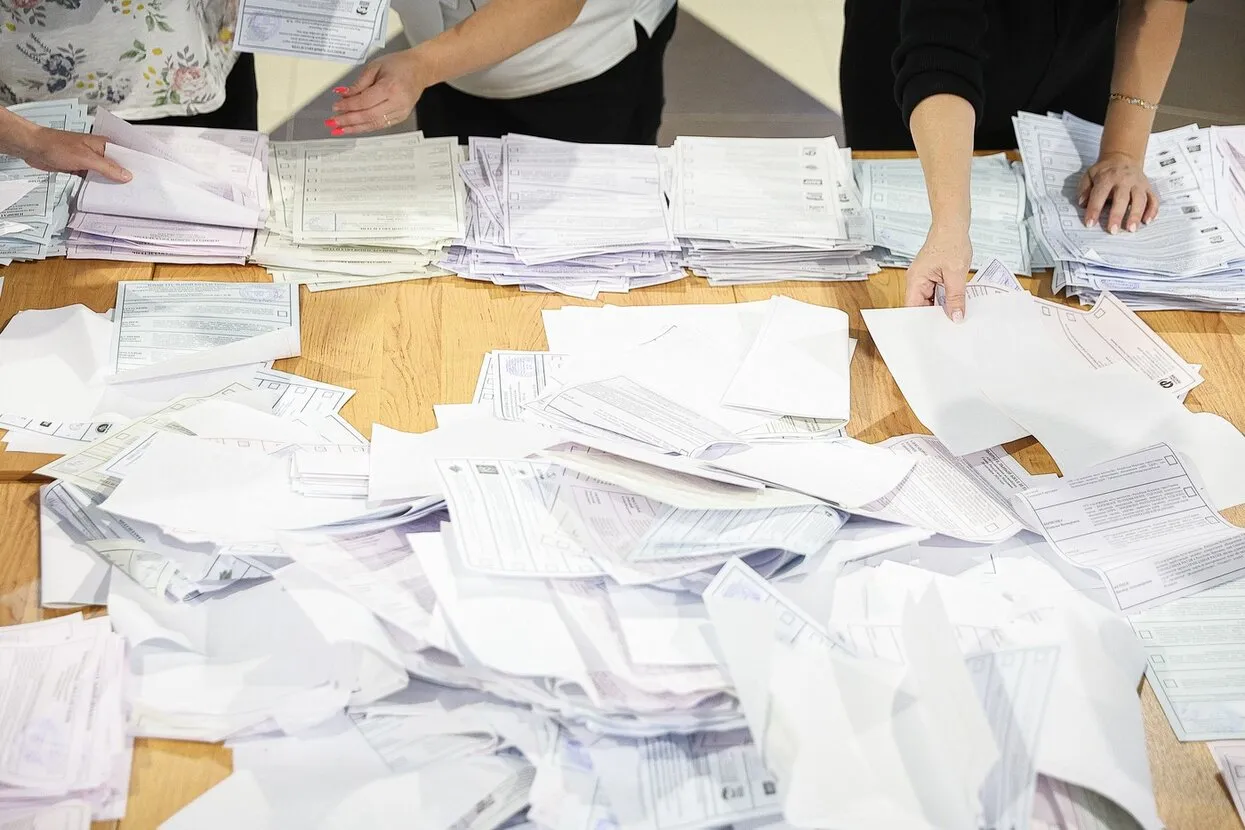
Russian state officials say ruling party United Russia won 58% in last weekend’s parliamentary election. Independent analysts estimate it was really 34–35% without manipulation.
Judging by the reports presented to Vladimir Putin, the recent parliamentary election must have gone very well: turnout was the highest since 2011, United Russia secured the largest State Duma faction in its history, and there were almost no irregularities. But independent analyses paint a very different picture from the one presented by the Central Election Commission: reported turnout was inflated by ballot stuffing and the authorities’ heavy use of state resources; more than half the votes recorded for United Russia appear to have been fabricated; and widespread fraud benefiting the ruling party nearly kept A Just Russia out of the State Duma, so votes had to be added to its tally at the last minute. Meduza reviewed what independent journalists and election analysts have written about the vote. The count is still underway, and experts are working with incomplete data.
- United Russia officially won 58% of the vote — more than in the prewar election of 2021. But analyses by Novaya Gazeta Europe and Important Stories suggest that without manipulation, United Russia’s share of the party-list vote may have been just 34–35%. The journalists reached these conclusions using a method developed by election analyst Sergey Shpilkin. According to Important Stories, roughly 18 million of the 30 million votes recorded for United Russia on paper ballots may have been fabricated.
Sergey Shpilkin is a physicist who began analyzing Russian election statistics in 2007. He based his work on an approach developed by American diplomat John Brady Kiesling, who was the first to study how the distribution of votes among candidates varied with turnout.
Shpilkin’s method rests on the premise that adding large numbers of votes for a single candidate simultaneously increases both that candidate’s vote share and overall turnout. In cases of fraud, data from ordinary polling stations plotted on a graph form a relatively even “cloud,” while data from anomalous stations form a “comet tail” extending toward higher turnout and a larger vote share for the leading candidate.
The method has limits. It can estimate only the scale of ballot stuffing — and only when ballot stuffing far exceeds other forms of manipulation and a substantial number of polling stations count votes honestly. The Shpilkin method does not account for cases in which one candidate is credited with another candidate’s votes or a precinct’s results are fabricated from scratch.
Leonid Volkov, who heads political projects at the Anti-Corruption Foundation, was among those who criticized the method on these grounds: “The Shpilkin method works when there is a clearly defined core of verifiably ‘honest’ polling stations, making it possible to get a good estimate of ballot stuffing and inflated vote totals at the relatively small number of ‘dishonest’ polling stations. But by 2026, the continued trend of extreme, Chechnya-style vote rigging had destroyed that core and blurred its boundaries. And the result we see [even] at polling stations where votes were counted properly can hardly be considered ‘genuine’ [because there was no competitive election campaign before the vote].”
Hi, I’m Vladislav Gorin.
I’m the host of Meduza’s daily Russian-language news podcast. This summer, the Russian authorities opened a criminal case against me — not for committing a crime, but for telling the truth about Russia and its war against Ukraine.
Because the Kremlin has branded me a criminal, I can’t go home. I also can’t safely travel to countries like Turkey — even though it’s a NATO member — because I could be arrested and extradited to Russia. I can’t even renew my passport at the consulate anymore.
None of this is going to stop me. I know there are hundreds of thousands of people in Russia who don’t want this war and who still believe in freedom and democracy, and they deserve access to independent journalism. Please support Meduza so I can keep reaching them.

- According to the Central Election Commission, turnout was nearly 60%. Only the 2011 parliamentary election drew higher turnout in modern Russian history, and it ended in protests. But analysts put actual turnout in the latest election at around 40%. They say the official figure was inflated by forcing public-sector employees to the polls — what expert Roman Udot described as pushing the machinery of government to its limit — as well as by ballot-box stuffing and outright fabrication of turnout figures.
- The rescue of A Just Russia has been called the election’s biggest “miracle”: the party was still below the threshold for entering the State Duma after 96% of precinct results had been processed, but had suddenly cleared it by the time 97.5% had been processed. The party’s tally jumped by 67,000 votes in a single hour. Analyst Boris Ovchinnikov believes that A Just Russia would have cleared the 5% threshold in an honest count, but that votes stolen in favor of United Russia had depressed its result. Once this became clear, votes began being added to A Just Russia’s tally instead.
- Experts and journalists did not analyze the remote electronic voting results because they cannot be verified. The system was already a “black box,” and it has since grown even more opaque. Meanwhile, the authorities sought to channel as many votes as possible through it. In Moscow, an “anomaly” left voters without paper ballots for several hours; officials blamed a technical failure. But these elections produced plenty of other “anomalies.”
- At overseas polling stations, where fraud is generally less systematic, United Russia lost in 40 of 152 countries. New People finished first in 39 of those 40. United Russia fared poorly at polling stations in hubs for anti-war Russian émigrés. Its successes came mostly in “friendly countries” — though New People also won in China. United Russia recorded its best result abroad — 79% — in the Central African Republic, where Wagner Group mercenaries remain.
At Meduza, we are committed to transparency about our use of artificial intelligence in the newsroom. The story you’re reading was written by one of our living, breathing journalists and translated from Russian using an AI model configured to follow our strict editorial standards. This translation process is the result of extensive testing and refinements to ensure our English-language coverage is timely and accurate. A Meduza editor reviews every draft before publication.
If you find any errors in this translation, please contact us at reports@meduza.io.
To read Meduza’s exclusive content in English, please subscribe to our newsletter.
The Shpilkin Method
Сергей Шпилькин — физик, который с 2007 года занялся анализом электоральной статистики в России. Он взял за основу подход американского дипломата Джона Брэди Кислинга. Тот первым стал изучать, как между собой согласуется распределение голосов за кандидатов при разной явке.
Метод Шпилькина основан на том, что массовое добавление голосов одному кандидату одновременно повышает и его результат, и явку. В случае фальсификаций нормальные избирательные участки на графике образуют относительно ровное «облако», а аномальные — «хвост кометы», вытянутый от него в сторону более высокой явки и высокого результата лидера.
У этого метода есть ограничения. Он позволяет оценить только объем вбросов — и только если количество фальсификаций такого типа сильно превышает иные виды нарушений и есть значительное число участков, где голоса считаются честно. Случаи, когда одному кандидату добавляют голоса другого или когда протокол голосования просто «рисуют» с нуля, метод Шпилькина не учитывает.
Именно поэтому применение метода Шпилькина критиковал, например, глава политических проектов ФБК Леонид Волков: «Метод Шпилькина работает, когда есть ясно выраженное ядро проверяемо ”честных” участков, и тогда можно хорошо оценивать вбросы и приписки на относительно небольшом числе ”нечестных” участков. Однако в 2026 году продолжающаяся чеченизация выборов уничтожила, размыла это ядро. Да и результат, который мы видим [даже] на участках, где считали нормально, трудно считать ”настоящим” [из-за того, что перед голосованием не было конкурентной предвыборной кампании]».
For example, like these
In Kamchatka, lawmaker Irina Yarovaya received 97% of the vote at each of two neighboring polling stations. In Derbent, United Russia won between 93.84% and 95.03% at 45 polling stations at once, a statistically impossible result. In Krasnodar, the election commission reported about 500 people voting early, even though voter lists showed only 50. In Moscow, ballot records were extensively corrected after voting had already ended.
For example, like this
On the first day of voting, an unusually large number of polling stations reported turnout of 30%. On the second day, the most common turnout figure was 40%, and by the third day, it was 85%.
CAR
Central African Republic