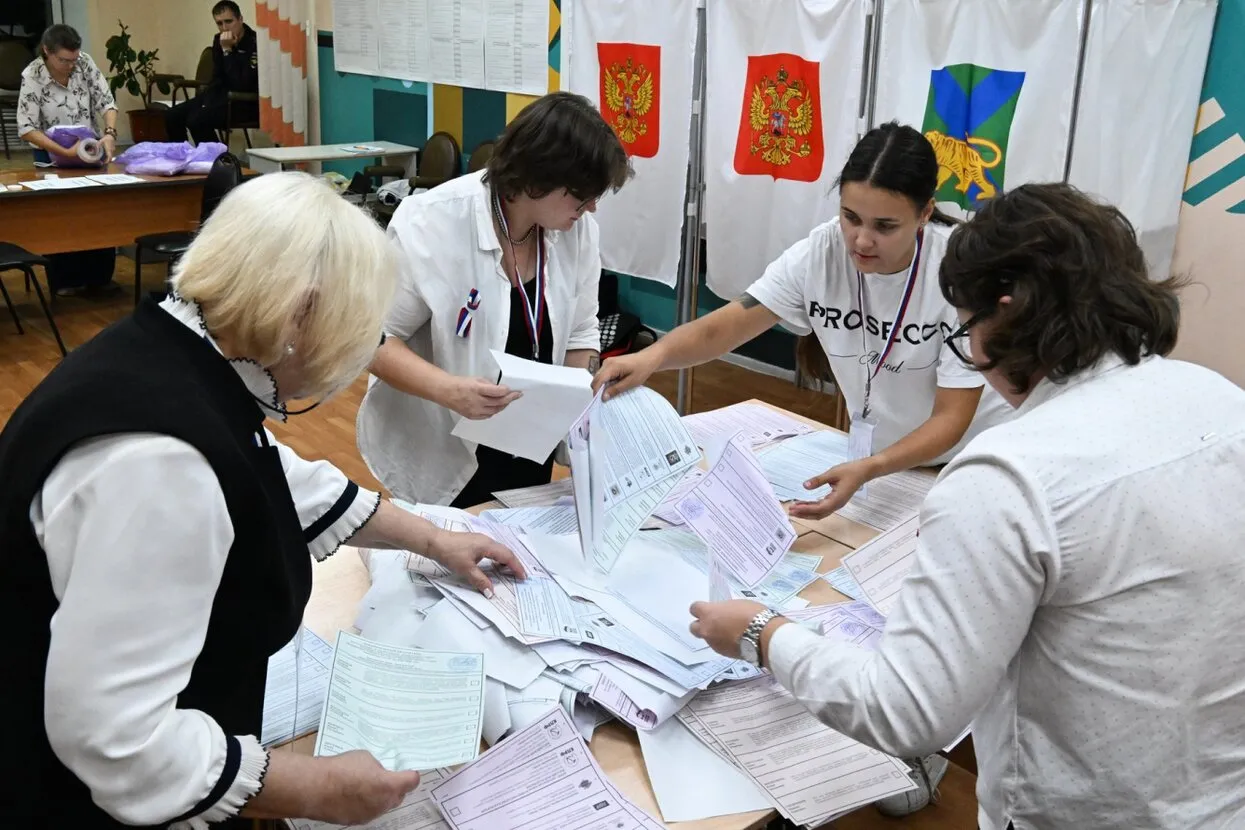
Russia held its first State Duma election since the full-scale invasion of Ukraine. Officials say the same five parties are set to return, with the ruling party on track to retain its majority.
Voting has ended in Russia’s State Duma elections, and United Russia has finished first. According to Central Election Commission figures as of 11:55 p.m. Moscow time on September 20, United Russia had won 57.19% of the vote on the federal party list, with 36.87% of precinct results counted. The Communist Party was second with 13.85%, the Liberal Democratic Party third with 9.16%, and New People fourth with 8.01%. Preliminary results also showed A Just Russia clearing the 5% threshold with 5.23%, enough to win seats in parliament. Ten parties took part in the elections; the Supreme Court removed an 11th, Yabloko, from the ballot. The results are not final and could still change. The count is expected to be finished by the morning of September 21, and the official results are not due before September 25.
United Russia candidates are leading in 161 of the 225 single-mandate districts, Russia’s Central Election Commission said after 20.12% of precinct results had been counted. The Communist Party is ahead in four single-mandate districts, A Just Russia in three, candidates running without a party nomination in three more, and the Liberal Democratic Party in two.
Turnout topped 56%. As of 8 p.m., the Central Election Commission put it at 56.66% — higher than in the parliamentary elections of 1993 (54.7%), 2003 (55.75%), 2016 (47.88%), and 2021 (51.72%).
According to Meduza’s earlier reporting, more than 29% of voters cast ballots on the first day of voting, September 18 — a figure the authorities achieved through remote electronic voting and by mobilizing employees at their workplaces. United Russia said publicly that it wanted turnout of around 50%. Sources close to the presidential administration, however, told Meduza the target was different: 55%.
Electronic voting turnout was 90.87%. By the evening of September 20, 3.6 million of the 4.03 million registered online voters had cast ballots. Remote electronic voting was used in 32 regions, not counting Moscow, which has its own system. In Moscow, almost 3.5 million people had voted online as of 8:15 p.m.
Throughout the three days of voting, however, it was impossible to vote online from abroad, because the Gosuslugi state services portal that voters must use to log in was down.
Preliminary electronic voting results put United Russia first with 49.06%, New People second with 15.42%, and the Communist Party third with 12.26%. They were followed by the Liberal Democratic Party with 10.79% and A Just Russia with 5.75%.
Eight regions held direct elections for regional leaders, and Central Election Commission figures show the incumbents winning. Vladislav Khovalyg is leading in Tyva, Artyom Zdunov in Mordovia, Ramzan Kadyrov in Chechnya, Alexander Shuvayev in the Belgorod region, Yegor Kovalchuk in the Bryansk region, Alexey Russkikh in the Ulyanovsk region, Vitaly Korolev in the Tver region, and Oleg Melnichenko in the Penza region.
Russians lost real elections a long ago. But you’ve still got a choice. If you live outside Russia, please donate to Meduza — for yourself or for those who remain inside the country and want to read independent news.After a massive strike on Moscow, Moscow Mayor Sergey Sobyanin and Russia’s Defense Ministry accused Ukraine of trying to disrupt the elections. Russian officials said Ukrainian forces launched at least 1,951 drones and eight cruise missiles on September 19 and 20, all of which were shot down by air defenses. Sobyanin said roughly 450 drones were downed on the approach to Moscow overnight into September 20. The attack set off a fire at the Moscow oil refinery in Kapotnya and damaged residential buildings. Three people were killed in the Moscow region. “The attempted massive attack on Moscow failed. The enemy did not achieve its objectives,” the Defense Ministry said.
The opposition had called on people to vote at noon as a protest against the war, but fewer took part than in the “Noon Against Putin” protest in 2024. In many cities in Russia and abroad, voters showed up at polling stations at midday, but there were no long lines like those seen in 2024. The most visible protests were in Yerevan and Berlin, outside Russian embassies.
Lines formed outside Moscow polling stations on September 20 because voters were not being issued paper ballots. Election commission staff told them the electronic voter roll system was down, so no ballots could be handed out. The Moscow City Election Commission called it a “minor glitch,” but it lasted several hours. Muscovites were offered the chance to vote remotely instead, but many refused. In some cases, voters filed complaints with election commissions. By 8 p.m., when voting closed in Moscow, hundreds of people at several polling stations still had not been able to vote, and those stations stayed open for everyone in line when they closed.
The Central Election Commission said it had recorded 100 million cyberattacks on election infrastructure. Commission member Igor Borisov said the number of attacks was up 8,300% from 2024, when there were 1.2 million. Officials said hackers had targeted both the electronic voting system and the electronic voter roll system. Commission chair Ella Pamfilova said an unnamed representative of “one of Russia’s established political parties” had tried to disrupt the electronic voting system by planting malware in it. She also said more than 3,000 waves of cyberattacks on Russia’s election system were recorded between September 18 and 20.
Election observers faced the most problems. They were barred from polling stations, removed from observation duties, offered vodka in attempts to provoke them, offered bribes, and detained. The monitoring platform “Vybory 2026 — nablyudaem vmeste!” (“Elections 2026 — Watching Together!”) counted more than 900 complaints filed with election commissions as of 8 p.m. Moscow time, one in three of them alleging violations of observers’ rights. The largest number came from Moscow, the Moscow region, St. Petersburg, and the Perm and Krasnodar regions.
Russia’s Prosecutor General’s Office, meanwhile, said it had recorded no serious violations of the law during the voting. The Interior Ministry likewise said it had registered no “substantial breaches of public order capable of disrupting the elections.”
This is the first State Duma election since the start of Russia’s full-scale invasion of Ukraine. Russians were recruited for the war while voting was underway — in Novosibirsk, for example, voters outside one polling station were offered contracts with the Defense Ministry. It also emerged that at least two Russians (1, 2) received notices that they had been added to the military registry after voting electronically.
At Meduza, we are committed to transparency about our use of artificial intelligence in the newsroom. The story you’re reading was written by one of our living, breathing journalists and translated from Russian using an AI model configured to follow our strict editorial standards. This translation process is the result of extensive testing and refinements to ensure our English-language coverage is timely and accurate. A Meduza editor reviews every draft before publication.
If you find any errors in this translation, please contact us at reports@meduza.io.
To read Meduza’s exclusive content in English, please subscribe to our newsletter.
Why is that?
Voting closed at 8:00 p.m., but those who had opened their electronic ballot in the final minute were allowed to keep voting until 8:15 p.m.