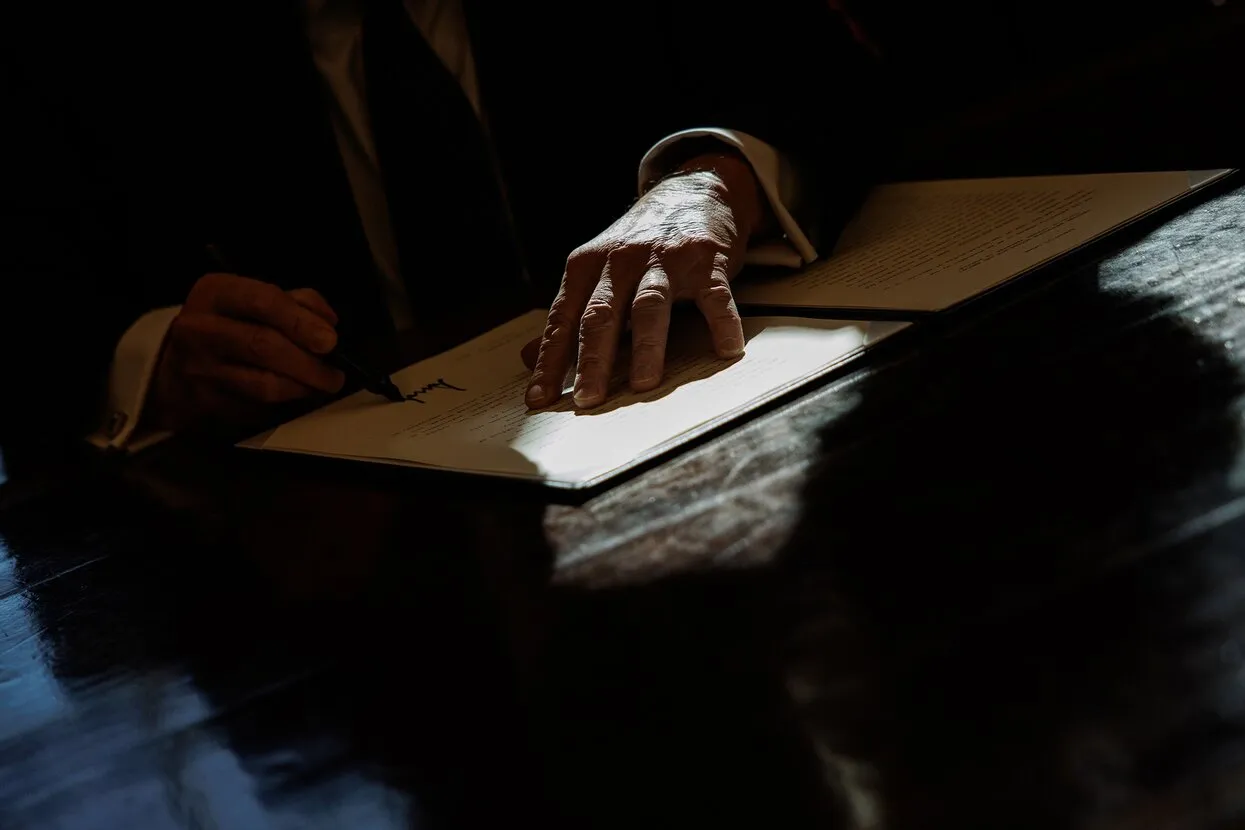
Trump signs Washington’s long-awaited ‘sanctions from hell’ law against Russia. It gives him 30 days to act and broad authority to suspend the restrictions.
U.S. President Donald Trump has signed into law a new package of sanctions against Russia, often called the “sanctions from hell.” A White House statement said the law “authorizes and expands statutory sanctions, tariffs, and prohibitions against Russia.”
The bill was introduced by Republican Senator Lindsey Graham, who died in July 2026. The law gives the president the authority to impose 100% tariffs on U.S. imports from the five countries that buy the most Russian energy. It also provides for sanctions on Russian defense, energy, and financial organizations, on Russia’s shadow fleet, and on the country’s leadership.
Graham and his co-sponsor, Democratic Senator Richard Blumenthal, initially proposed prohibitive 500% tariffs on any buyer of Russian oil and gas. The bill was later scaled back.
The president must impose most of the sanctions no later than 30 days after the law takes effect. He does, however, have the authority to suspend the restrictions if national security requires it.
China and India are the largest importers of Russian oil. Critics of the law stressed that it gives the president broad discretion in choosing sanctions targets, since it names no specific countries and sets out no mechanism for determining which ones import the most Russian oil and gas. According to Reuters, Trump’s decision to sign may be tied in part to his upcoming meeting with Chinese leader Xi Jinping on September 24, with the law giving the U.S. president “additional leverage.” The news agency also said an announcement on tariffs could be delayed by the midterm elections in early November: new tariffs would push oil prices higher still, and U.S. voters are already unhappy about rising costs.
A day earlier, The New York Times reported that Trump, who often uses carrot-and-stick tactics, is currently using more carrot than stick in his approach to Russia. According to the newspaper, the U.S. administration is considering business deals with Russia even before the war in Ukraine ends.
Ukrainian President Volodymyr Zelensky thanked Trump for signing this “critically important legislation.” In his view, “the best way to honor Lindsey’s memory will be to implement the provisions of this law fully and swiftly.” “And the best reward for everyone helping us put pressure on Russia to end its war will be peace. Peace and an end to all the problems and challenges this war has brought,” he wrote on social media.
The Kremlin has not yet commented on Trump’s signing of the sanctions law. But after Congress approved it, Russian presidential spokesman Dmitry Peskov said the new U.S. sanctions would complicate negotiations on ending Russia’s war with Ukraine. On the morning of September 19, Dmitry Medvedev, the former Russian president who now serves as deputy head of the Security Council, said in a post on his Telegram channel that “across the ocean they understand only the language of direct military deterrence, and that is the language in which Russophobic filth like the law of the dead terrorist Graham should be answered.”
The war in photographs: elections in occupied Ukraine
A banner in occupied Sevastopol
Alexey Pavlishchak / Reuters / Scanpix / LETA
Voting in occupied Simferopol, September 18, 2026
Dmitry Makeev / RIA Novosti / Sputnik / Profimedia
Donetsk, September 18, 2026
AP / Scanpix / LETA
Voting in Donetsk
Alexander Ermochenko / Reuters / Scanpix / LETA
Voting in Mariupol, September 18, 2026
Alexander Ivanov / RIA Novosti / Sputnik / Profimedia
Early voting in Mariupol. September 10, 2026
Alexander Ivanov / RIA Novosti / Sputnik / Profimedia
Early voting in the Donetsk region. September 14, 2026
AFP/ Scanpix / LETA
A Russian serviceman with a ballot box during early voting in the Donetsk region
AFP / Scanpix / LETA
At Meduza, we are committed to transparency about our use of artificial intelligence in the newsroom. The story you’re reading was written by one of our living, breathing journalists and translated from Russian using an AI model configured to follow our strict editorial standards. This translation process is the result of extensive testing and refinements to ensure our English-language coverage is timely and accurate. A Meduza editor reviews every draft before publication.
If you find any errors in this translation, please contact us at reports@meduza.io.
To read Meduza’s exclusive content in English, please subscribe to our newsletter.
SVO
The “special military operation” is what Russian authorities call the invasion of Ukraine by Russian troops.
Что это значит?
Категория В - ограниченно годен к военной службе, категория Д - не годен к службе. При этих категориях возможно досрочное увольнение из российской армии по состоянию здоровья.