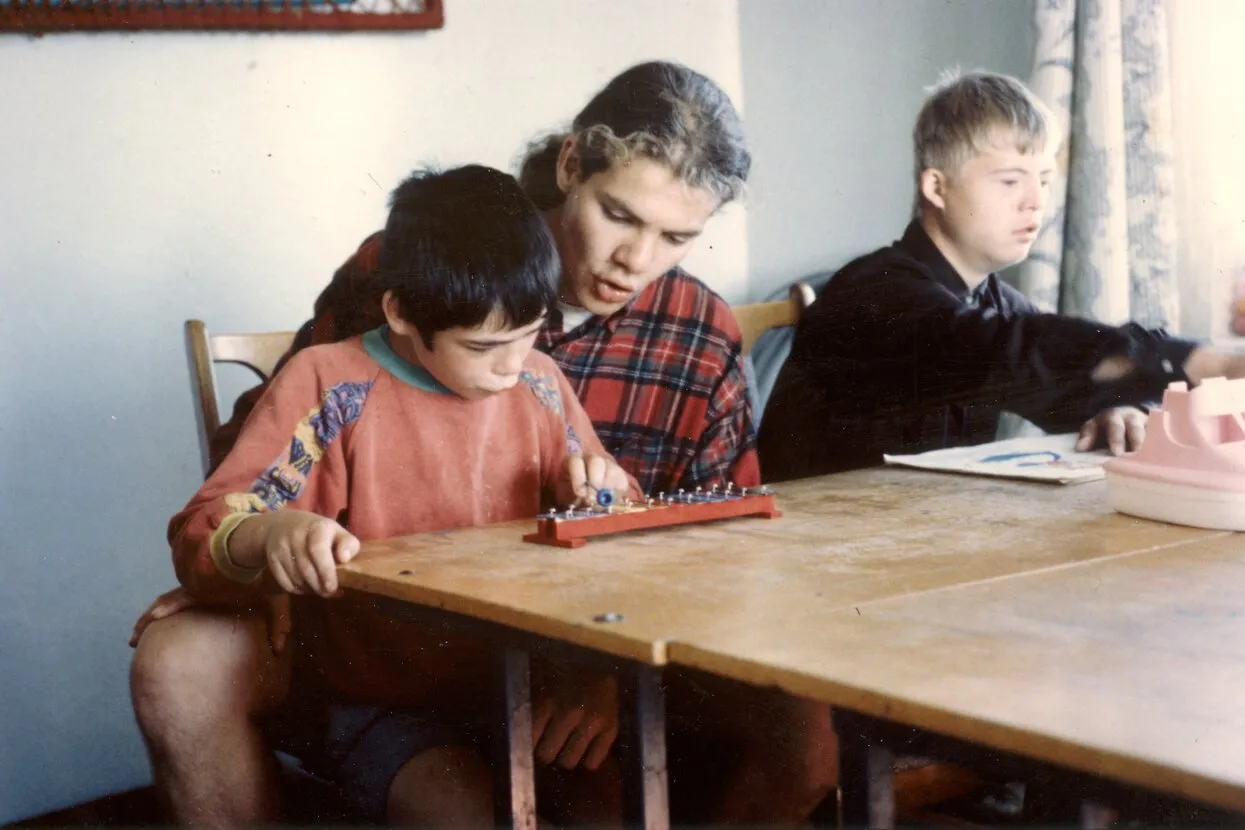
Germans who opted for alternative civilian service once went to help vulnerable people in countries devastated by the Nazis, including Russia and Belarus. Then Moscow started a new war in Europe.
From 1990 through the 2000s, Germans traveled to Russia and several other countries to perform alternative civilian service. German women came too, but as volunteers. They worked in hospitals, residential facilities for people with mental and neurological disabilities, and other care homes, and helped older people in their homes. One motivation was to atone for their ancestors’ guilt during World War II, seek reconciliation with the peoples who had suffered under Nazi Germany, and do something useful for them. Meduza spoke with volunteers from those years and the organizers behind the initiative.
In the mid-1980s, pacifist organizations took Germany’s alternative civilian service program abroad
After World War II, West Germany had no armed forces of its own. It did not begin establishing them until the mid-1950s, and a military service law was adopted in 1956. At the same time, West Germany’s constitution enshrined the right to refuse military service on grounds of conscience and perform alternative civilian service instead. This service had to benefit society in some way and was performed in hospitals, nursing homes, and other social care institutions.
An army began taking shape in East Germany at around the same time. But unarmed service was not permitted until 1964. Men who refused to bear arms on religious or other grounds could then serve in construction units known as construction battalions. This was not a civilian alternative in the West German sense: members of the construction battalions remained military personnel and wore uniforms, but were not issued weapons. They could be assigned to build defense installations and other military facilities.
For many years, proving one’s pacifist convictions in West Germany was extremely difficult. The process became easier in the 1980s, and officials realized that people seeking alternative civilian service could provide cheap labor. The number of people entering alternative civilian service rose sharply. Eventually, Sergey Krivenko, a board member of the International Memorial Association, told Meduza, German pacifist organizations secured permission for participants to perform this service abroad.
One of these organizations was Action Reconciliation Service for Peace (ASF). Founded in the late 1950s, it later helped men perform alternative civilian service abroad in countries that had suffered under Nazi aggression. ASF also recruited men and women seeking volunteer experience for projects abroad.
“ASF and other organizations began looking for local groups that could arrange this kind of volunteer work,” Sergey Krivenko said. “In other words, it wasn’t done through the government but through NGOs [nonprofit organizations]. In the early 1990s, a special center called Compassion was established within Moscow Memorial to help former victims of political repression. Those were hard times, with everything falling apart. Social services were only just being established. Most of the work was like this: older people lived alone and needed someone to clean, cook, and go shopping for them. The idea came up to bring in volunteers from [ASF and other organizations] to do this work. And it worked.”
The German initiatives also established contacts with other NGOs, churches, and residential institutions, sending volunteers to work with them.
In her book “Nestrashny mir” (“A World Without Fear”), special education teacher Maria Berkovich says that at the children’s home near St. Petersburg where she began volunteering in the 2000s, all volunteers were called Germans because there had never been any others:
The first German volunteers came to the children’s home more than 10 years ago. Ever since then, they have come every year and stayed for a year; when their term ends, new volunteers replace them. The organization also has ties to a German school for occupational therapists, so every year two or three of the school’s graduates come to the children’s home for six months to work with the children… Tanya, Sveta, and I became the first Russian volunteers at this children’s home.
The director of a St. Petersburg foundation that helped children and adults in residential institutions told anthropologist Anna Klepikova that when volunteers began working at the children’s home, few staff members saw any point in it. Klepikova quotes her in the book “Naverno, ya durak” (“I Must Be an Idiot”):
Most people thought we were wasting our time on nonsense. They told me point-blank, ‘Sure, you can tell the Germans whatever you want to get money out of them, but you and I understand that these children don’t need anything, right? And that they can’t develop, right?’ I think that if it hadn’t been a German organization, it simply wouldn’t have happened, because Russians who suddenly started working with children like these would have been seen as idiots. That’s all there is to it.
Hundreds of volunteers came to Russia — most of them without knowing Russian
The German volunteers who spoke with Meduza said the organizations that sent them paid for their trips. The program was funded not by the government but through donations collected by civic organizations. These funds could be used to rent shared apartments for volunteers and cover food, transportation, and other basic expenses.
Sergey Krivenko said Germans worked in at least Moscow, St. Petersburg, Volgograd, and Perm in Russia, as well as Minsk in Belarus. Their numbers were not especially large: Moscow, for example, might have hosted 10–20 volunteers a year. In all, hundreds of young people from Germany spent time in Russia and Belarus over the years.
Perm, 2004: An ASF volunteer helps a woman show photos of family members who were victims of Stalinist repression
ASF
Sergey Krivenko gave Meduza his overall impression of the German volunteers he met in the late 1990s and the 2000s:
They were incredibly interesting young men and women. [Some of them] were part of the volunteer ”social year” program. But of course they were young and wanted to have fun. After all, this kind of work was a chance to travel somewhere for free, and an adventure too. They also had strong ideological motivation: we’re doing a good thing, helping people. […] Sometimes we met some very interesting characters. One, for example, was the grandson of an SS general. He made a conscious decision to go to Russia to repay his family’s debt, as he saw it.
The volunteers studied the language while they worked. Many of Meduza’s interviewees said they were supposed to take a two-week intensive Russian course in Germany before leaving. Some spoke positively about the course; others did not. Either way, they had to overcome the language barrier once they arrived.
“They came without knowing Russian,” Sergey Krivenko said. “And within the first three months, through their contact with victims of political repression… they began to speak and understand it reasonably well. It was amazing.”
Young men doing alternative civilian service came to Russia from the early 1990s through the late 2000s. Germany abolished compulsory military service in 2011 and shifted to a professional army, reducing the number of German citizens working in social care institutions. Even so, volunteers continued coming to post-Soviet countries to do charitable work.
‘I have so many memories that usually shock people’
“If you have no connection to Russia, you don’t pay attention to what the media reports about it,” one German volunteer said in an interview with the charity Perspektivy. “Of course, I had a general picture in my head: freezing winters, Red Square, Moscow, St. Basil’s Cathedral, a samovar. All the usual clichés. Growing up in East Germany, I encountered the ‘big brother’ from the Soviet Union in kindergarten and at school, but even so, I had no idea what Russia was really like. I even bought a kettle back then and brought it to Russia because I didn’t know whether I’d be able to buy one there.”
Moscow, 2011: An ASF volunteer helps a child with a disability
ASF
Sofia came to Russia in the early 1990s. She told Meduza that her work had been arranged through a Moscow church:
A priest met us and arranged for us to stay in his nephew’s apartment. It had three rooms: the nephew lived there, and the five of us got the other two rooms. Four boys and me. We had fun, but I got away from them pretty quickly. I was from East Germany, and they were from West Germany. We could communicate easily, but they were too Western for me. And I realized I wouldn’t learn Russian if I stayed with them.”
With help from the Orthodox community, Sofia then found a home with a local family. The host church also arranged volunteer placements for her and the other young people. They mostly helped older people in their homes:
I had to buy groceries, and I learned to make porridge. Cleaning too. It was very nice. I met some remarkable people. One was a former Russian teacher who would sit with me and teach me the language. There was also a former cosmonaut who told me how he had been made to stand on his head for long periods and how they had conducted some kind of terrible experiments on him.
Volunteers could also help at one of Moscow’s residential institutions in their free time if they wished. Sofia said about 50 children of all ages lived there, from infants to teenagers approaching adulthood. Because the facility was understaffed, some of the children were often tied to their beds. “It was a very sad sight,” Sofia said. “The home had children with severe illnesses, as well as orphans who acted as caregivers for the sick children. I tried to teach them English and German. I was just a volunteer — I saw what needed doing, and I did it.”
Another volunteer, Matteo, performed his alternative service in Minsk through ASF in the mid-2000s. He said he became interested in Russian while still in school, thanks to a Ukrainian friend of his father’s. Alternative service in the former Soviet Union therefore seemed like an appealing option. Matteo was assigned to a children’s residential institution in the Minsk neighborhood of Navinki. He also spent some time helping adults at a residential facility for people with mental and neurological disabilities in the city’s Drazhnya neighborhood. Matteo said:
I still remember the stench in the hallways [at the institution in Navinki]. I have so many memories that usually shock people, yet by the end of the conversation, you’re left feeling that the person you’re talking to still hasn’t really understood. Because they never lived in that system.
There was one very withdrawn autistic boy who usually stood in a corner and sometimes hit himself. By the end of the year, I could communicate with him and was the only person who could calm him down. I was proud of that at the time. But at the end of the year, I told him I was leaving. He hit me and himself very hard. When I came back for a couple of days six months later, he was just as withdrawn as ever. Who knows whether that means it was all for nothing. Or maybe it wasn’t…”
The train one volunteer rode from Berlin to Minsk, a trip that took 18 hours
ASF volunteer
The Novinki district, where ASF volunteers worked — a monastery is visible in the background
ASF volunteer
Matteo also told Meduza about the institution in Drazhnya:
For me, Drazhnya was darker than Navinki. The building was bigger, and I usually stayed in the first two rooms on the ground floor. Four young women with cerebral palsy lived there; they had previously been at the institution in Navinki. Farther down, in the shadows of the hallway, there were beds and wheelchairs with people in them, amid moans and a stench. And there was a television mounted on the ceiling, with two or three orderlies sitting around it. I only found the courage a couple of times to ask someone from the hallway to go for a walk outside. I usually preferred the comfort and familiarity of those first two rooms.
Matteo said that he and the women who lived in the first two rooms would usually go for walks, talk, drink tea, smoke, go shopping, dye their hair, and listen to music. “We had a friendly relationship, but naturally, it wasn’t entirely equal,” Matteo said. “Unlike in Navinki, they had their own lockers and even cellphones. They often called to ask when we were coming back. Sometimes they messaged so often that it got annoying.”
Anthropologist Anna Klepikova’s book “Naverno, ya durak” (“I Must Be an Idiot”) includes a foundation director’s account of how difficult it was to find volunteers for an adult residential institution in St. Petersburg: “Volunteers fainted, and we had to send the German volunteers home because they couldn’t handle working in the adult institution.” According to the director, volunteers found it easy to imagine themselves in the adult residents’ place and picture themselves living in the same “utterly inhuman conditions.”
“We spent three years fighting just to get the residents spoons, for example,” the foundation director said. “There were no spoons, and they lapped food out of bowls like dogs. And the smells — when we first arrived at the residential facility for people with mental and neurological disabilities, it was absolutely horrifying. People lay there all day, wet and covered in filth, in pain that no one paid any attention to.”
Like Matteo, a volunteer named Emma worked in Minsk, though she came in the 2010s. She decided to volunteer immediately after finishing school, before enrolling at a university. Emma’s mother was a historian, and Emma said Germany’s history had mattered to her since childhood:
When you realize that you’re German, what that may mean to other people, what grievances they may have — entirely justified grievances… It was important to me to do this work.
Our hosts in Minsk had lists of former prisoners of concentration camps and other Nazi camps, including elderly women who had been forced to work in Germany. We visited them to help. We went shopping and cleaned for them. But they were always fussing over us and feeding us. It was very nice.
I also worked at a center for children with various kinds of cancer. We just played with them, made things out of clay, and drew pictures. I remember spending a lot of time with one girl who was seven or eight years old and lived in isolation in a separate room. You couldn’t simply walk in to see her. You needed a mask and shoe covers. I played with her so her mother could get some rest.
‘Our volunteer service was in the cause of peace. And now there was a new war’
The institutions’ overall atmosphere did not strike the volunteers who spoke with Meduza as “a horror movie with no escape.”
Although conditions in the social care institutions were difficult, Sofia said the people around her were very curious during her time there, and it was easy to become part of the local community. Everyone was intrigued: “Some Germans have come here to volunteer.” People wanted to support the young volunteers who had come to help.
One volunteer told the charity Perspektivy that he ate nothing but bread and butter for his first few weeks: “Back then, every store still had those separate departments, and without knowing Russian, it was almost impossible to buy anything. It took some time, but human relationships are always what matters most. And because our relationships with people were good, I felt comfortable and quickly got used to everything. We were a good team, and people took good care of us.”
Meduza’s interviewees said they made many local friends and stayed in touch with them for years. As a result, after volunteering, Sofia, Emma, and Matteo all returned more than once to Moscow, Minsk, and other cities in the former Soviet Union.
St. Petersburg, 2018: Volunteers who came for two weeks that summer help siege survivors, including by repairing their apartments
Helena Schätzle / ASF
In early 2022, Emma flew to Russia as an exchange student studying medicine. Her program lasted around six months, so she was in Moscow when Russia launched its full-scale invasion of Ukraine:
Our earlier volunteer service was in the cause of peace. We felt guilty, and it took decades before we were able to come as volunteers to countries that had suffered during World War II. And now there was a new war.
If I had known in advance, I wouldn’t have gone at all. Everything became clear only on February 21–22. I’ll never forget those days. I don’t think the other German exchange students felt the way I did, because they hadn’t had my experience or grappled with the subject of war the way I had. And I couldn’t find the words [to explain it all to them]. In those circumstances, with all that propaganda, and especially as a German, a “daughter of fascists,” it wasn’t easy.
Following Russia’s full-scale invasion of Ukraine, Emma volunteered at Moscow’s Sakharov Center in her free time until her exchange program ended in the summer of 2022.
At Meduza, we are committed to transparency about our use of artificial intelligence in the newsroom. The story you’re reading was written by one of our living, breathing journalists and translated from Russian using an AI model configured to follow our strict editorial standards. This translation process is the result of extensive testing and refinements to ensure our English-language coverage is timely and accurate. A Meduza editor reviews every draft before publication.
If you find any errors in this translation, please contact us at reports@meduza.io.
To read Meduza’s exclusive content in English, please subscribe to our newsletter.
Alisa Gorbunova
Meduza’s note
An occupational therapist helps people relearn everyday skills — dressing, washing, cooking — to whatever degree possible. Those skills don’t always return in their usual form: some people need additional devices, others must learn new movements. Finding the approach that works best for each person is the therapist’s job.
Example
Berkovich recounts the following exchange, apparently with an orphanage staff member:
— Hi, Germans!
— Hi, we’re not Germans.
— Then who are you?!
Note
Volunteers also worked in other countries that had suffered Nazi aggression. This article focuses on Russia and Belarus.
Note
The name has been changed at the subject’s request.
What money?
From 1995 to 2000, German public organizations were the sole funders of non-governmental assistance to children in residential institutions in St. Petersburg. They also brought in humanitarian aid, and Russian donors gradually began to participate as well.
Note
The name has been changed at the subject’s request.
What is this?
This is a program in which young people who have finished school spend a year volunteering at social institutions. They do not receive a salary, but the state and the host organization cover the cost of their education during that year, along with pocket money and other benefits.
What does this mean?
A special education teacher helps children with intellectual disabilities, neurodivergence, and other differences learn to acquire new knowledge and master various skills.
Note
Sergey Krivenko is speaking about the volunteers who helped victims of repression through the Compassion center.