Russian journalists fled their country after the invasion of Ukraine. My Undesirable Friends: Part II follows their lives in exile.
The Venice Film Festival hosted the world premiere of My Undesirable Friends: Part II — Exile, a documentary by Russian-born American filmmaker Julia Loktev. The film follows journalists from TV Rain, iStories, and Novaya Gazeta as they find themselves in exile after Russia’s full-scale invasion of Ukraine in 2022. In this latest chapter of her documentary epic about Russian journalists, Loktev explores how her subjects struggle to find their footing and keep doing their work despite the challenges of life abroad. Film critic Anton Dolin reviews the film for Meduza.
An unwitting déjà vu. With a flicker of dread, you realize you’re about to sit through six hours of documentary footage on a subject you’ve already studied in exhaustive detail — and lived through yourself. Then the film draws you in: you start worrying about the people on screen and can’t tear yourself away. By the end, your head is full of thoughts you want to share with readers and future viewers alike — until you remember that a year and a half ago, you already wrote about Julia Loktev’s My Undesirable Friends.
I flip through that piece, nodding along, and find myself agreeing with what I wrote. The important things have already been said. What is there to add? Do I really need to retell the “plot” that pushes the film’s characters — journalists from TV Rain, iStories, and Novaya Gazeta — into forced emigration and scatters the action across a dozen locations?
At the time, I wrote that I was watching Loktev’s nonfiction epic as my own story. That’s not exaggeration: you’re reading this piece by a film critic convicted in absentia and designated a foreign agent by Russian authorities, writing for a publication that Russia has declared an “undesirable organization.”
What’s more interesting is something else. Over more than a year in theaters, My Undesirable Friends has found viewers across a striking range of countries — from Iran to the United States, from Belarus to Israel — who recognize themselves in this unusual film, an iPhone-shot chronicle of shattered hopes seen through the eyes of young Russian liberal journalists.
Unconventional in every respect, the film has landed on numerous “best of the year” lists, won best documentary at the Gotham Independent Film Awards, and made the Oscar shortlist. Loktev seems to have captured the spirit of the times — the “last air” referenced in the subtitle of the first part of My Undesirable Friends.
At roughly 12 hours total, the project invites comparisons to a great Russian novel — or any novel of similar sprawl — whose sheer volume is at once intimidating and comforting. A simpler analogy is a TV series: My Undesirable Friends is divided into 10 chapters, and that’s no accident.
But watching it in a theater matters. The deliberate clash between the homemade, chronicle-like iPhone footage and the sheer scale of the runtime and the screen captures an essential paradox: the tragic, almost grotesque imbalance between the smallness of a person under political persecution and the unencompassable scale of the historical machine that grinds any one of us to dust.
There’s something else, too. You don’t step into the theater to unwind — you’re condemned, in effect, to live there for a while, growing close to characters who mature and change before your eyes. A cold, detached gaze is almost impossible. The film demands your empathy. By the end, these “undesirables” become your friends, too.
Loktev, absent from the frame, shoots and edits without hurry, without compressing time, letting air into other people’s claustrophobic spaces — perhaps not the last air after all, since everyone ultimately manages to escape and survive. Her touch is delicate enough to reveal her as more than a sympathizer. As Novaya Gazeta put it, she’s an accomplice.
It’s not only a TV series or a novel that can stretch across long, endless hours — life does too. When you’re caught in the thick of events, especially shocking and dramatic ones, you lose the ability to see them from a distance. Film has that resource. By giving shape to the formlessness of reality, My Undesirable Friends reveals patterns and, carefully, step by step, leads its lost, hapless émigrés toward the light — maybe not toward the triumph of good over evil, but at least toward clarity.
Venice Film Festival
The credits seem to separate “characters” from “performers.” The former are listed by diminutive first names, without surnames — they’re friends, after all. The latter are real people. Who is playing whom? Playing, or, on the contrary, shedding a social mask and setting aside a professional role to let real emotion through?
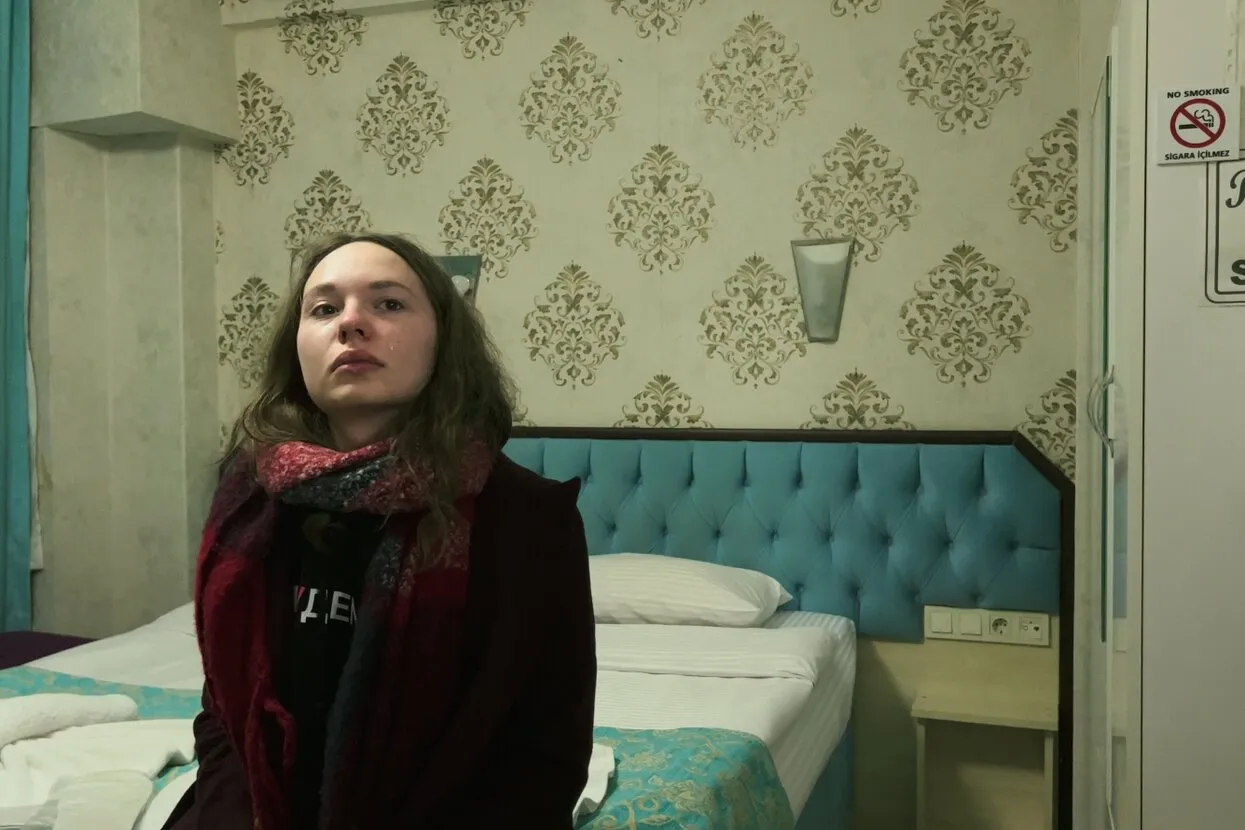
In the film’s first chapter, set in spring 2022, Anya — Anna Nemzer — is in Israel, bewildered, preparing to leave for Georgia. Ksyusha (Ksenia Mironova) and Lera (Valeria Ratnikova) are in tears, trying to check into a random hotel in Istanbul. Alesya (Alesya Marokhovskaya) and Ira (Irina Dolinina) look around uncertainly in Prague. And Lena (Elena Kostyuchenko), her voice full of horror, states the inevitable: to file truthful reports from Ukraine, she’ll have to quit Novaya Gazeta.
By the end, each character’s arc feels complete, even though all of them — young, full of energy and even hope — remain at a crossroads on their own path, far from any imagined destination. The film does have one unqualified advantage over life: it gets to end with closing credits.
The Venice Film Festival, where Part II of My Undesirable Friends is having its world premiere, is hosting several other monumental documentaries this year: Sergei Loznitsa’s three-hour Imperium, Alex Gibney’s four-hour Musk, and Mariano Llinás’s five-hour Life of Jorge Luis Borges. Loktev’s runtime sets a record even against that field — and this is only half the entire film. Apparently only films this uncompromisingly detailed, this painstakingly thorough, can answer the unasked questions of a disoriented viewer.
A brief digression: this summer’s most unconventional box-office hit was Christopher Nolan’s three-hour The Odyssey, whose sheer length did nothing to deter audiences. The characters of My Undesirable Friends wander uncharted seas and hostile islands while their own Trojan War rages on. They don’t have a single chance yet to sail off into the sunset.
Loktev’s film, though, moves past the two basic plots in Borges’s classification cited above: it isn’t a siege story (that was Last Air in Moscow), and it isn’t a homecoming that can only be dreamed of. The third Borgesian plot is the search. Ksyusha, Lera and Anya, Lena, Alesya and Ira are searching not just for a safe harbor but for the lost meaning of their work — and, with it, of their existence. Loktev, stitching scattered misadventures into a patchwork of a unified narrative, helps them find that meaning, but does so, fortunately, without moralizing or drawing categorical conclusions.
Tel Aviv and Riga, Tbilisi and Amsterdam, New York and Prague, Istanbul and Washington, and finally — how could they not appear? — Moscow and Kyiv… Ksyusha, stone-faced, walks out of the courthouse where her fiancé, Ivan Safronov, was sentenced to 22 years in prison. Lera fantasizes about The Hague, where she imagines herself reporting live on air during Putin’s trial. Anya discusses the news with her father over Zoom, then tries to locate the spot in her body that reacts to the sale of her grandmother’s apartment — somewhere near the solar plexus.
Meanwhile, Lena and her girlfriend, Yana (Yana Kuchina), seriously discuss Russia’s Federal Security Service (FSB)‘s plans to kill Lena, then, just to be sure, tell their fortune with a book — a random volume of Harry Potter that happened to be at hand. Rowling’s grim fairy tale also appeared in the first part of the film. It’s easier to imagine yourself fighting dementors and death eaters if you’re still hoping for a happy ending.
Warning: this video contains explicit language.
A clip from My Undesirable Friends, Part II: Exile
The Upcoming
The climax arrives in the fourth, penultimate chapter. While Lena works on a book with the provocative title Moya Lyubimaya Strana — “My Favorite Country” (in the Russian edition, the word “favorite” is censored with asterisks, leaving readers plenty of room for interpretation) — TV Rain lands at the center of a scandal in Latvia, where opposition television journalists who had fled Russia had obtained a broadcasting license. Twice, they let the phrase “our army,” referring to the Russian army, go out on air. For that, they would lose their right to work and their visas — exiled once again.
Loktev tells this story from start to finish, without omissions, foregrounding the internal and external chaos of everyone caught up in the conflict. A single possessive pronoun becomes the apple of discord. There’s no room for compromise. The two sides in the standoff speak different languages — and no, not Latvian and Russian. The rift runs far deeper than a linguistic misunderstanding.
Surprisingly, it’s this episode that dots the i’s. The resolution itself is ambivalent: in the moment, Latvian authorities win, while a later court ruling overturns the fairness of their decision. But more than two years have passed since then, and TV Rain relocated to the Netherlands long ago, where it now broadcasts — probably for the best, for everyone involved.
It’s exactly then, in the winter of 2022–2023, that it becomes clear opposition journalists from Russia no longer have an “ours” on either side of the border. But that also means their moral choices are made without regard for “their own.” At this point My Undesirable Friends — “my,” another possessive — finally takes shape as a film about choice and the act of claiming agency. This is what the characters were searching for all along: not a home, not a job, not stability, but an inner anchor that would let them keep doing their work, whatever stood in the way.
Navalny’s killing — Lera cries reading the news at her monitor. Trump’s inauguration — Ksyusha, in Washington, finds herself in the middle of the celebrations. This story has no ending and can’t have one. Sometimes, it turns out, you don’t need a resolution — a setup is enough. New characters appear: former TV Rain journalist Petya (Peter Ruzavin) and his Ukrainian wife, Natalka (Natalia Humeniuk, the former head of the Ukrainian news outlet Hromadske). Blurring the increasingly faint line between journalism and activism, they find support in each other. However irresponsible their dreams for the future may be, the path they’ve chosen is perfectly clear. Petya goes off to fight for Ukraine, and his personal story opens a new chapter.
For all its chronicle-like quality and seeming neutrality, My Undesirable Friends restores, as if by a wave of a magic wand, faith in the idea that everyone has power over their own tomorrow — even if the day after tomorrow is shrouded in impenetrable fog. It’s probably an illusion, but the kind of illusion that, even in the worst of times, makes life feel meaningful.
At Meduza, we are committed to transparency about our use of artificial intelligence in the newsroom. The story you’re reading was written by one of our living, breathing journalists and translated from Russian using an AI model configured to follow our strict editorial standards. This translation process is the result of extensive testing and refinements to ensure our English-language coverage is timely and accurate. A Meduza editor reviews every draft before publication.
If you find any errors in this translation, please contact us at reports@meduza.io.
To read Meduza’s exclusive content in English, please subscribe to our newsletter.