Putin announced battlefield encirclements that the evidence doesn’t show, but Russia’s real offensive is accelerating elsewhere
At a late-night press conference in Bishkek on September 1, Vladimir Putin said what he believed was happening on the battlefield. Once again, his account clashed with the Russian military’s documented gains. Putin is evidently aware that even troops at the front do not accept his reports, so he cited sources in the General Staff and “other agencies.” He said the picture, as it “appears” to him, is “fairly objective.” He immediately said that Ukrainian units had been encircled in two places in the Kharkiv region and that Sviatohirsk, near Sloviansk, had been captured. The claims surprised even the people behind Telegram channels close to the Russian military command, who likely work at the headquarters of the units responsible for the sectors Putin mentioned. Yet, strange as it may seem, Putin’s optimism about these operations is not detached from reality: Russia’s offensive accelerated in late summer and again pushed Ukrainian defenses into crisis along several important axes in early fall.
The Kharkiv region
- Putin said several thousand Ukrainian troops were encircled near Vovchansk and pinned against the border. Russian forces have indeed broken through from two directions southeast of the city, which Russia captured by mid-2026 after two years of heavy fighting. One group advanced from Vovchansk in the north and approached the large settlement of Bilyi Kolodiaz; another is advancing toward it from the Russian border to the east.
- Russia’s Defense Ministry said a month ago that Bilyi Kolodiaz had also been captured. Since then, however, published videos filmed by Russian units have shown strikes on Ukrainian positions inside the settlement. The nearest Russian positions are in tree lines several kilometers to the north.
- Published videos indicate that the force advancing from the east has not moved past Kupyne, 25 kilometers (16 miles) from Bilyi Kolodiaz.
- To be fair, the most recent videos from the area date to mid-August, and the situation may well have changed considerably in the weeks since. Still, it would be unusual for such changes to leave no visual trace at all — the Russian push toward Bilyi Kolodiaz in early August and the Ukrainian counterattacks that followed were both well documented.
- In any case, Russia does not have enough troops in this sector to encircle a 25-by-25-kilometer (16-by-16-mile) area. No encirclement of that size has been completed since May 2022, despite many attempts by both sides.
- An encirclement of Ukrainian units near Pisky-Radkivske, south of Kupiansk, seems even less likely. The Ukrainian army has maintained a large bridgehead on the eastern bank of the Oskil River for four years, centered on Borova, north of Pisky-Radkivske. Ukrainian forces also have numerous crossings over the shallow Krasnooskilske Reservoir. From the bridgehead, they periodically attack near the junction of the Kharkiv and Luhansk regions, trying to keep a small part of the Luhansk region under Ukrainian control so Russia cannot capture the entire region. Overall, this stretch of the front remains a “backwater.” Most troops in the area are fighting either near Kupiansk to the north or near Lyman to the south.
- Russian forces have made gains around Kupiansk and inside the city in recent months, retaking territory Russia lost during Ukraine’s counteroffensive last winter. They have also seized large areas on the eastern bank of the Oskil between Borova and Kupiansk-Vuzlovyi. But Putin said last fall that Russia already fully controlled Kupiansk, so this time he did not mention these actual gains. Nor did he mention a new Ukrainian attempt to pressure the northwestern flank of the Russian force advancing on Kupiansk near Dvorichna and Zapadne.
Lyman and Sviatohirsk
- Putin said Russian forces had captured Sviatohirsk, a city on the northern bank of the Siverskyi Donets River, 20 kilometers (12 miles) from Sloviansk. But no Russian positions have been documented in the immediate vicinity of Sviatohirsk in recent months. Moreover, Ukrainian forces have rolled back Russian incursions into the nearby villages of Yarova and Pryshyb, on a small Russian bridgehead on the river’s southern bank.
- Ukrainian forces are also trying to push Russian troops farther from Lyman, a city Russian forces tried and failed to storm in early summer.
- Overall, Ukrainian forces have managed to halt the Russian advance toward Sloviansk on the river’s northern bank, but not on its southern bank.
Sloviansk, Kramatorsk, and Dobropillia
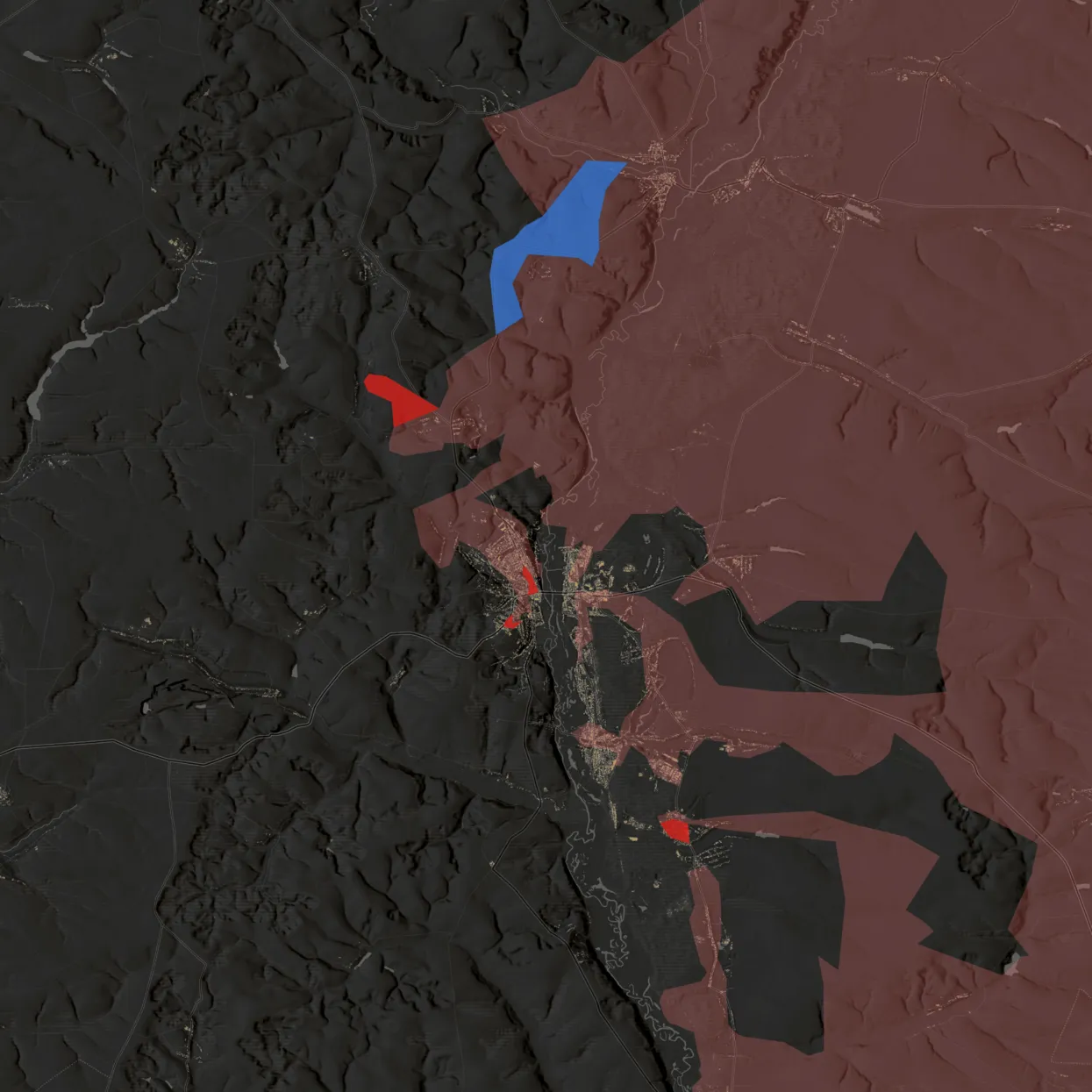
- After capturing most of Kostiantynivka — where scattered groups of Ukrainian troops still remain — Russian forces found themselves in early August in a situation they had hoped to avoid. Despite their success in the center of the front, which stretches more than 100 kilometers (62 miles) from the Siverskyi Donets River to Pokrovsk, they could not advance directly on the Kramatorsk–Sloviansk urban area. Attacks on the flanks — the Pokrovsk–Dobropillia, Dobropillia–Druzhkivka, and Lyman–Sviatohirsk sectors — were stalling, and a direct push toward Kramatorsk and Sloviansk from Kostiantynivka or Chasiv Yar was difficult without support from the flanks.
- In recent weeks, Russia’s offensive on the western flank, from Dobropillia to Druzhkivka, has intensified sharply.
- Russian forces captured settlements south of Dobropillia and then reached Annivka on the city’s eastern outskirts. Exactly a year after a failed attempt to break through to the Dobropillia–Kramatorsk road, Russian troops struck again at the same point, this time with far larger forces and more extensive preparation. They captured Kucheriv Yar — which Russian forces had also occupied in August–September 2025 — and Rubizhne. Farther east, Russian forces also pushed toward the Dobropillia–Kramatorsk road, reaching the area around Novoandriivka.
- Russian forces continue to advance toward Druzhkivka along the Kazennyi Torets River. They have crossed the river and taken up positions in Raiske, 4 kilometers (2.5 miles) from the city. Along the entire stretch from Dobropillia to the northwestern approaches to Druzhkivka, Ukrainian defenses are in a full-blown crisis requiring urgent measures — such as redeploying major reserves, as Ukraine did in the same area a year ago.
- The situation is also deteriorating southeast of Druzhkivka, where Russian troops are advancing rapidly — by the standards of this war — from the direction of Chasiv Yar. They have already reached Izhivka on the approaches to Oleksiievo-Druzhkivka.
- Farther north, on the southern bank of the Siverskyi Donets, Russian forces have reached the outskirts of Mykolaivka, which shields Sloviansk.
- The two sides’ starting positions for the battle over the Kramatorsk–Sloviansk urban area will depend on how Ukrainian commanders respond to these advances from several directions. A delayed or inadequate response could mean the battle begins as early as winter. Kyiv has created new command structures but has not yet transferred additional troops, which could be freed up only by weakening other sectors of the front. Ukrainian forces in the northern Donetsk region are clearly feeling the absence of an army corps — an air assault formation. The formation was sent southwest in the spring to the junction of the Dnipropetrovsk, Zaporizhzhia, and Donetsk regions to stop the Russian advance deeper into the Zaporizhzhia region, particularly toward Orikhiv.
Orikhiv and Mala Tokmachka
- In August, Ukrainian forces made another attempt to advance near the junction of the three regions. They broke through near the Donetsk–Zaporizhzhia road and advanced 10–12 kilometers (6–7 miles) to the Mokri Yaly River. The breakthrough point seemed well chosen: it was right at the junction of the Russian “Vostok” and “Tsentr” groups, bringing Ukrainian troops onto the western flank of the “Tsentr” group’s 90th Tank Division, whose positions faced north.
- Russian commanders, however, quickly brought in forces from the 90th Tank Division and the neighboring 41st Combined Arms Army to repel the Ukrainian attack from the west. In mid-August, both sides published videos showing their flags raised in about 10 villages. Ukrainian forces did so first, followed by units of the “Tsentr” and “Vostok” groups. The situation has remained unclear since then, but the lack of new information suggests that the Ukrainian advance was stopped, perhaps only temporarily, and that Ukrainian forces lost some of the territory they had previously retaken.
- Ukrainian forces also failed to achieve the offensive’s primary goal. Strikes on the northern flank of the “Vostok” group, which began in the spring, were meant to halt its advance eastward toward Orikhiv, in the central Zaporizhzhia region. The advance was only slowed, and it has now resumed with renewed force.
- Russian forces have reached the Orikhiv–Novomykolaivka road in several places. It is one of the main supply routes for the Orikhiv garrison. Russian troops have often failed to hold positions along the road or in nearby villages, however: Ukrainian forces continue to hold positions behind and on the flanks of the advancing Russian troops and are even counterattacking.
- The clash between small groups of assault troops on the steppe has already had dire consequences for Orikhiv itself. The “Dnipro” group’s 42nd Motorized Rifle Division had failed for two years to break through the Novodanylivka–Mala Tokmachka line south and southeast of Orikhiv; it did so in just two weeks. Russian forces have captured all of Novodanylivka, and assault troops from the 42nd Division have also established positions on the southern outskirts of Orikhiv.
- For the first time in a long while, Russian assault troops have also reached the center of Mala Tokmachka, a large village familiar from its frequent appearances in reports by pro-war commentators. Russian troops have cut the road from the village to Orikhiv. It remains unclear whether the 118th Mechanized Brigade, which had held Mala Tokmachka since early 2024, managed to retain positions even on the village’s outskirts. With Russian forces in their rear and the road to Orikhiv cut, doing so will be extremely difficult.
How territorial control has changed
At Meduza, we are committed to transparency about our use of artificial intelligence in the newsroom. The story you’re reading was written by one of our living, breathing journalists and translated from Russian using an AI model configured to follow our strict editorial standards. This translation process is the result of extensive testing and refinements to ensure our English-language coverage is timely and accurate. A Meduza editor reviews every draft before publication.
If you find any errors in this translation, please contact us at reports@meduza.io.
To read Meduza’s exclusive content in English, please subscribe to our newsletter.
Meduza