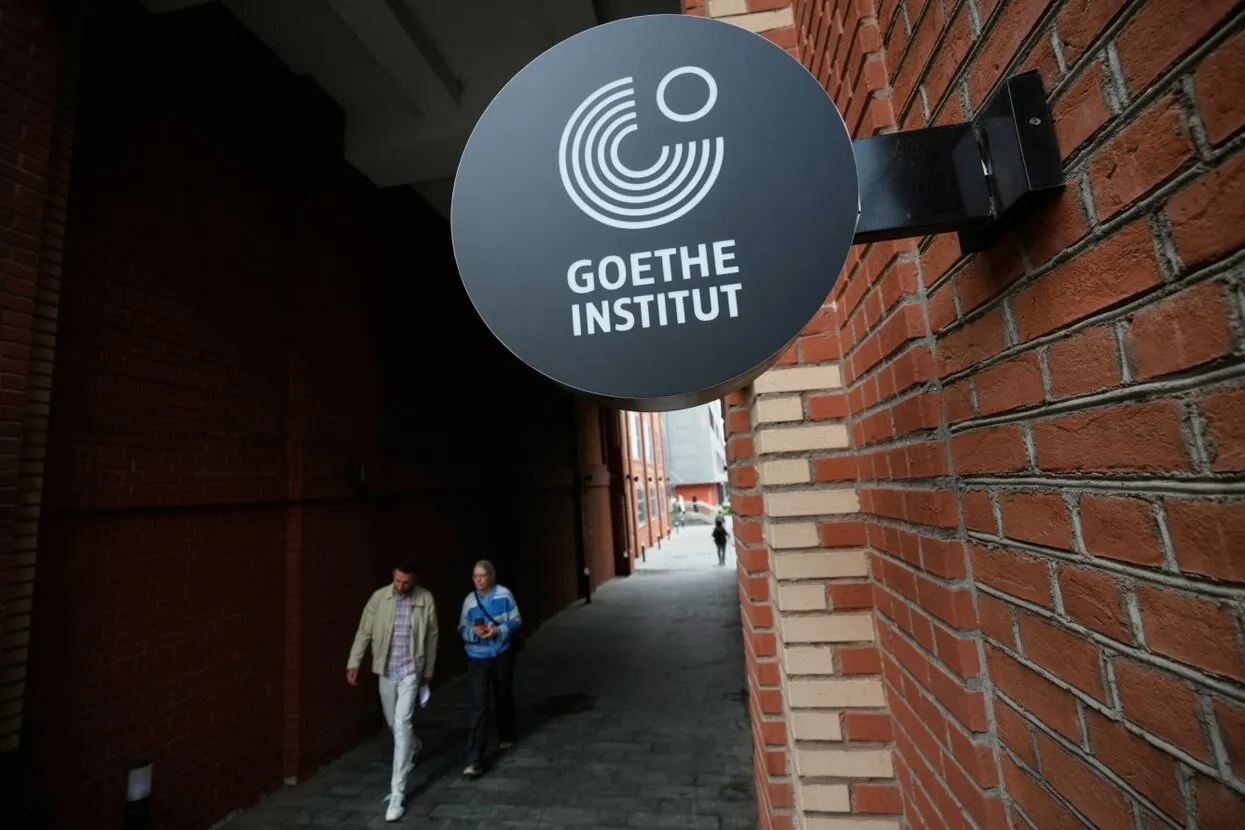
Russia is shutting down the Goethe-Institut. For many Russians, it was their gateway to Germany.
What is the Goethe-Institut
The Goethe-Institut was founded in West Germany in 1951 to train foreign teachers of German. The institute later expanded into a broader language and cultural exchange, teaching German to other students and immersing them in the country’s culture. Goethe-Institut centers now operate in 100 countries.
The institute opened its first Russian branch in Moscow in 1992, followed by others in St. Petersburg and Novosibirsk. Russia is now home to four Russian-German cultural associations, 16 reading rooms, 18 German language centers, and 60 educational literature centers affiliated with the Goethe-Institut.
The German Academic Exchange Service (DAAD), a partner of the institute, provided scholarships to students seeking bachelor’s or master’s degrees in Germany. Russian authorities designated the organization “undesirable” in February 2026, and DAAD subsequently closed its Moscow office and ended its scholarship selection process in Russia. Russians must now apply from third countries.
What former and current Goethe-Institut students say about its closure
Alina (name changed)
took online German courses at the Goethe-Institut and later got into a master’s program in Germany; now lives in Berlin
I started learning German at the Goethe-Institut in the fall of 2023. At the time, I was in my third year at university, though I had been studying German since my first year. I had decided to pursue a master’s degree in Germany, which meant passing a C1-level exam at the start of my fourth year. My university’s program wasn’t going to get me there in time, so about a year before the exam, I enrolled at the Goethe-Institut.
I think it was the best-known option for learning German, and it was fairly cheap. I studied online, first at the Moscow center and then at the one in St. Petersburg. Goethe-Institut centers outside the capital charged noticeably less.
Cost was exactly why I didn’t choose a private language school or tutor. A 78-academic-hour course at the St. Petersburg Goethe-Institut cost 27,000 rubles with a student discount in the fall of 2022. That’s about 346 rubles per academic hour, far less than an hour with a private tutor.
The main problem for me was that people within the same group weren’t always at the same skill level. To get placed at a particular level, you had to take an online test and were asked not to use outside resources — though of course people could still peek at something.
Unfortunately, some people didn’t take the test entirely honestly, or they had attended previous courses [after which you don’t need to retake the test] without really applying themselves. As a result, they ended up at a level clearly above their actual language ability.
After my first online course at the Moscow center, I asked for a recommendation to move straight up to a higher level. There, I felt my language skills were genuinely progressing and developing. It was a good course, and the young female teacher was pleasant.
But there was another problem: everything moved too fast, and there wasn’t always enough time to practice the material. That actually worked in my favor, though, since I needed to prepare for the exam as quickly as possible.
Unfortunately, the course didn’t last long. At the end of May [2023], we got a letter saying it was closing and the Goethe-Institut was going on an early summer break. I remember it came as a response to sanctions against the “Russian House” in Berlin. It was all quite unexpected. At the time, I didn’t even know what the “Russian House” in Berlin was or why it had anything to do with the institute shutting down. Now I live in Berlin, and I know.
They wrote that we could request a refund for the remaining part of the course if we wanted.
They also wrote that the institute’s partner centers would keep operating in Russia. As I understand it, these are the same language centers, just without the Goethe-Institut name: they started calling themselves German language study centers, and they existed in cities across Russia. The library also kept operating.
Besides the courses, I also used materials from the Goethe-Institut’s website. They have sample exams that I now use myself when teaching German, since I work as a tutor, along with good prep textbooks and sample tests — all of it really helps.
When I saw recently that Germany had refused to renew its agreement with the “Russian House” in Berlin, it became clear to me that the Goethe-Institut would be closed too. The two organizations go together.
It’s very sad, of course, because for many people in Russia, the Goethe-Institut is the main, best-known, and most accessible source of information about Germany, educational courses, events, and everything connected to the German language.
The courtyard of the Goethe-Institut in Moscow, September 2, 2026
Ramil Sitdikov / Reuters / Scanpix / LETA
I think it’s great that this system was spread across the whole country. It’s wonderful that courses in the regions cost less than in the capital, which meant people living there could take part. There was a chance to take the exams and then use that certificate to study abroad.
Now all of that is becoming much more complicated. There are online courses and online schools, but nothing comparable to the Goethe-Institut in terms of name recognition and accessibility. There’s surely some alternative out there, but you would already need to know where to look.
I hope that people who stay in Russia will get the chance to take Goethe-Institut online courses through other countries.
Oleg
tutor who prepares students for the German language exam at the Goethe Center and for DAAD scholarship applications; currently pursuing a master’s degree in Germany
I chose Germany for my master’s degree primarily because of free education. I already knew the language and was familiar with the system, and I had several acquaintances and friends who had already been studying and living there for years. I knew I’d have someone to turn to if I needed anything.
What appealed to me most was how well everything was set up, along with the free education and its overall quality. The education in my field is probably better in the U.K., but it’s much harder to get admitted there, and tuition is far more expensive.
I decided to apply at the end of my third year, which is also when I started preparing — about a year before classes were set to begin. I already knew German from studying it in school, and by that point I was teaching it myself, so my level was fairly good. I just needed to get more familiar with the exam format.
I had already taken the Goethe-Institut exam back in school, at the A2 level. Our school had a partnership with the institute, and its staff and my teachers knew each other. In Samara, there weren’t really any other options [to confirm your German level].
I took the exam I needed for admission in Moscow in the fall of 2023. The main difficulty was payment: it was only accepted in euros, to a German account. I didn’t have a foreign card or any close friends living abroad, so I had to ask friends of friends.
The Goethe-Institut matters for more than just exams. It’s also a place to learn about admissions and the education system itself, and to get advice.
I applied for a German master’s program, but a much more common path is going straight into a bachelor’s program after finishing school. That’s harder, since schooling in Germany lasts 12 years versus 11 in Russia, so there’s a special program set up for foreigners.
The Goethe-Institut was where you could learn more about what options exist, how to apply, and what documents to prepare — probably one of its main roles, besides teaching the language and administering exams.
These days, it’s mostly people planning to move to Germany or other German-speaking countries who study the language.
I see interest in moving and applying among my acquaintances, though my sample is obviously skewed — mostly people who graduated from good Moscow universities, mainly in the humanities. They’re finding it hard to find a place for themselves in Russia right now, so they’re more often interested in moving abroad.
Because of the Goethe-Institut’s closure and problems with scholarships, studying in Germany is becoming significantly less accessible. There are now major difficulties with taking the exam and securing funding.
I suspect interest in German among Russians has declined since the [full-scale] war in Ukraine began, because there are fewer opportunities to use it in Russia. Before the war, there were German companies and joint projects. Now, if you study German, it’s already quite hard to find work in business in Russia — unlike in the cultural sphere.
Olga
has taken the German language exam several times and frequently visited the library and events at the Goethe-Institut; lives in Russia and plans to apply to study in Germany
I decided to apply for a master’s program in Germany back when I was still in my second year [of a bachelor’s degree]. The decision was fairly simple: Germany is one of the developed European countries where you can get [financial] support and study more or less for free, which greatly expands opportunities for people from CIS countries.
I looked into which universities offered a good level of education and liked that they aren’t concentrated in Berlin. Every field has its own strong programs in different cities, and the humanities are well developed throughout Germany.
At the time I didn’t know the language. I only started learning it in my second year. There aren’t many options in Russia for taking a German exam if you need an officially recognized certificate; really, there’s only the Goethe Center. There’s also the TELC (The European Language Certificates) exam, but taking it means traveling to another country.
There’s also TestDaF, which can be taken remotely, but it’s held roughly once every three months, and you have to pay for it with a foreign card. There are also problems with proctoring: the internet can drop, or the microphone or screen sharing can fail. I know someone who had to retake the exam because of a technical issue.
In Russia, taking the German exam at the Goethe Center was the most convenient option. For those who had already studied there, it worked even better, since the teachers know the exam format well and can prepare students specifically for it.
I didn’t end up studying the language at the Goethe Center: by the time I started learning German, enrollment for the academic year had already closed. I found a tutor and later didn’t want to leave him, but I’d originally considered the Goethe Center my main option. It’s a respected institution, and when you’re just starting to learn a language, it seems like the logical place to go.
I also used the Goethe Center’s library, which is very large. I haven’t seen another place in Moscow where you can borrow that many books and educational materials in German in such quantity. Even buying the textbooks you need can be difficult, since Russia simply doesn’t have that kind of selection. In that sense, the Goethe Center was a pretty unique resource.
Besides the library, they also have film screenings, exhibitions, and lectures devoted to German culture. There are quite a lot of opportunities. But for me, the library was the main thing, and I was very upset about losing it.
There are quite a lot of Goethe Centers in Russia, and I’m not sure whether they’ll all actually close. When I was still planning to take the B2 exam and looking at options [in 2025], it was even possible to take the exam in Sergiev Posad [outside Moscow]. I’m curious whether they’ll really close every location.
The atmosphere at the Goethe Center is very friendly. [While taking the B2 test] I was late for the exam, and by the rules I shouldn’t have been allowed to take it at all, but I was able to take it anyway: no one humiliated me [for being late], no one gave me a hard time, no one added unnecessary stress. The same thing happened with the C1 exam. The examiners are kind and, as much as they can, try to help you, or at least stay out of your way.
At the end of September, I was planning to retake the listening and reading portions [of the C1 exam]. Because of the news about the institute’s closure, it’s still unclear whether the exam will even take place. I was very upset. My first thought was almost panicked, because it’s unclear what to do.
I have an exam scheduled in two weeks that I’ve been preparing for all summer, and they’re holding my certificates. The exam consists of four parts, and if you fail one, you can retake it separately. The Goethe Center keeps certificates for each part, and once you’ve passed all four, they’re combined into one overall certificate — the one you can then submit to a university or anywhere else that requires proof of your language level.
If they suddenly shut down now, what happens to those papers? Will I have time to pick them up? And what am I supposed to do with them afterward if I don’t have a complete certificate? For now, I don’t have a clear idea of how this is going to work.
The Goethe-Institut building in Moscow, September 3, 2026
Pavel Bednyakov / AP / Scanpix / LETA
I think it’ll make sense to write or call them to figure out what to do about my situation once the Goethe Center puts out an official announcement. For now, the plan is to wait for the exam date and not panic. In the worst case, I could go take the exam in another country. If I have to, I have to.
The Goethe-Institut was also closed in Belarus [in 2021], and quite suddenly. I can’t say that significantly reduced students’ or schoolchildren’s interest in German or in studying in Germany. At least, the people I know just go to Russia to take their exams. But of course it’s more convenient when you can not only take the exam but also be integrated into the culture [by attending a center like that].
Even at the closed Goethe Center in Belarus, where exams and classes no longer take place, there are still occasional film screenings in German and lectures. It has remained more of a cultural space. It would be great if it survived in Russia in at least that kind of format.
It seems to me that, over the years, studying in Germany is becoming less accessible for people who don’t have a financial cushion or who haven’t started preparing for it well in advance.
It used to be possible to get into a DAAD program in Germany without knowing the language at all, because there were separate competitions for Russians and Belarusians. People were admitted primarily based on their academic achievements and dealt with the language afterward. Now there are fewer of these opportunities.
If you apply to DAAD now, you [as a citizen of Russia or Belarus] have to compete in the general global pool. On top of that, the choice of universities is shrinking, especially if you need funding. Getting into a program in Germany is turning into a long game.
For me, the Goethe Center was primarily a place to take the exam. But for many people, it’s also a way to sustain their interest in Germany: going to exhibitions, conversation clubs, film screenings, and lectures. We’re probably losing not so much the ability to take the exam as, more broadly, an opportunity for globalization.
At Meduza, we are committed to transparency about our use of artificial intelligence in the newsroom. The story you’re reading was written by one of our living, breathing journalists and translated from Russian using an AI model configured to follow our strict editorial standards. This translation process is the result of extensive testing and refinements to ensure our English-language coverage is timely and accurate. A Meduza editor reviews every draft before publication.
If you find any errors in this translation, please contact us at reports@meduza.io.
To read Meduza’s exclusive content in English, please subscribe to our newsletter.
Meduza
Note
Russian authorities can treat a comment or interview published by Meduza as participation in the activities of an “undesirable” organization. A first “violation” carries a fine of 5,000 to 15,000 rubles; a repeat “violation” within a year can bring criminal liability — up to four years in prison.