At least 37 killed after Russian strike hits an ammunition depot near Kyiv, triggering massive explosions. Many of the victims were residents of a nearby care home.
The Russian army struck the village of Myla on the outskirts of Kyiv on the evening of August 28, setting fire to a warehouse where ammunition was being stored. The fire triggered a series of detonations, sending flames into nearby private homes. The explosions were powerful enough that authorities shut down traffic entirely on the Zhytomyr highway between the 15th and 32nd kilometer markers. Nearly 400 people were evacuated from the area affected by the strike.
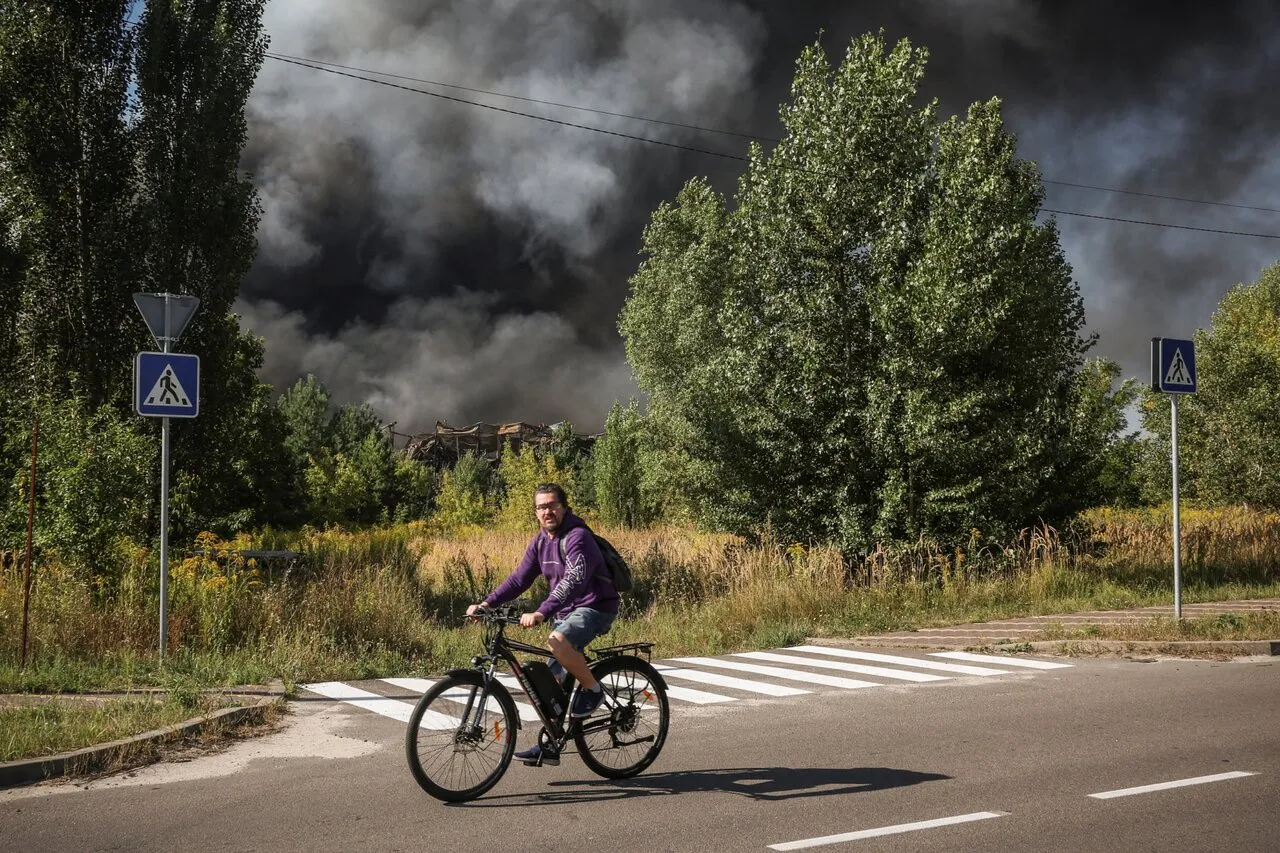
Smoke rises from a fire in the Kyiv region after a Russian strike, August 29, 2026
Alina Smutko / Reuters / Scanpix / LETA
Russian drones also struck Kyiv again. A 2-year-old girl died and five more people were injured when a drone came down, according to Mayor Vitali Klitschko. August 29, 2026
Serhii Okunev / AFP / Scanpix / LETA
A firefighter extinguishes a tire warehouse fire in Kyiv after a Russian strike, August 29, 2026
Oleksandr Gusev / Reuters / Scanpix / LETA
Tymur Tkachenko, head of the Kyiv Regional Military Administration, said Saturday morning that at least 27 people had been killed in the Russian strike on Myla, in Kyiv region’s Bucha district. Another 42 people, including four children, were injured to varying degrees. Among the dead was Taras Didych, head of the Dmytrivka community in the Kyiv region, who had been helping rescue people from the fire.
Update. As of 2:00 p.m. Saturday, 37 people are known to have died in the Russian strike, Tymur Tkachenko wrote.
About 50 residential buildings were damaged. The heaviest damage was to a nearby care home for elderly and disabled residents, where 20 people died, according to local social media pages.
An apartment building in Kyiv damaged by a Russian drone. August 29, 2026
Reuters / Scanpix / LETA
A fire truck on the highway near the site of the Russian attack in the Kyiv region, August 29, 2026
Alina Smutko / Reuters / Scanpix / LETA
Volodymyr Zelensky confirmed the care home had been damaged. “Those who allowed this must certainly bear responsibility for their decisions. Investigators from the National Police and the Security Service of Ukraine are conducting a pretrial investigation, and a criminal case has been opened over official negligence. There are rules: ammunition cannot be stored near homes or other residential buildings. There will definitely be appropriate conclusions,” the president of Ukraine said.
Ukrainian Prime Minister Serhii Koretskyi called what happened in the Bucha district the result of “criminal negligence,” recalling the “terrible tragedy in Vyshneve,” which he said “did not serve as a lesson.” Russian forces struck a Ukroboronprom warehouse in Vyshneve, near Kyiv, in July. The resulting detonation damaged 300 residential buildings and killed nine people.
The Kyiv region declared August 30 a day of mourning for those killed in the Russian strike.
Russia’s Defense Ministry stated that its drones struck an ammunition warehouse belonging to the Ukrainian defense company Fire Point in the village of Myla, where components for FP-1/FP-2 UAVs were stored. The ministry also claimed that overnight on August 29, Russian troops struck logistics centers in the villages of Chaiky and Kalynivka near Kyiv, where components for Ukrainian “Flamingo” cruise missiles were stored as well, among other things.
At Meduza, we are committed to transparency about our use of artificial intelligence in the newsroom. The story you’re reading was written by one of our living, breathing journalists and translated from Russian using an AI model configured to follow our strict editorial standards. This translation process is the result of extensive testing and refinements to ensure our English-language coverage is timely and accurate. A Meduza editor reviews every draft before publication.
If you find any errors in this translation, please contact us at reports@meduza.io.
To read Meduza’s exclusive content in English, please subscribe to our newsletter.
What debris?
Russian propaganda often uses the phrase “drone debris” to downplay the scale of an attack and highlight the effectiveness of air defenses. Ukraine has adopted the same approach. Fragments of drones and missiles do sometimes fall to the ground, but in wartime conditions such claims can rarely be quickly confirmed or refuted. Treat reports of “drone debris” with caution.