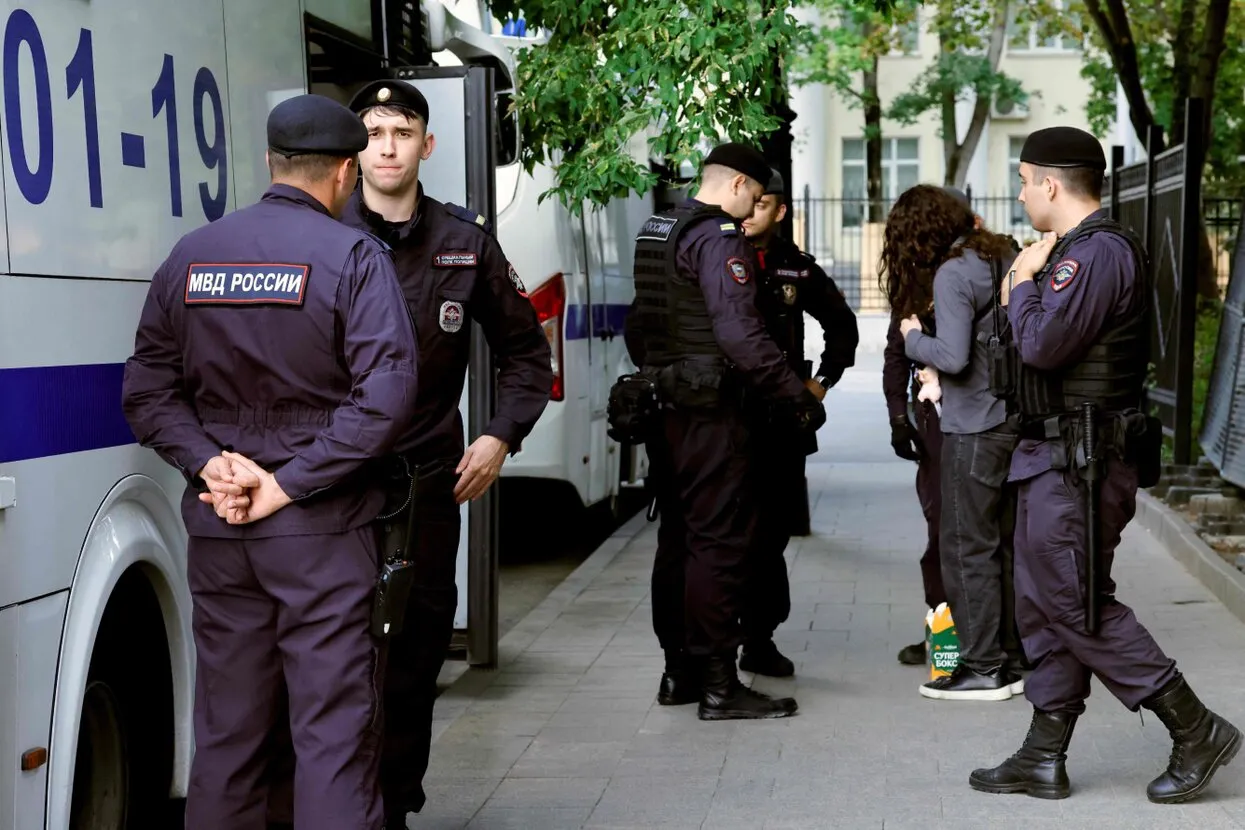
More than 80 young supporters of Russia’s antiwar Yabloko party were detained outside the Supreme Court as it upheld the party’s removal from the ballot. Five of them describe the day.
On August 17, Russia’s Supreme Court upheld its ruling barring the liberal Yabloko party from this year’s State Duma elections. Just as on August 10, when the Supreme Court heard the suit against Yabloko at its Povarskaya Street building, large numbers of the party’s young supporters turned out for the appeal ruling. Police detained more than 80 people. Those who were 18 or older were released from police stations within a couple of hours; the rest had to wait for adult relatives to come get them. The independent journalists’ cooperative Bereg spoke with young antiwar Russians who believed until the last moment that they’d be able to vote for the party campaigning under the slogan “For Peace.” Some of them were among those detained. Meduza is translating this story in full.
Pavel (name changed)
19, a university applicant and Yabloko volunteer from Moscow
I’ve followed Yabloko for about four years now, since ninth grade, and I’ve always respected its position. A couple of weeks ago, I became a volunteer for the party. Now I put up flyers and drop pamphlets in mailboxes. From what I’ve seen, a lot of people don’t even look at the flyers, and some tear them down outright. You can tell how people in a given building feel about Yabloko just from that. I also run a TikTok account that isn’t connected to the party, but a video I posted recently in support of Yabloko really blew up.
I managed to get into the courtroom to watch the August 10 hearing on removing Yabloko from the ballot. I was really surprised by how many people showed up — it seemed like no one had expected that. There was a sense of unity among Yabloko supporters that made the whole thing less nerve-racking. On the 10th, the police didn’t seem ready for that many people, and they didn’t seem to know what to do. They barely had any police vans that day.
Yesterday [August 17] was different. I counted four police vans, if you can believe it — maybe there were more. Police officers stood around smiling, well aware they could take us away at any moment.
Still, on both the 10th and the 17th, everyone who came to the court knew exactly what they were doing. Everyone came to support Yabloko and show they weren’t alone. It’s important to show the people in power just how much discontent there really is [in society].
Yesterday, some friends and I were among the first to arrive at the court, at 7:30 a.m. We met recently through Yabloko and share the same goals, convictions, and interests.
At first there weren’t many people at the court, but the crowd grew steadily. As soon as people began showing up, a police officer came over and asked why we’d come, trying to get us talking. We tried to ignore him — we knew that the moment one of us answered, they’d probably throw us all in a [police van].
Outside the courthouse, two old guys [among the Yabloko supporters] stood up for the younger crowd, going back and forth with the so-called officers of the law and trying to talk them out of hauling us in. They told the police we’d disperse on our own at 10 a.m., which may be why people weren’t taken away earlier.
Right off the bat, the officers said outright that anyone without a pass arranged in advance wouldn’t be let into the hearing. Only journalists could get passes ahead of time; everyone else had to go to entrance No. 5 of the courthouse, phone in from the landline there, and hand over a passport to get one.
I think they said all this deliberately, to get us to leave. But no one left. One guy politely asked an officer to identify himself, and they hauled him off to a [police van] on the spot.
Shortly before 10 a.m., they told us, “You’ve got one minute — leave, or we start loading you into the vans.” One guy called back, “And on what grounds are you planning to do that?” They asked how old he was; he said 16, and they took him away.
At 10 a.m., a few friends and I bolted from the courthouse — that’s the only reason we weren’t taken. We walked from Arbat, where people were also being detained, to the Moscow City business district, then back to the Arbatskaya metro station to meet [Nikolai Rybakov, the chairman of Yabloko,] after the hearing. By then, maybe 30 to 40 people were still there. You could see how sincerely they supported Nikolai and Yabloko, and how ready they were to put themselves at risk again just to support them. I don’t think the authorities liked that very much.
If I hadn’t gotten drunk yesterday, I don’t know how I would have handled the court’s ruling. We knew what it was probably going to be, but you still want to hope for the best right up to the end.
But this isn’t the end. At the very least, there are still the single-mandate district races. And we need to educate people, because a lot of them don’t even know what Yabloko is.
I want the war to end. I’m troubled by how it’s changing society: violence is gradually becoming normal, and people are forgetting that other people’s lives are worth anything. I’ve heard more than once that older generations, for some reason, don’t care about other people’s lives — no matter what country or nationality those people come from. Fear and hatred are starting to feel normal. It shouldn’t be like that.
For me, the antiwar work is the most important thing Yabloko does, though it works on other things too, like protecting the environment and fighting illegal development.
Working as a volunteer, I didn’t just hand out flyers — I tried to talk to people, too. I heard all kinds of opinions — some sensible, some not so much. One guy was even for bringing back the monarchy. Sometimes it’s really hard to listen to. A lot of people honestly don’t give a damn about what’s happening in Ukraine or in Russia. At the Yabloko office, they warned us that if you’re going to engage with people, you have to be mentally tough.
I’ve already been accepted to study abroad, because before [Yabloko was barred from running in the State Duma elections], I was planning to build my life in one particular country. My parents also drilled it into me from childhood that the only way to make things better is to leave.
But now I’ve started to reconsider — maybe I’ll change what I’m studying. And I don’t rule out joining Yabloko. I don’t want to tell my relatives about it yet, because they worry about me a lot. Few of my friends and family are willing to make politics part of their lives, and they don’t understand why I’d want to. I think dictatorship fatigue is setting in. And that’s exactly what dictatorship is for — it crushes moral resistance.
If any of this reaches people who are still on the fence, or people whose loved ones are deeply involved with Yabloko, I want to say something: you don’t have to share your loved one’s political views, but right now, support and acceptance really matter to us. Fighting for these values really does wear you down, mentally and physically.
Eva
18, a college student from the Stavropol region
When the war started, I was 13 or 14, and I didn’t really think much of it. Back then I didn’t understand what it was.
I started getting interested in politics about two years ago, when my uncle and his cousin were sent off to the so-called ”special military operation” — one signed a contract voluntarily, the other was drafted. Thank God, both are still alive.
I first heard of Yabloko about a month ago, when I saw its slogan on either TikTok or Instagram: “For Peace, for a ceasefire, for a life without fear.” I liked that stance, so I started digging into its platform, and now I follow it closely.
There’s absolutely nothing I’m okay with in [Russian politics]. The authorities are taking away our right to choose, and now they’re stamping out Yabloko and its supporters simply because, in our country, being for peace has apparently become a bad thing.
They’re stripping us of freedom of speech and pouring insane amounts of money into a fratricidal war. Meanwhile, our lawmakers’ children live it up abroad, and the lawmakers themselves throw fits the moment someone suggests they go to the front — Alexei Zhuravlev, the head of the Rodina party, for one. The government spends billions of rubles on pointlessly blocking websites, even though that money could go toward improving schools and hospitals.
I’m sick of being afraid every day — for my future, for my people, for Russia.
Every party in this election campaign is really just United Russia, the ruling party, under a different name. There’s no point in peacefully expressing disagreement with the authorities — they’ll only get the message once people start taking to the streets and smashing things up. And even that’s not guaranteed, judging by how they cleared everyone out in front of the Supreme Court. They basically spat in the face of everyone who came out just to support the party, and told us one more time that we have no voice and no choice.
I still don’t know who I’ll vote for, but I definitely will. I have no idea whether anything will actually change — I’m completely in the dark. It seems to me our people will just put up with it and get scared yet again. But I can’t judge them; I understand perfectly well why.
I see my future in Russia. I truly love my homeland, its culture, its people — I like absolutely everything about Russia except the government. If change comes, it definitely won’t come peacefully. But even if things go completely to shit, I’ll walk this whole hard road with my country.
Anna (name changed)
18, a college applicant from Moscow
I never even made it to the entrance of the Supreme Court yesterday [August 17]. Several of us were detained behind the courthouse rather than in front of it. We got to the area around 9:50 a.m. Riot police stationed near the court told us that the way forward was blocked but that we could go around, so that’s what we did.
We had almost made it around the building when Interior Ministry officers caught about 10 of us. Behind the building there’s a kind of park with benches. They marched us over there, where more than 15 people were already sitting, guarded by four officers, I think. We asked why we were being held, but all we got were evasive answers — or rather, “jokes.” When we asked what was going on, one officer said, “We’re shooting a movie.” Another said, “It’s summer, I think it’s summer right now.” No one answered our questions.
Tatyana Makeyeva / AFP / Scanpix / LETA
Yulia Morozova / Reuters / Scanpix / LETA
Photo by an eyewitness
A guy in plain clothes who was with the officers filmed us the whole time. He accused us of taking part in a rally, even though it was the police who’d gathered us all in one place. After a while, a police van arrived, and we were “asked” to get in. The girls just had their bags searched; the guys got patted down, head to toe.
Inside the vehicle, almost everyone had their phones taken away. Some of us managed to hide ours because the police weren’t paying close attention, and someone even smuggled in a tablet. Most of those detained were, I’d say, between 14 and 23 years old. Police didn’t use force, since no one tried to resist, but when one guy tried to walk away, they grabbed his arm and told him to stay put, warning that they’d use force.
We were taken to a police station, where we sat from about 10:30 a.m. until 3 p.m. Officers took everyone’s passports; from those who didn’t have documents on them, they took photos or scans saved on their phones. They photographed every detainee — there were 27 of us at our station. We weren’t allowed to use our phones the whole time; they only handed them back so we could show photos of our documents.
We were allowed to call our parents only several hours later, even though we’d asked repeatedly. They made us sign detention reports. There were no threats, but they made it clear we had no choice.
The other detainees and I talked about what might happen to us and trash-talked the cops and the government. We sang songs and supported each other. At first, most of the kids were scared, though I wasn’t scared at all, to my own surprise — I honestly couldn’t have cared less. Then a sense of unity set in, and everyone just laughed at how absurd the situation was. The report didn’t even list a specific reason for the detention — it simply said we’d been brought in for a “preventive conversation.”
Photo by an eyewitness
More than half of those detained were minors. Most had come to support Yabloko, but some were just kids who happened to be nearby and got swept up in it. This was the first time I’d ever been detained.
Even now, I’m not scared at all. If anything, this only confirmed what I already thought about how shameless and inhumane the [Russian] government is. Getting detained didn’t scare me off; it gave me a reason to keep fighting and not give up, even at that cost. Fear is exactly what they’re after.
Right now I’m applying to a college publishing program, and after that I’ll go on to study journalism. This whole situation has made me want to study it even more.
Darya
19, a college student from Samara
I’m studying at a teacher-training college to become an elementary school teacher, and I also work at a preschool.
I wasn’t particularly interested in politics before. The turning point for me was 2022, when all this horror started. Before that, I trusted the state, even though there were warning signs: police broke up the peaceful 2021 rallies in support of Alexei Navalny, detained the people who came to them, and arrested Navalny himself. Then, [in February 2024], came the premeditated murder of Alexei… And I started to worry about my future.
I worry that I won’t be able to get an apartment, even with a mortgage, or give my kids what they need. I worry that I won’t have the kind of youth my parents had, and that I’ll end up working my whole life for a 30,000-ruble [$350] pension — all because of what’s happening right now. “Stability” doesn’t always guarantee a good life for citizens.
I hadn’t followed [Yabloko’s activities] before — I only started after seeing a TikTok video in June 2026. I remember one video by Kirill Goncharov, the head of Yabloko’s Moscow branch. I was impressed that party members carried themselves with such confidence, unafraid to talk openly about something that’s been brewing in society for almost five years now. Then people picked up the slogans and calls for peace, started making their own videos, and began speaking openly about how the authorities behave. That’s when I realized Yabloko’s approach — pursuing political goals peacefully — really grabbed me. I have real respect for that.
What shocked and outraged me most [after the ruling] was that a party this old had its federal list thrown off the State Duma ballot at a moment of crisis. The plaintiff [the Rodina party] has no real arguments; the copyright claim over an image of a dove is a complete stretch. This election campaign should have gone differently.
I haven’t gone to any rallies in support of Yabloko. Rallies and protests aren’t exactly peaceful ways of fixing [what’s going on], if you ask me. But if there are peaceful, legal ways to support the party, I’d like to join in: putting up flyers, spreading the word through videos and songs — creative things like that. Though everything Yabloko is doing right now is already a peaceful way of disagreeing with the authorities…
Being in the opposition today is risky — the situation doesn’t allow you to speak openly about the country’s problems. The detentions outside the Supreme Court today [August 17] show just how dire the consequences are. But I sincerely believe people will be released [this conversation was recorded before the detained Yabloko supporters were released]. All of this is being done simply to stop people from coming to the court.
Unfortunately, the situation in the country has made young people wonder whether it’s worth staying in Russia and fighting or giving up and leaving. Personally, I can’t abandon Russia at such a difficult time. My family and friends are here, too. But it hurts so much; I feel powerless and hopeless because of the current chaos.
I’ve discussed the political situation with my parents, but unfortunately our views differ — they’re financially secure and have a stable life. My future is uncertain, though, since it’s unclear whether the fighting will continue or everything will end with a Yabloko victory [this conversation was recorded before the ruling was handed down].
I think we need a change of government. There’s always a chance [for democratic change], and it’s necessary and right to fight for your future — and fighting doesn’t mean using aggressive methods to get what you want. Goncharov has spoken about this, and it’s what Nikolai Rybakov, the party’s chairman, and its lawyer, Vitaly Isakov, are trying to get across to the court: that people shouldn’t be afraid to speak and think about tomorrow.
People now have hundreds of reasons to doubt whether they can stand up to the regime, but in my opinion, inaction is the worst thing that could happen right now. Personally, I’m not afraid — I want to say what I think, and I will, because it’s my right. No one has the right to violate the Constitution and shut me up.
I’m still sure I’ll vote for Yabloko, because Rybakov told us not to be afraid, and I’m not. I’m waiting to see who the single-mandate candidates in my district will be, though as far as I know, there currently aren’t any candidates from Yabloko in the Samara region.
Dmitry (name changed)
19, a law student from Moscow
I started getting interested in politics around age 12, I think — political videos began popping up on my YouTube feed even back then. Since I was living in a small town at the time, issues like social injustice, low incomes, and a low standard of living really bothered me. I could see that people lived better elsewhere, so I started looking for the reasons behind that inequality, got interested in history and politics, and began watching content on those topics.
I started following Yabloko’s activities when I was about 13 or 14, around the same time I met one of the party’s supporters in my home region. In 2021, Yabloko had already come out with the slogan “For Peace,” even though it wasn’t the main theme of its campaign. Yabloko was the only party that warned the ”special military operation” was coming — and said so openly.
Democratic and liberal ideas had a powerful pull on me by then, and from 2022 on, I was an active supporter.
Yabloko’s main slogan [for the 2026 election campaign] — “For Peace and Freedom!” — is basically a call to everybody in Russia and around the world with their head on straight to start talking about what actually matters. There’s this whole shake-up going on right now, everything moving toward some new order, and Yabloko says we need to strive for something more decent and civilized. That’s exactly what draws me to the party.
I wasn’t in Moscow on August 10 and couldn’t make it to the hearing. I planned to come to court on the 17th, but once I heard the detentions had started, I realized I probably wouldn’t go. It’s dangerous.
I followed both court proceedings. On August 10, I watched the livestream from start to finish. As a future lawyer, I found it fascinating to watch.
But the appeal hearing on August 17 was ridiculous beyond belief. It’s an appellate panel, after all — you’d think justice would prevail. [By law], Supreme Court judges are held to a higher standard: they’re meant to safeguard justice at any cost. Unfortunately, that’s not what happened.
When I saw the Supreme Court’s ruling, I didn’t feel anything. I’d understood on the 10th that nothing was going to happen, and I’d already been through all the trauma by then.
Honestly, the Rodina party and the authorities gave Yabloko a lot of free publicity. Even now, as far as I know, Yabloko has 300,000 subscribers on its Telegram channel, three times as many as United Russia’s. That audience isn’t going anywhere. The problem is that the authorities will probably try to destroy Yabloko within the year.
Whatever arrangements there apparently were between Vladimir Putin and Grigory [Yavlinsky, Yabloko’s founder] probably don’t interest anyone anymore.
I see my future in Russia. I can’t imagine myself abroad. If I ever faced the threat of criminal prosecution, that would, of course, be scary, and I don’t know what decision I’d make. I love Russia — it’s my country. I don’t see any way to make something of myself anywhere else, and I don’t want to.
My Telegram status has the Yabloko emblem on it. I don’t think some cop is going to show up at my door tomorrow and make me answer for it, and I don’t feel like I’m doing anything wrong. But if I start speaking out more actively and they do come for me, I probably won’t be scared — especially since I’ve already had a run-in with law enforcement, back in 2022.
There are still ways to show you disagree with the authorities in Russia today — they just come with risks. Right now, if I’m not mistaken, there are about 2,500 political prisoners in Russia, and far more people who disagree with the authorities and say so. A lot of people speak out openly on their Telegram channels, on VKontakte, and on other social media. They can’t lock everyone up.
Among the people I talk to, there are a lot of Yabloko supporters — people who think like me. They’re all really smart; many compete in academic olympiads, and they understand everything. Seventeen or 18 is actually when your mind is at its sharpest — you’ll never be smarter than you are at 18.
The main thing right now is not to get discouraged, as Nikolai Rybakov says, because things are going to get worse again. I’m sure of that. Every path is going to be cut off. But the saying “the darkest hour is just before the dawn” really is true.
Our views, the experience we’ve gained, the sense of being part of something politically huge — all of that stays with us for good. As young people, we’ve already felt that we can accomplish something real: when Yabloko’s poll numbers literally double in a week, that’s mind-blowing. Every like on TikTok, every repost and message might make someone else stop and think.
We’re living through a period of real crisis, and hard times always produce strong people. This experience will serve us well in the future fight for a beautiful Russia.
At Meduza, we are committed to transparency about our use of artificial intelligence in the newsroom. The story you’re reading was written by one of our living, breathing journalists and translated from Russian using an AI model configured to follow our strict editorial standards. This translation process is the result of extensive testing and refinements to ensure our English-language coverage is timely and accurate. A Meduza editor reviews every draft before publication.
If you find any errors in this translation, please contact us at reports@meduza.io.
To read Meduza’s exclusive content in English, please subscribe to our newsletter.
Yelizaveta Antonova for Bereg
What video?
A wave of pro-Yabloko videos spread across TikTok and Instagram in late July and early August, racking up hundreds of thousands — in some cases, millions — of views. Engagement with these posts grew 4.5 times over from the last week of July to the first week of August, though it still trailed United Russia and the Russian political party New People. In some videos, young Russians dance and lip-sync to Yabloko (“Apple”), a song by IOWA and Yolka; in others, they say or show that they plan to vote for Yabloko in September.
What were the “arguments”?
Rodina claims Yabloko violated copyright and campaign rules and received foreign funding.
The plaintiff argued that Yabloko infringed copyright by using ChatGPT to generate campaign images, since the pictures and photographs the neural network drew on to create the final images belonged to others. Rodina also accused Yabloko of illegally using photos from historical events and several other images, including pictures of Victoria Bonya and Dmitry Medvedev.
Yabloko has called Rodina’s accusations baseless and politically motivated.
The Rodina Party
Rodina is a far-right, populist, pro-Kremlin party founded in 2003 by four men: Dmitry Rogozin, a former Roscosmos chief and senator; Sergei Glazyev, state secretary of the Union State of Russia and Belarus; Sergei Baburin, one of the main ideologists behind the “Russian Marches”; and Yuri Skokov, first secretary of Russia’s Security Council.
The party disbanded in 2006 and was revived in 2012, built on the Congress of Russian Communities public association. Alexei Zhuravlev took over as head of Rodina; at the time, he chaired the Congress of Russian Communities and sat in the parliamentary faction of United Russia, the country’s ruling party. Zhuravlev has been sanctioned by the European Union, the United States, the United Kingdom, and several other countries over his support for Russia’s war against Ukraine. Rodina, which courts a patriotic audience, is running in the 2026 elections again.
Note
Bereg knows the details but is withholding them to protect the source’s safety.
Is that true?
The human rights group Memorial’s latest data puts the number of political prisoners currently held at 1,789. In total, Memorial recognizes more than 5,600 people as political prisoners.
Whose phrase is this?
The line is often credited to Winston Churchill, but it first appeared in a 1650 book by the English theologian Thomas Fuller, A Pisgah-Sight of Palestine and the Confines Thereof. Researchers say Fuller may simply have recorded an existing piece of folk wisdom.
What is Yabloko’s rating?
An open poll by the Russian pollster Russian Field showed Yabloko’s rating in Moscow at 5.3% in July. The Telegram channel of the independent Russian political newsletter Faridaily cited a closed poll by the Public Opinion Foundation (FOM) putting the party’s nationwide rating at 5.5%, and at 11% in Moscow. The Russian newspaper Nezavisimaya Gazeta, citing research from one of the polling centers, reported that Yabloko’s rating reached 9.38% at the end of July, though the outlet didn’t specify whether that figure was nationwide or regional. At the time this piece was published, Yabloko’s rating stood at 4%, according to FOM data.