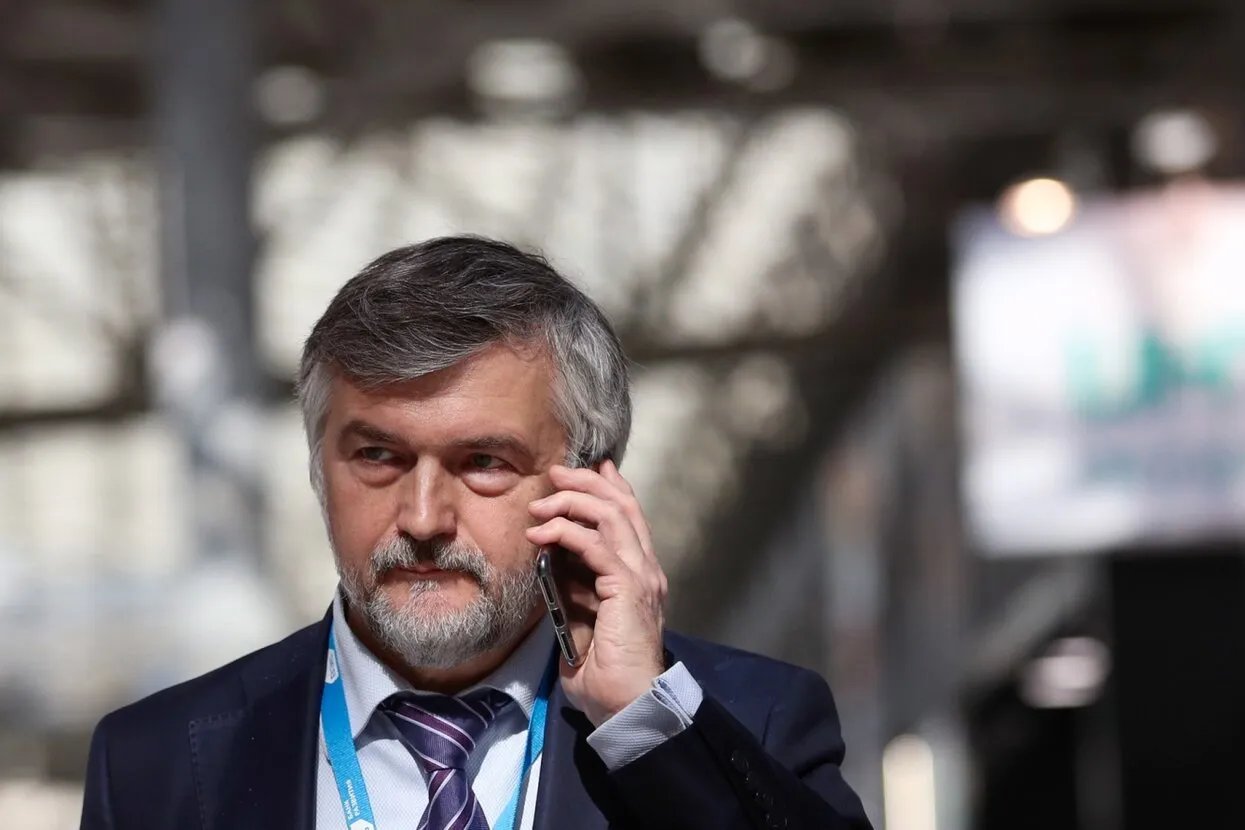
Russia’s biggest state development corp fires Andrei Klepach, its chief economist, for saying in May that Moscow is losing its war of attrition with the West, and losing it ‘in some ways’ to Ukraine
The Russian state development corporation VEB.RF has fired its chief economist, Andrey Klepach. The corporation dismissed him over “harsh personal assessments” of Russia’s economic and political development — views that did not match VEB.RF’s own position, an acquaintance of Klepach’s told the Russian business daily Vedomosti. VEB.RF head Igor Shuvalov removed Klepach from his post after a phone call from higher up, according to one of The Bell’s sources. The independent Russian outlet was the first to report the firing.
Klepach lost his job over remarks he made at a meeting of the Moscow Exchange’s Nikitsky Club, another of The Bell’s sources said. He delivered them back in May, but they drew wide attention only this month. The Russian-language service of The Moscow Times was the first to notice them, and on August 14 it published a story headlined “Kremlin’s Top State Bank Predicts Russia’s Defeat in Economic ‘War of Attrition’ With the West.” The story spread to many other outlets, and VEB.RF fired Klepach on August 16.
“In this war of attrition, we’re not going to come out ahead,” the economist said in those remarks. Russia would not collapse even under the weight of the war, isolation, and sanctions, Klepach said, but it would lose the technological and economic race — “and not only to China and the United States, but in some ways to Ukraine as well.” Costs and imbalances in the economy would keep growing, he said, and could in the end produce a serious social crisis. Describing that crisis, Klepach drew parallels to Russia’s February Revolution of 1917 and the collapse of the Soviet Union in 1991.
“You see, whatever we do with our economy, it will survive. In that sense, there’s no critical point for the economy. But there are losses: investment has fallen, and there’s no growth, let alone growth in productivity. You can raise productivity with some organizational changes, but that’s no cure-all, and the effect is short-lived. The problem, rather, is that we’re falling behind. We’re losing both the technological and the economic race worldwide. And, as I’ve said, we’re losing it not only to China and the United States — in some ways we’re losing it to Ukraine, however unpleasant that may be for me, too.
“Ukraine’s economy, of course, has been partly destroyed, and there’s a demographic catastrophe. But, again, the Ukrainian economy is surviving despite everything. Of course, there’s enormous financial aid there, and without it everything would have collapsed. Aid on that scale — for military spending and their own spending — comes to almost 50% of our budget. And if you take all the aid together, it’s many times greater than our capital outflow. So we’re financing the world, and the world is financing Ukraine. The Western world, at any rate — the unfriendly one.
“That’s why we won’t come out ahead in this war of attrition. We’re under the illusion that everything over there will collapse. It hasn’t collapsed and it won’t. Our costs keep rising. Public opinion polls show that the quality of health care is getting worse. In science and technology, things are very uneven. In some areas we have results and breakthroughs, but overall, in my view, we’re losing the competition, not winning it. Inequality problems are mounting. After a significant decline in 2023 and 2024, everything has now gone the other way.
“In my opinion, the economy will hold up, but a social crisis could arise — and precisely when no one particularly expects it. And let me remind you, no one expected the February Revolution either. Lenin wrote in December 1916 that ‘we won’t live to see it,’ but he lived to see it just a few months later. As for the situation in the Soviet Union in 1991, it took us a long time to get there, step by step, and everyone understood we were heading for a crisis, but there was nothing inevitable about the Union’s collapse.
“I believe Russia won’t fall apart, but I’m almost certain we’ll end up in a social crisis. Economically we won’t collapse, but we’ll keep falling further behind, with all the consequences that entails.”
More from Klepach’s remarks at the Nikitsky Club:
- “Yes, poverty here is falling. But the disparity between the poorest regions and the richest isn’t shrinking — it’s growing. The gap between Ingushetia, on one side, and St. Petersburg and Moscow, on the other, is in fact widening.”
- “Our monetary policy is unique: we’re at war, spending a ton of money on defense, and squeezing the economy — the civilian sector above all — with sky-high borrowing costs. There are no other historical examples of this kind of policy in wartime.”
- “From what I can judge, there’s some anxiety in the government, and it’s growing. But it has more to do with public opinion polls, which show that support for United Russia is falling and the president’s approval rating has started to decline — and with how much of that is because of the economy, how much to the problems with Telegram, to fatigue with the ‘special military operation’ [the Kremlin’s term for its full-scale invasion of Ukraine], and so on. From my experience at various closed-door events, they’re more sensitive to polling data than to macroeconomic indicators.”
- “You can’t imagine the level of disrespect for statistics among the country’s top leaders. We won’t name names.”
Klepach is one of the best macroeconomists still in Russia, according to Alexandra Prokopenko, a senior fellow at the Carnegie Russia Eurasia Center in Berlin, and the journalist Georgy Bovt. “Only paid propagandists — not respected economists — could fail to see a problem in growth rates barely above zero, a two-speed industrial sector, and falling investment alongside rising unproductive defense spending,” Prokopenko told The Bell.
Klepach has always been cautious but honest in his assessments, the economist Igor Lipsits told the Russian-language network Current Time. Klepach told the truth this time as well, Lipsits said, and that’s why he “got into trouble.” The economist Nikita Krichevsky, however, said there was nothing politically seditious in Klepach’s report overall: “Trivial, fluffy pronouncements with no analysis of causes or consequences, no verification of the data. … Putin talks about the current situation in the same tone (!). The one to blame for all the troubles, according to Klepach (and not only him), is Russia’s central bank. Quite the ‘revelation.’”
Klepach spent 12 years as VEB.RF’s chief economist. Before that, he served eight years as one of Russia’s deputy ministers of economic development. He also teaches at Moscow State University and has written dozens of academic papers. Some are studies in his own field of macroeconomics and forecasting. Others are far more contentious. One paper links Russian history to cycles of solar activity; another says Russian civilization “shows clearly marked features of a cosmoplanetary world.”
At Meduza, we are committed to transparency about our use of artificial intelligence in the newsroom. The story you’re reading was written by one of our living, breathing journalists and translated from Russian using an AI model configured to follow our strict editorial standards. This translation process is the result of extensive testing and refinements to ensure our English-language coverage is timely and accurate. A Meduza editor reviews every draft before publication.
If you find any errors in this translation, please contact us at reports@meduza.io.
To read Meduza’s exclusive content in English, please subscribe to our newsletter.
What is this?
A nonprofit organization affiliated with the Moscow Exchange that hosts discussions featuring leading Russian economists.
SVO
“Special military operation” is how Russian authorities and propaganda refer to the Russia–Ukraine war.