Ex-Marine Robert Gilman tried to get out of a Russian prison by volunteering for the invasion of Ukraine. He got out on humanitarian grounds instead — so what does Putin want in return?
Russia has released Robert Gilman, a 32-year-old American whom a court had sentenced to 10 years in a penal colony. Gilman was detained in Voronezh in January 2022. According to the Russian authorities, he kicked a police officer in the leg after being pulled off a train for causing a drunken disturbance. The court first gave him four and a half years, then raised the term to 10 over claims that he had attacked guards and an investigator behind bars.
Gilman said his troubles began with poisoned vodka. He said he remembered little about the incident with the police officer in Voronezh. He acknowledged drinking vodka and said something may have been added to it. There were at least five attacks on officers of the Federal Penitentiary Service and the Investigative Committee, Russia’s main federal investigative agency. One sent someone to the hospital. Gilman cited abuse in prison and attempts to keep his conditions from worsening.
Robert Gilman in court in Voronezh. August 11, 2025.
Vladimir Lavrov / Reuters / Scanpix / LETA
Gilman’s family has insisted that he ended up behind bars solely because of his citizenship. His father, Vladimir Gilman, said in 2024 that his son had struck the officer accidentally while he was sick, had caused no serious injuries, and had still received a near-maximum sentence. The accusations of fights in the penal colonies and the pretrial detention center, he said, were the result of provocations meant to bring new charges against his son. He was convinced Robert had been convicted unlawfully so that Russia could later trade him for one of its citizens imprisoned in the United States, and he urged Washington to press for his son’s release.
Robert Gilman has Russian roots. According to his family and to Gilman himself, his parents are from St. Petersburg, he was born in Poland, and he had spent his entire life in the United States. He served in the U.S. Marine Corps and then taught English. He ended up in Russia in transit: he was flying to Moldova for work when he fell ill at the airport and had to stay to get treatment and replace his passport. Somewhere in the process, he got the idea of applying for Russian citizenship. In court, he spoke both English and Russian, and he once quoted, perhaps unwittingly, a meme well known to Russian speakers. “I really regret it. I was just walking toward success. And I find that from now on I will keep walking toward success,” he said in Russian.
Gilman asked to be sent to fight in the war against Ukraine, and he said staff at his pretrial detention center had put him up to it. At a hearing in April 2026, he abruptly announced that he wanted to be sent to fight in the “special military operation,” the Kremlin’s official term for the war. “My father served in Russia, his father served in Russia. My great-grandfather was a captain third rank and took two bullets at Stalingrad. So I believe I’m fully fit for service and am following in their footsteps,” he told the judge. She advised him to take the matter to a military enlistment office. Gilman replied that detention center staff had suggested he make the statement in court specifically. He had said earlier that he had pleaded guilty in the case involving the police officer because he had been promised a lighter sentence that never came.
Gilman’s family has long expressed concern about his health. A week ago, news broke that he might be dying. Global Reach, the human rights group that represented the family, said that Gilman had long been pumped full of unidentified drugs and that in June 2026 he had been admitted to the psychiatric ward of a civilian hospital in a state of dissociative stupor. He could not communicate, was being fed through a tube, and his life was in danger, the group told Reuters. The Reuters report also showed that U.S. officials were already working on the case: on July 23, Secretary of State Marco Rubio raised Gilman’s release with Russian Foreign Minister Sergey Lavrov.
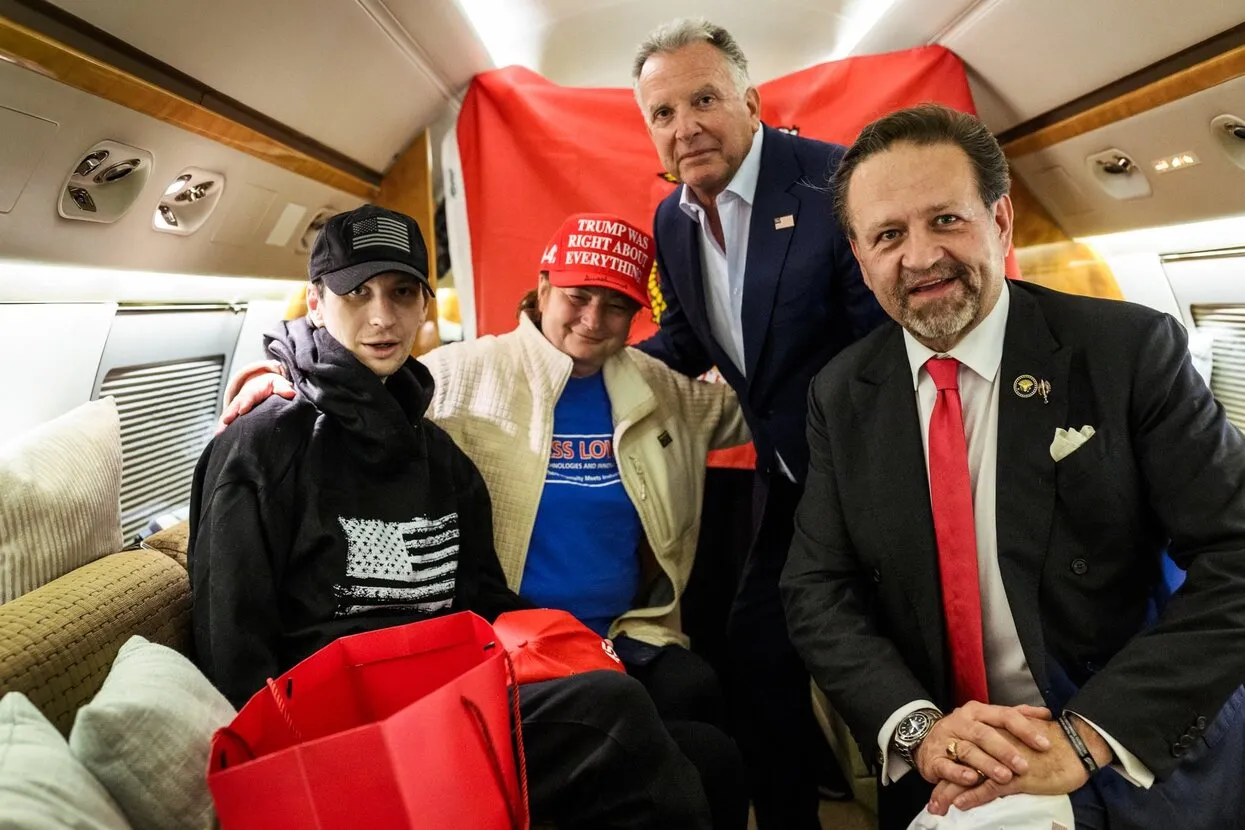
Gilman was released soon afterward. On August 12 — six days after the Reuters report on the threat to his life — Steve Witkoff, Donald Trump’s special envoy, posted photos of Gilman and his family aboard his own plane. Witkoff has flown to Russia repeatedly for talks with Vladimir Putin. Gilman looks severely emaciated in the pictures, but he is conscious and smiling. After arriving in the United States, he was scheduled to be sent to a military hospital in Texas for a medical and psychological evaluation, Global Reach representatives told The New York Times.
Steve Witkoff / X (Twitter)
Trump said Putin had released Gilman on humanitarian grounds and had asked for nothing in return. Ivor Bennett, the Moscow correspondent for Sky News, found that suspicious. “For now it’s a gift, but Russia will undoubtedly be hoping for something in return,” he wrote, suggesting that Moscow wants to win back Trump’s support in its negotiations with Kyiv. Dmitry Drize, a political commentator for Kommersant FM, also said the release could be groundwork for a new round of talks with Washington on peace in Ukraine.
Five more Americans remain imprisoned in Russia, according to Global Reach. One of them is Steven Hubbard, 73, who was detained in 2022 during Russia’s occupation of Izium, in Ukraine’s Kharkiv region, and accused of taking part in Ukraine’s territorial defense. A Russian court sentenced him to nearly seven years in prison. Ukrainian prisoners who were held with Hubbard and later released have described how he was mistreated.
At Meduza, we are committed to transparency about our use of artificial intelligence in the newsroom. The story you’re reading was written by one of our living, breathing journalists and translated from Russian using an AI model configured to follow our strict editorial standards. This translation process is the result of extensive testing and refinements to ensure our English-language coverage is timely and accurate. A Meduza editor reviews every draft before publication.
If you find any errors in this translation, please contact us at reports@meduza.io.
To read Meduza’s exclusive content in English, please subscribe to our newsletter.
With what?
Vladimir Gilman did not say what illness his son had at the time. Senators Edward Markey and Elizabeth Warren, who asked the U.S. State Department to secure Gilman’s release, said the American struck the officer while he was vomiting.
Is that true?
Yes. Following the Voronezh incident, Robert Gilman was convicted under Part 1 of Article 318 of Russia’s Criminal Code, which bars violence against a government official. The statute allows for penalties ranging from a fine of less than 200,000 rubles to five years in prison. Gilman received four and a half years in a penal colony — near the maximum — despite pleading guilty, apologizing to the officer, and paying 15,000 rubles in compensation.
What is that?
A state in which a person stops moving, speaking, and reacting to outside stimuli, with no illness or injury that could explain it. Dissociative stupor is considered a reaction to severe stress.
Why?
The family said Gilman’s passport was damaged while he was unconscious at a Russian airport.
СВО
«Специальная военная операция» — так власти РФ называют вторжение российских войск в Украину.