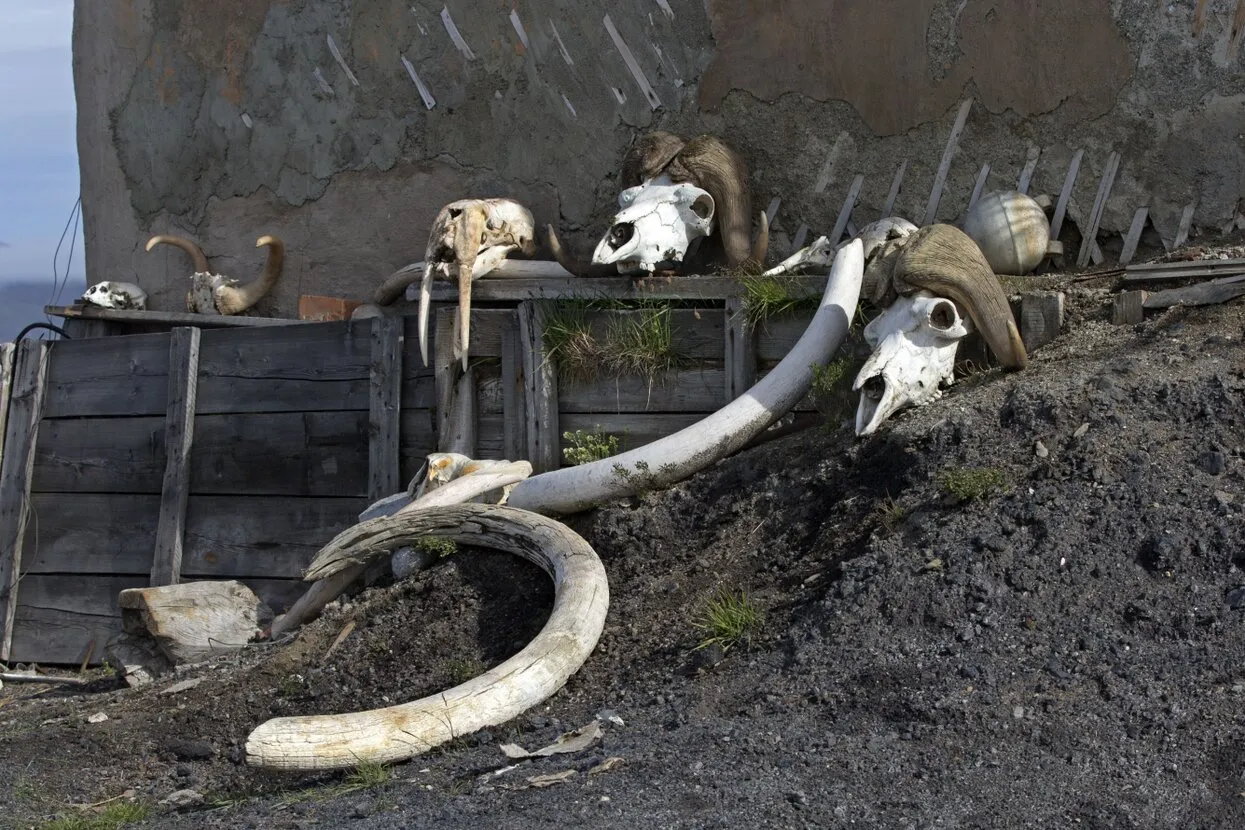
Where did the ivory trade go after China banned elephant tusks? North, into the Russian permafrost — where an estimated 10M frozen mammoths lie waiting, and a kilogram of tusk fetches up to $1,900.
Mammoth tusks came to be known as “ethical ivory” after China banned imports of elephant tusks in 2017, closing the market that elephants were being slaughtered to supply. China and Hong Kong are home to the world’s most developed tusk-carving industry, in which a single piece can sell for as much as billions of rubles (tens of millions of dollars). Meeting that demand fell to Yakutia‘s tusk hunters, who dig the frozen ivory out of the permafrost. The independent Siberian outlet People of Baikal describes how this punishing trade works — and what the hunters may be costing science and themselves. Meduza has translated the story in full.
Some names were changed at the request of the people involved.
part one.
‘Ethical ivory’
part two.
The curse of the earth rat
part three.
Into the tundra with your own toilet
part four.
A deep blue tusk
party of five.
Moving underground through sticky slurry
part six.
A bulldozer in a skirt
part seven.
How scientists tried to ‘resurrect the mammoth’ and turn it into a meatball
part eight.
The path to a mammoth begins with an application to the Federal Security Service
part nine.
‘Let something remain for our descendants’
A mammoth tusk fresh out of the ground smells like a wet dog. It has lain in the permafrost for tens of thousands of years, barely changing. But once it’s hauled out into the sun, the countdown runs in weeks, and even in days, before it dries out and cracks. Hunters race to sell it before it loses value.
Yuri trudges along the sticky shoreline with a probe — a long metal rod. He looks about 50, dressed in khaki, with thigh-high rubber waders and a rifle slung across his back. “It should sound like tysh-tysh. When the probe hits bone, it makes a ringing sound. But when the sharp tip goes into wood, it gets stuck and makes a dull sound instead: tuk-tuk,” Yuri says.
A mammoth tusk is easy to mistake for a piece of wood. Locals sometimes call tusks “horns,” though they’re actually the incisors of an animal that died out 4,000 years ago. The permafrost has held the remains ever since, like a freezer. Researchers estimate the ice may hold around 10 million mammoth carcasses. Stocks of tusks still in the ground may reach half a million metric tons.
Mammoth remains surface when permafrost thaws or erodes. Tusk hunters spend whole days walking the ocean shore, following the ravines and tapping the ground with their probes, dreaming of the treasure that might lie beyond the next hill. The simplest method — searching “by eye,” as locals call it — requires nothing more than a metal probe.
Yuri found his biggest tusk by eye as well — about 85 kilograms (187 pounds), near a mountain river. He won’t say what he sold it for, only that an intact, crack-free tusk weighing 100 kilograms (220 pounds) or more goes for around 3 million rubles (about $36,000).
A kilogram of pervach, the top grade, can bring a hunter 40,000 rubles (about $485), and the price climbs higher when both tusks from the same mammoth turn up together. Second grade — intact tusks that have already sat in the sun and cracked — sells for about 15,000 rubles (about $180) a kilogram. The lowest grade, shchepa, or splinters, means tusks that have crumbled into fragments; it brings only about 5,000 rubles (about $60) a kilogram, and hunters usually leave it where it lies, since the fuel would cost more than the haul.
‘Ethical ivory’
Yuri remembers when a whole mammoth tusk could be had from reindeer herders for a few bottles of vodka. In Soviet times, his father ran a carving club at a local school and ordered craft materials from people he knew. His father died 10 years ago; Yuri keeps a red suitcase in his father’s memory.
Yuri unfolds a piece of velvet and lays out several dozen figurines his father carved with his students: a polar bear and a dog the size of a matchbox, an ancient warrior with a spear and shield, a reindeer herder saddling his mount. One piece, carved from a chunk of tusk, shows a battle scene: revolutionaries rising up.
“There used to be a lot of them lying around,” Yuri says. Tusks turned up right underfoot. People made them into souvenirs, knife handles, boxes, and jewelry, and decades ago tusks even went into small parts for airplanes and radios, prized for not conducting electricity. Once plastics and composites came along, manufacturers dropped them.
A figurine of the warrior Nyurgun Bootur carved from a mammoth tusk
Viktor Chernov / the Russian state news agency RIA Novosti / the Russian state propaganda outlet Sputnik / Profimedia
Mammoth tusk prices jumped after China banned the import and sale of elephant ivory at the end of 2017. Until then, Chinese bone-carving factories had been buying elephant ivory. In Europe and North America, ivory went into piano keys, billiard balls, jewelry, and even medicine — a trade that killed roughly 75,000 elephants a year.
By the end of the 1980s, the African elephant population had been cut in half, to around 600,000 animals. Countries party to the Convention on International Trade in Endangered Species, or CITES, responded by banning the ivory trade, and the United States, France, and China — the biggest markets — gradually adopted domestic bans of their own.
Ivory sellers and manufacturers sought a substitute, and top-grade mammoth tusk proved the perfect fit. Its creamy white color earned it the nickname “ice,” or “ice ivory,” and it works almost exactly like elephant ivory. The only way experts can tell the two apart is by their Schreger lines, the barcode-like pattern on a tusk’s cross-section.
But most important of all: no one has to kill anything to get mammoth tusks. The animals died on their own long ago, traders reasoned, so mammoth ivory fell outside the CITES ban and could be traded legally. Sellers began marketing it as “legal,” “ethical,” and “not linked to killing animals.” Northern Yakutia — the banks of the Yana, Indigirka, and Kolyma rivers, plus the New Siberian Islands — supplies 80 percent of the mammoth tusks on the world market. The remaining 20 percent is found in other regions of Russia — Chukotka, the Magadan region, and Taymyr — and in North America, in Alaska and Canada.
Up to 97 percent of tusks from Russia are shipped to China and Hong Kong, where a kilogram can bring up to $1,900 — several times what it fetched coming out of the Arctic.
The curse of the earth rat
“You should never search for or dig up tusks! In the old days, that was a grave sin!” Vera Rozhina, an elder of the Yukaghir people, exclaims, then cuts the conversation short. Born and raised in the village of Yukagir, she now lives in Kazachye. Old-timers here forbid not just searching for mammoths but talking about them at all. The animal’s name in the Yukaghir language is made up of two roots: “kholg,” meaning mammoth, and “ol,” meaning death. Legends passed down through generations warn that anyone who disturbs the sacred giant’s thousand-year sleep will be cursed and die soon after. Certain death awaits not that person alone but the whole settlement.
For most northern peoples, the mammoth is tied to evil spirits and the underworld of death. Only shamans could take its bones — for use in rituals for traveling to the Lower World, for example. The Yakuts call the mammoth the Water Bull (Uu ogusa). The Nenets describe it as a giant rat afraid of light, tunneling through the depths with its huge tusk-horns.
As long as the mammoth stays underground, it is alive; the moment it surfaces, breathes air, or sees sunlight, it dies instantly. That is how Yakutia‘s Indigenous legends explain why people find only carcasses and bones, often jutting out of the ground along riverbank bluffs.
For Indigenous peoples, the mammoth is a magical creature that literally shaped the land. Evenki and Even legends say that when nothing existed but water, the giant pulled lumps of clay and earth from the bottom to create dry land. According to a Sakha legend, the mammoth grew so heavy that it gouged the Earth with its tusks and the world nearly tipped over under its weight — for which a supreme deity punished it by turning it to stone, or, in another version, driving it underground.
Over time, the biblical story of the Great Flood worked its way into local mammoth legends. Ethnographers have recorded several versions among the Sakha people, including one in which the mammoth tried to board Noah’s Ark and nearly capsized it. To keep the ark and the other animals from sinking, Noah pushed the mammoth away, and it drowned.
The Russian authors of Giants of the Ice Age recount the story of Khristofor Struchkov, a hunter from the village of Suturuokha. His luck was extraordinary: he handed 30 top-grade tusks to the state and reported two valuable finds to scientists — the Tirekhtyakh mammoth, discovered in 1970, and the mummified remains of the Mylakhchin bison, found in 1971. Struchkov became famous, and in the summer of 1971, journalists from national newspapers, paleontologists, and writers flew out to his hunting cabin.
Soon after, Struchkov — energetic and to all appearances healthy — fell ill and died. The story went that his children had returned a 700-ruble bonus the authorities had given their father, hoping the illness wouldn’t pass to them. In fact, no one returned anything: Struchkov’s story had simply become another folk myth about the mammoth’s curse. What actually killed him is unknown.
The Yakuts used to sacrifice and bury an entire reindeer to pay the spirits for a large tusk. For a small one, they buried money or scraps of fabric. Modern tusk hunters have adapted this ritual, known as sir belege, “gift to the earth.” Ahead of a hunt, they order strings of colorful Chinese plastic beads from an online marketplace, break them apart, and scatter the beads into a river or ravine.
“Do you need some kind of spell or prayer for the ritual?” we ask Yuri.
“We’re northern people; we don’t speak loudly. We commune with the spirits silently, inside ourselves. We thank the spirits and the earth for giving us their material.”
Into the tundra with your own toilet
At any given time, 100 to 200 crews are out searching for mammoth tusks in Yakutia‘s Arctic districts. The season runs from June to October. With no roads across the tundra, hunters travel by boat, working the few months when the rivers — the region’s main transport routes — are free of ice.
The Laptev Sea coast, where most of the searching happens, is divided into zones among local Indigenous communities. Even so, people from Yakutia and other Russian regions turn up to hunt every year, along with groups from Belarus, Kazakhstan, and sometimes farther afield. Hoping to find enough tusks to get rich, some take out loans and sell their apartments.
“I don’t understand people who take out loans and use that money to go after tusks. Nobody buys lottery tickets on credit! Searching for tusks is very hard, hard psychologically. It’s a lottery. You can spend the money, make the investment, and find nothing. You can end up not just earning nothing but going into the red,” Yuri says.
Preparations for an expedition begin months in advance. Men form crews of three to five. Equipment, fuel, and food are hauled in ahead of time along a winter road from Yakutsk, 1,000 kilometers (621 miles) away. If something turns out to be missing once the expedition is underway, there’s nowhere to buy it.
Excavation of mammoth remains in the Yamalo-Nenets autonomous district, July 24, 2020
the Russian state news agency TASS / Profimedia
Tusk hunters carry mammoth bones on the shore of Lake Pechevalavato near the village of Seyakha, Yamalo-Nenets autonomous district
TASS / Profimedia
A crew needs about 1 million rubles (about $12,000) to get through the season. “Just count it up: you need half a metric ton (about 1,100 pounds) of gasoline with you and enough food for several months. The boat needs a good motor, imported, preferably Japanese. And all of that cargo has to come from Yakutsk,” Yuri says.
Expedition members live in tents, and the earnings are usually split evenly. When the season ends, the crews go back to their regular lives: Yuri teaches computer science; most locals hunt, fish, or herd reindeer.
Outsiders usually work alongside locals, because without someone who knows the tundra, it’s easy to get lost or run into trouble in the Arctic. Yuri recounts, smiling, how one inexperienced newcomer shipped a portable toilet up the winter road along with the necessary cargo, saying he wasn’t used to living without amenities. When the season opened that summer, the crew used the toilet a few times and then left it behind in the tundra.
Finding tusks takes some “luck,” Yuri says, but locals know quite specific places where parts of a mammoth can be found: the ravines and fissures along the sea coast. With good fortune and sensible planning, a hunter can come out of a single season with enough to buy an apartment.
Yuri’s older son, 23, already knows how to search for tusks. The younger one is training to be a pilot, and his daughter is still in school. Yuri says he’d like his sons to do what he does but has no intention of pushing them: “Let them decide for themselves. It’s their fate.”
The money from tusks lets Yuri live the way he wants. When his younger son finished school, Yuri surprised the whole family with tickets to Sochi, which he had bought well in advance.
His younger son will remember that trip for the rest of his life: at an amusement park, he made his first bungee jump. “Before that, he was afraid of heights. Good for him — he beat the fear,” Yuri says proudly. But after a couple of weeks away, Yuri starts missing home. “Nature,” he says.
A deep blue tusk
Searching for tusks isn’t just expensive — it’s dangerous, and locals say so constantly. Out at sea, a boat can capsize or break down. The hunters here are called bivnists, from bivni, the Russian word for tusks, and they risk running into polar bears. Crews clash over territory, sometimes to the point of gunfire and knife fights. Within a single crew, fights break out when it’s time to split the earnings.
“Our territories are huge. People go missing; it happens,” says Sergei, a local resident. He recalls an incident from several years ago: two friends went out after tusks, and only one came back. At home, he said his companion had gone off somewhere in the boat and that he had never seen him again. What really happened to the missing man, no one knows.
On one of his first tusk-hunting trips, 20 years ago, Yuri traveled more than 200 kilometers (124 miles) with his companions. They landed on one of the New Siberian Islands in northern Yakutia, known for its mammoth graveyards, and while they searched the shore, waves carried their boat off and smashed it. “Remember Robinson [Crusoe] from the book? That’s what we were, Robinsons. A real storm blew in, the waves tore loose the rope we’d tied the boat with, and it got thrown into a ravine. We were beginners then; we didn’t know you’re supposed to leave someone with the boat and the supplies,” Yuri says.
They found the wrecked boat below the ravine about 5 kilometers (3 miles) from where they’d landed. Only the canned meat and the pasta survived — the meat sealed in tins, the pasta in a plastic bag in the glove compartment. The ammunition got wet.
“The bread was covered in sand. We’d scrape the edge off with a knife and eat it. You could feel the grains crunching between your teeth,” Yuri says. They pitched a tent for the night, and the next morning, as Yuri was taking it down, he noticed something beside it that looked like a piece of wood sticking out of the ground. It was a large tusk, weighing 65 kilograms (143 pounds).
All that remained was getting off the uninhabited island. They spent several days there, climbing a hill to watch for a passing boat. When a motorboat finally appeared on the horizon, the “Robinsons” started shouting and waving their arms. “Our shouting sounded like the noises Arctic foxes make. It was autumn, and that’s exactly when Arctic foxes bark and howl. ‘Listen to those foxes carrying on!’ we joked at the time,” Yuri says with a satisfied smile.
The motorboat slowed, and the helmsman switched off the engine to listen. Once the hunters were sure they’d been heard, they fired several shots into the air. These were the last of the ammunition they’d brought with the rifle.
“They picked us up. We were overjoyed!” Yuri says.
“And what about the tusk? Did it wait for you?”
“Ah, the tusk. Of course it waited. It can’t run, after all,” Yuri says, still joking. And again he dodges the question of what he sold the find for, adding only that the tusk was a rare color — a deep, deep blue. Scientists explain that over thousands of years in the permafrost, a tusk soaks up minerals, chiefly vivianite. The more unusual a tusk’s natural pattern and shade, the more it is worth; blue tusks are considered the most valuable of all.
After that adventure, Yuri prepared more carefully for his trips: he watched the forecast and the wind direction, and he stopped leaving the boat on the shore.
Moving underground through sticky slurry
Hills sliced in half, riddled with gaping holes: that is what a place worked by tusk hunters looks like. It is as if unknown creatures really had tried to claw their way out of the underworld, boring multilevel tunnels through the icy hills. Against those unearthly surroundings, a person looks like a grain of sand. Amos Chapple, who spent three weeks in Yakutia with the hunters, photographed the work.
Armed with fire hoses, the hunters wash the ice away centimeter by centimeter. The tunnels run dozens of meters (100 feet or more) deep. They move underground in waterproof suits, coated head to toe in sticky slurry, while outside, gasoline pumps rattle and spit clouds of smoke, drawing water from the river and forcing it through the hoses under pressure. The runoff — dirty water mixed with icy slush — goes back into the river.
Yuri describes another method that appeared a little over a decade ago: diving for tusks with scuba gear. One or two members of a crew put on the gear, go down into a river or lake, and work the slopes and the bottom with their probes.
It’s the most expensive method. A single wetsuit can run 150,000 rubles (about $1,800) or more; a tank starts at 50,000 (about $600); and crews also need spare tanks, compressors, and other equipment. Putting an expedition like that together takes even more money, Yuri says — around 2 million rubles (about $24,000) for gear, spare parts, fuel, and a season’s food. But there’s less competition.
Children on the bank of the Kolyma River in the Yakutian village of Zyryanka, July 5, 2019
Michael Robinson Chavez / The Washington Post / Getty Images
Yuri and his crew are self-taught, having learned in local lakes. They usually search river bends or spots where the bank has washed out, going down as deep as 9 meters (30 feet). Each dive lasts about an hour, as long as the tank holds out. A diver can manage five dives in a day at most; doctors advise no more than three or four.
At least one crew member always stays in the boat to watch the dive and pull the divers out in time. In recent years, crews have turned more often to underwater drones with cameras: someone in the boat pilots the drone and looks for tusks, and the divers go down only to bring a find up.
A recovered tusk is cleaned of dirt, wiped dry, and “stabilized” — sealed in a vacuum bag. Because a tusk has only days before it starts to spoil, hunters line up buyers in advance. When the boats come in, a box-bodied UAZ van is waiting right at the water’s edge. The hunters unload the goods and take the money. What becomes of the tusks after that doesn’t interest them.
A bulldozer in a skirt
Buyers pay more when hunters dig up not a single tusk but a matched pair from one mammoth. Hunters usually take only the tusks and leave the carcass lying in the ground or on the surface.
When hunters come across a carcass, they may feed the meat to their dogs. In Soviet times, when the republic employed Arctic fox trappers — state farm workers who harvested the then-valuable fur on state orders — mammoth meat was used as bait. Today, besides tusks, collectors and dealers occasionally order teeth, bones, or other parts of a carcass.
Yuri once saw the remains of a whole mammoth inside a crack on Soplivaya Mountain, about 130 kilometers (81 miles) up the Yana River from Kazachye. In summer the icy mountain thaws and a mix of earth and water runs down it — hence the name, Soplivaya, or “Snotty.” “The water washes the carcass and the bones come through to the surface. A mammoth is easy to recognize once you’ve hunted tusks a lot and seen a lot of remains. Big bones, long fur… how could you not know it!” Yuri says.
People from Moscow once contacted him and asked him to collect three sacks of mammoth fur. It was an unusual order. “I said no. Think about it — how am I supposed to get that fur? One guy collected some, knitted a hat out of it, and sold it for $10,000,” Yuri says.
The story sounds like a tall tale, but it checks out. Media outlets reported on Vladimir Ammosov, a construction worker from Yakutsk, and published photos of the hat. He got a certificate of authenticity from the mammoth museum in Yakutsk, and the museum’s director, Semyon Grigoriev, confirmed the hat really was made of mammoth fur. “It’s the scratchiest hat I’ve ever put on. It has no smell at all,” Ammosov told reporters. In the photo, the hat is dark brown.
Illustrations usually depict mammoths as reddish-brown. But modern research suggests their coats ranged from dark brown to cream. Genetic studies confirm that at least some animals were light-colored.
Long fur over a thick undercoat covered the mammoth’s whole body. On the flanks and belly, the strands reached a meter (3 feet) in length, forming a warm “skirt.” On the neck and withers sat a fatty hump, like a camel’s. Mammoths stored nutrients in summer and spent them through the hungry winter.
Tusks — greatly enlarged upper incisors — grew throughout a mammoth’s life and curled inward like a corkscrew. In adult males, they reached 4.5 meters (15 feet) in length and weighed up to 140 kilograms (about 310 pounds). The animals used them like bulldozers, shoving snow aside to get at food. Calves were born with milk tusks a few centimeters long, which later fell out and were replaced by permanent ones.
Entrepreneur Pavel Mukhoplev shows mammoth tusks stored in his warehouse in Yakutsk, March 31, 2017
Sergei Karpukhin / Reuters / Scanpix / LETA
Mammoth tusks at a jewelry and bone-carving workshop in Hong Kong
Bobby Yip / Reuters / Scanpix / LETA
Like modern elephants, mammoths probably lived in family herds of 8 to 20 animals, led by an adult female, while adult males kept to themselves.
The animals traveled long distances in search of food, trampling wide paths that early humans later followed. Adult mammoths stood up to 3.5 meters (11.5 feet) tall and weighed as much as eight metric tons (about 17,600 pounds). The giants were long-lived, reaching 75 or 80 years.
Modern research doesn’t support the familiar image of early humans as mammoth hunters. More often, people were scavengers: they ate the meat of mammoths that had already died and finished off the weak and the wounded.
During the last ice age, mammoths lived from the Atlantic to the Pacific. Their traces turn up in Spain, France, Germany, Poland, Russia, Kazakhstan, Mongolia, China, Alaska, and Canada. But nowhere are they preserved as well as in the permafrost of Yakutia.
How scientists tried to ‘resurrect the mammoth’ and turn it into a meatball
In May 2013, Semyon Grigoriev, the mammoth museum director from Yakutsk, set out for the Arctic with his assistants on snowmobiles and all-terrain vehicles.
“I had an overwhelming urge to taste it,” Grigoriev says, scraping fur and dust off pieces of meat with a knife. The slices are pink, with ice crystals inside — a sign the mammoth froze immediately after it died.
“The meat’s a bit tough,” Grigoriev says, studying two pieces on a white napkin in front of him. He sniffs one, then takes a small bite. “I’m probably the only person in the world who has tasted raw mammoth meat,” he says solemnly to the camera.
Mammoth meat tastes like slightly rancid dried reindeer meat, one resident of the village of Yukagir tells People of Baikal. He found a mammoth carcass while searching for tusks and cut off a piece to try. Not exactly a delicacy, but not disgusting either.
The mammoth Grigoriev tasted had lain in the ground on Maly Lyakhovsky Island for some 30,000 years, preserved in the permafrost as if in a good freezer. A hunting crew took its tusks. One of the hunters was Grigoriev’s brother, Pyotr, who reported the find to researchers at the university in Yakutsk and agreed to hand over the tusks. Tusk hunters don’t usually do that. Hunting sites are strewn with the skulls and bones of mammoths and other animals: the tusks are taken and the rest is mostly discarded, with rare exceptions.
As the carcass was being chipped out of the permafrost, a dark red liquid suddenly began to flow from it. “I hit it once with a pickaxe under the belly. Pfft — something started flowing out, something like blood,” Pyotr says. “It was astonishing! Nobody had ever seen anything like it. How can mammoth blood be liquid, and in that kind of cold!” his brother Semyon says, unable to contain his excitement.
The carcass was pulled out of the ground piece by piece and delivered to a laboratory, where scientists determined it was a female about 55 years old. Among the tissue recovered were the nipples of an adult female. Layers inside her tusks showed she had borne at least 11 calves. That is a lot. Mammoth pregnancies lasted about 22 months, with several years between births, and over a lifetime a female could carry up to 10 calves.
Once the female was out of the ground, the expedition members performed a ritual called “putting the mammoth’s spirit to death.” “We didn’t dig you up for money. This is all for science,” Grigoriev recited as a kind of “prayer.” They lit a fire at the bottom of the pit and “fed” it a few pancakes. Then the members of the expedition took turns walking up to the fire and throwing colored beads into it.
“That’s the best gift for the spirits. We did it to appease the mammoth’s spirit, so it wouldn’t be angry at us for pulling it out after 30,000 years,” Grigoriev says. He concedes that asking spirits not to punish the people who disturbed a sacred creature’s rest is superstition. ”[But] sometimes you think: there really is some kind of connection,” Grigoriev says.
The find from Maly Lyakhovsky Island became a worldwide sensation. In the laboratory, scientists found that the liquid from the carcass contained blood cells with traces of hemoglobin. Foreign researchers started coming to Yakutia.
The South Korean specialists at Sooam Biotech, a lab that did commercial dog cloning, were especially interested. They tried to find living mammoth cells, extract their nuclei, and transplant them into Asian elephant eggs to produce a live embryo. It didn’t work out. No living cells had survived in the liquid, and the scientists never found an undamaged cell nucleus to clone from.
How mammoth cells from Yuka were transplanted into mice
In 2019, scientists from Russia and Japan conducted an experiment with cells from a woolly mammoth named Yuka, another female preserved in the permafrost of Yakutia. She was about eight years old when she died, and she lay frozen for some 28,000 years. Using a technique roughly similar to that developed for cloning, the international team transplanted mammoth cells into mouse egg cells to see whether the cells retained any biological activity.
The researchers observed that some processes in the transplanted cells still began: proteins began to gather around the nuclei, structures associated with cell division took shape, and the cell itself tried to “recognize” the ancient genetic material. But no full cell division occurred. The mammoth’s DNA had been damaged too badly by thousands of years in the permafrost.
The scientists concluded that cloning a mammoth with current technology is impossible. Their other finding was that traces of biological activity within cellular structures can persist for tens of thousands of years in permafrost. For the researchers, that was an important step — not toward “resurrecting the mammoth,” but toward understanding how long DNA can hold onto its properties.
In 2021, the American company Colossal Biosciences announced that it wanted to “bring the mammoth back” through genetic engineering: altering the cells of an Asian elephant so that calves would be born with mammoth traits — thick fur, a layer of fat, and the ability to live in the cold. The scientists spoke less of “resurrecting” the mammoth than of creating an elephant-mammoth hybrid, a mammophant. Among the people behind the project is the well-known Harvard geneticist George Church.
The project is still going. In 2025, the researchers presented a “woolly mouse” carrying mammoth genes, with long, golden, wavy fur. They expect to have the first “mammoth” elephant around 2028.
In 2023, the Australian company Vow unveiled a “mammoth meatball” at the Nemo science museum in Amsterdam — a grapefruit-sized ball grown not from real tissue of the ancient animal but from synthetic protein. Scientists took the published mammoth DNA sequence, filled in the missing fragments with African elephant genes, and inserted the resulting sequence into sheep cells. Nobody ate the meatball; its creators worried the protein might not be especially good for people.
No one has managed to clone a mammoth. The research continues, but without Grigoriev. He died suddenly seven years after the expedition, in May 2020. Grigoriev was 46. His colleagues said his death might have been linked to poisoning. Locals believe the spirits punished him: he didn’t just pull a mammoth out of the permafrost, he ate its meat. And what especially outraged the old-timers was that he filmed it.
The path to a mammoth begins with an application to the Federal Security Service
Russian law permits collecting only tusks that lie on the surface; nothing may be dug up and no ground may be washed out. Violators face fines starting at 2,000 rubles (about $25). Using motor pumps brings a penalty under Article 7.6 of Russia’s Administrative Offenses Code for “unauthorized occupation of a body of water or use of one in violation of established conditions.” If the work is also done in a specially protected natural area, Article 8.39 of the code applies, with fines of up to 500,000 rubles (about $6,000) for companies and organizations.
There are places where the penalties for illegal digging are far harsher than in Russia. In the Canadian province of Alberta, anyone who finds the bone of an ancient animal or another fossil is required to leave it where it is and report it to scientists. Digging it up yourself can bring a fine of up to 50,000 Canadian dollars and up to a year in prison — both at once.
In Russia, traveling to one of the main tusk-hunting areas — the New Siberian Islands — requires obtaining a permit from the Federal Security Service’s border service, because the islands lie in a border zone with special rules for visitors. The hunters themselves say that in practice many work without one: there are no permanent border posts out there, and inspections are rare.
Tusk hunters are also required to carry a license for collecting mammoth fauna. It costs 7,500 rubles (about $90) and grants the right to collect up to 150 kilograms (331 pounds) of remains — tusks, bones, and other fragments. A person or an organization has to register the plot where the collecting will happen and file paperwork naming who will do the searching and describing how the work will be done. Licensees are also required to keep records and document what they find. Crews usually go out “wild,” as locals say — filing no paperwork, or only part of it.
The hunters get into their boats, head out to sea, and reach the islands, where they roll out kilometers of fire hose and start up gasoline generators. “Poachers wash away the permafrost with directed jets of water. This does irreparable damage to the tundra, turns whole areas into swamp, and accelerates permafrost degradation,” said Sakhamin Afanasyev, Yakutia‘s former environment minister and now a senator, in remarks published by the Arctic Russia portal.
Officers of the Federal Security Service, the prosecutor’s office, and Rosprirodnadzor, Russia’s environmental watchdog, rarely appear in these places. “Bivnists aren’t afraid of inspectors. First of all, how would they even get here? If a boat’s coming up the river, you can hear the motor from several kilometers away. If a helicopter’s flying in, you can hear that from far off too. You can hide, and nobody will find you,” a local resident says.
Even when inspectors — environmental prosecutors or border guards — do reach a dig, the bivnists usually scatter in all directions, abandoning their haul. In December 2025, for instance, news outlets reported that inspectors on the bank of the Yana River in Yakutia found seven fragments of mammoth tusk weighing 20.7 kilograms (46 pounds). The fragments were declared ownerless and became state property.
Environmental prosecutors documented that the bank’s destruction had killed crustaceans, benthic organisms, and zooplankton living in the river. The damage to the ecosystem was put at 404,000 rubles (about $4,900). A criminal case was opened under Article 257 of Russia’s Criminal Code for violating the rules protecting aquatic biological resources, but no one was identified to be charged, and the culprits were never found. Fines are rare here as well, because catching a violator in the act across the tundra’s vast expanses is next to impossible.
On the way out of the tundra, a hunter can say he found the tusk lying on the ground. Selling it and shipping it out, though, is not so simple. Formally, a found object belongs to whoever collected it. But the finder must submit the tusk for examination by the Academy of Sciences, and if the experts determine that the specimen is unique, it goes to the state. Science values tusks that carry information about a mammoth’s life and were found without destroying the site. Museums prize rarities: unusually large tusks, intact ones, or ones with beautiful natural coloring.
Anatoly Strunin / TASS / Profimedia
The examination can take anywhere from several weeks to several months. Hunters don’t have that kind of time. Tusks that stayed intact for thousands of years can spoil in a few weeks.
Judging by the licenses issued, about 150 metric tons of mammoth remains are extracted in Russia every year, 96 percent of that tusks. There is no public information on how many experts examine the finds, or how much of that mass has stayed in museums and institutes after being deemed valuable. Research suggests that another 50 to 75 metric tons may be illegally extracted in addition to the licensed 150.
‘Let something remain for our descendants’
Wang Zhongbang, a master craftsman from Nanjing, in the Chinese province of Jiangsu, is in no hurry to cut. He studies the tusk for a long time, judging the grain direction and examining the color. From the outside, a block can look nearly perfect and still hide cracks and voids. The first cut, Wang says, is the most nerve-racking part of the job: a mistake of a few centimeters can cost him the best — that is, the most intact — section of the tusk, and nothing can replace it.
The tusk is sawed into large blocks, with cracks and damaged sections cut away. Only then is it clear how much carvable material is left. The craftsman starts working out a composition: a long, well-preserved curve becomes a dragon or a boat; a wide, massive piece becomes a mountain landscape or a multi-figure scene. Wang talks about the tusk as a living material he has to adapt to.
Wang says the switch from elephant ivory to mammoth was hard. Mammoth tusk demands more care. But it has something elephant ivory doesn’t: natural color. Over its time in the permafrost, a tusk can take on honey, amber, brown, bluish, and near-black tones, depending on the soil it lay in. Some carvers deliberately leave the colored sections untouched and work them into the composition. Cut away too thick a layer and the pigment is gone.
Carvers say mammoth tusks saved their craft. Chinese bone carving is considered one of the oldest artistic traditions in the world; it dates to the second century B.C. Without mammoth raw material, the traditional trade might simply have died out. The best examples of the art sell at auction and on online marketplaces for tens and hundreds of thousands of dollars.
Most of the tusks dug up in Yakutia go to China, where an entire industry has grown up around mammoth ivory. In Russia, by contrast, the work remains a traditional craft — the domain of small workshops and individual carvers.
A tusk carved with figures of sages and musicians sold for nearly $550,000. Some mammoth ivory pieces make their way back to Russia, where online stores present them as luxury gifts for loved ones. A multi-tiered composition called Zheng He’s Sea Voyages, for instance, is listed for sale at a cool 2 billion rubles — about $24 million.
With small objects — pendants, figurines, beads — even connoisseurs have trouble telling mammoth tusk from elephant ivory. And small objects are most of what’s on the market. Scientists obtained 79 uncarved blanks from craftsmen in Hong Kong and China; 44 turned out to be elephant tusk, the rest mammoth.
Researchers at the University of Hong Kong write that traders can use mammoth tusks to “launder” material. Elephant tusks are still smuggled into China and passed off as “ethical” mammoth ivory. Scientists estimate that 24,000 elephants a year are killed worldwide for their tusks. Mammoths, then, have become cover for the illegal trade in elephant ivory. Some U.S. states have already banned trade in mammoth tusks for that reason.
Russian scientists estimate the damage from the illegal tusk trade at billions of rubles a year. But the loss of information matters far more. The permafrost is an enormous archive. It holds a record of processes that unfolded tens of thousands of years ago: human campsites, what people did, and how they lived alongside animals.
Innokenty Pavlov, a research engineer in the mammoth fauna department of the Academy of Sciences of the Republic of Sakha (Yakutia), tells People of Baikal that tusk hunters often hand over finds — bones bearing the marks of ancient tools, for example. The researchers are grateful for these gifts: they can’t always get out to a site themselves, even when locals report a find.
Scientific expeditions to the Arctic cost millions of rubles, and the places where mammoth remains turn up are often hundreds of kilometers from the nearest settlement. The only ways in are by helicopter, along winter roads, or by boat during the short navigation season.
But every bone that falls out of the permafrost or is washed out by water is already a find that has lost part of its scientific value. What matters to paleontologists is not only the remains but how they lay in the ground: the position the animal was in, why it died, and which plants, insects, and microorganisms survived beside it. That context makes it possible to reconstruct, quite literally, a mammoth’s last days and the ancient ecosystem around it.
Excavations in permafrost can take weeks; each layer of soil is carefully cleared and documented. Unlike tusk hunters, paleontologists don’t use motor pumps, which can erode entire slopes in a few hours. That method reaches the tusks fast, but it destroys everything around them. As a result, many unique specimens are either lost to science for good or reach researchers only after the site has been wrecked.
“Research in the permafrost is going on. Slowly, you could say. But it matters for all of humanity, however grandiose that sounds. Eternity is ahead of us. Let something remain for our descendants,” says paleontologist Sergei Leshchinsky.
Yuri the tusk hunter doesn’t dwell on eternity. He walks along the endless shore, wet clay squelching underfoot. He stops every few meters and drives a metal rod into the ground: tuk-tuk.
“Maybe it’s lying right here,” Yuri says, and taps the probe again. The answer comes back dull: tuk-tuk.
At Meduza, we are committed to transparency about our use of artificial intelligence in the newsroom. The story you’re reading was written by one of our living, breathing journalists and translated from Russian using an AI model configured to follow our strict editorial standards. This translation process is the result of extensive testing and refinements to ensure our English-language coverage is timely and accurate. A Meduza editor reviews every draft before publication.
If you find any errors in this translation, please contact us at reports@meduza.io.
To read Meduza’s exclusive content in English, please subscribe to our newsletter.
Text by Olga Mutovina, edited by Vladimir Shvedov, People of Baikal