Who blew up Nord Stream? For his new book, WSJ correspondent Bojan Pancevski spent years reconstructing the plot: seven Ukrainians, a rented yacht, and about $250,000.
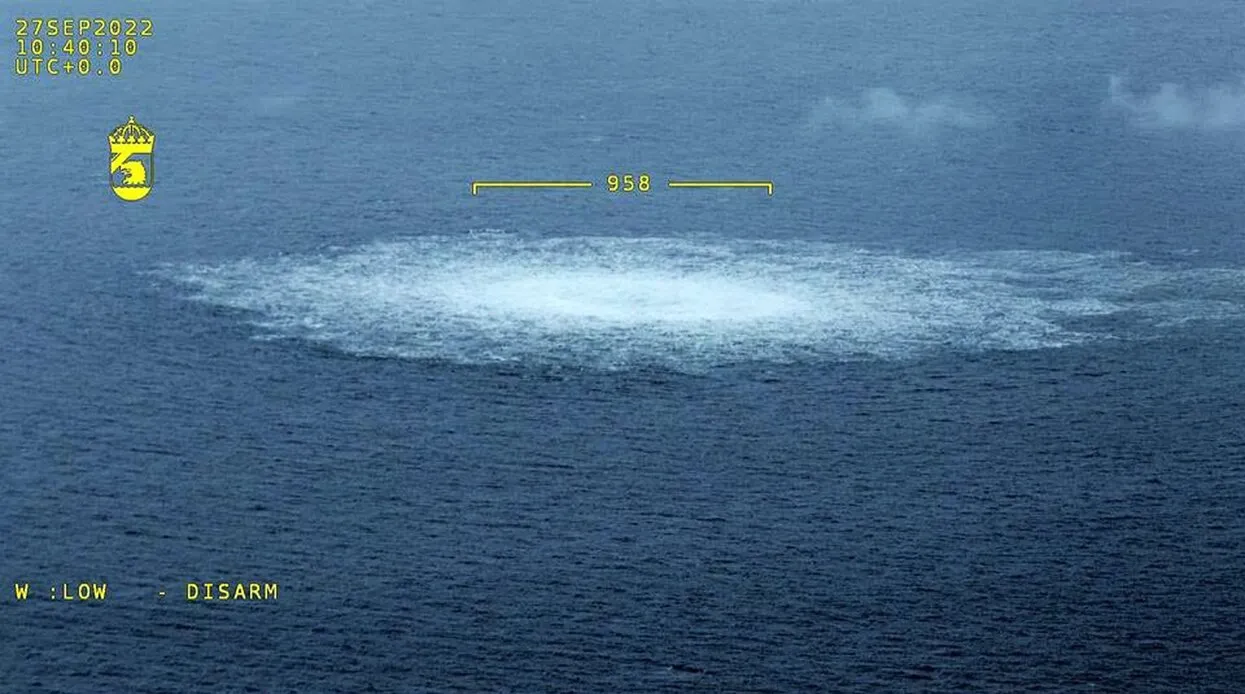
On the night of September 26, 2022, explosions ruptured three of the four pipelines that make up the Nord Stream 1 and Nord Stream 2 gas pipeline systems in the Baltic Sea, near the Danish island of Bornholm. German investigators pursued theories ranging from a Russian provocation to the involvement of Western intelligence services. Not until 2024 did they conclude that a Ukrainian sabotage group had destroyed the pipelines.
Bojan Pancevski, the chief European political correspondent for The Wall Street Journal, spent several years investigating the Nord Stream sabotage, interviewing both the people who carried out the operation and the investigators pursuing them. In June 2026, he published ”The Nord Stream Conspiracy: The Inside Story of the Explosions That Shook the World,” which reconstructs the planning and execution of the operation in detail. Meduza special correspondent Elizaveta Antonova spoke with Pancevski about the extraordinary act of sabotage that German prosecutors attribute to members of Ukraine’s armed forces and that Kyiv denies carrying out — and about where it fits in the history of Russia’s war against Ukraine.
‘The operation is exemplary of the asymmetric, adaptive, innovative war that Ukraine is fighting against Russia’
Bojan Pancevski
— For readers who haven’t followed this story closely, briefly: what happened during the sabotage operation?
— The operation had two key goals: to reduce the revenues that Vladimir Putin’s war machine was getting from Europe, and to break the geopolitical bonds between Russia and the West — Germany in particular. The Nord Stream pipelines were, in a way, the embodiment of those bonds. The original plan was to destroy TurkStream as well, but that part of the operation was a failure.
The plan to destroy the pipelines was conceived and executed by a special forces unit of Ukraine’s armed forces — veterans of clandestine operations behind enemy lines. They first looked for combat divers within the military, but they couldn’t find any, because special forces typically don’t operate at such depths. So they had to turn to civilians, whom they found in Ukraine’s deep-sea diving community.
In the end, the crew aboard a yacht hired in Germany consisted of three Ukrainian officers and four divers who had passed a very rigorous selection process.
The entire operation cost something like $250,000, which is extremely cheap. The pipelines cost about $20 billion to build. If you look at the ratio of cost to result, it was — from the Ukrainian perspective — a pretty incredible success.
The operation is exemplary of the asymmetric, adaptive, innovative war that Ukraine is fighting against Russia.
— One of the divers you write about is a woman you call Freya. What can you tell us about her?
— That’s actually not her real name. I don’t use the participants’ real names at all, because I had to keep them anonymous. But I chose nicknames that I felt were somehow connected to their personalities, or to the associations they evoked in me.
Freya is a deep-sea diving instructor with great experience — about 20 years, I think. She was the only female member of the entire crew, and she played a crucial role in the operation.
The operation was set for late September, and there was a storm in the Baltic at the time; the men were a bit reluctant to dive in those conditions. The mission was dangerous anyway — the storm just added another layer of danger. According to some of her colleagues and her superior officers, it was Freya who encouraged the men to go down. So in a certain sense, her role turned out to be key.
She’s a very interesting personality. Freya passed all of the [military’s] tests, but initially some of the commanders didn’t think it was a good idea to take a woman on board. One general told me he felt that having a single woman in an otherwise all-male group might create additional complications.
The operational commander, however, saw leadership qualities in her. And he had great experience running operations like this — including with civilians, women among them.
Toward the end of my work on the book, I spoke again to the general who had originally opposed her appointment. He admitted: “Actually, the best decision we ever made was to take her on board.”
— In the book, you quote Volodymyr Zelensky as calling the blasts a “Russian terrorist attack against Europe.” How has his position changed over time?
— Initially, he claimed — without any evidence — that Russia was behind it. Then, when news reports started revealing possible Ukrainian involvement, he denied everything: he said he never knew about the operation and that Ukraine wouldn’t do such a thing. Today, both Zelensky and his closest aides completely deny any involvement in the attack.
A view of the gas leak site. September 29, 2022
Danish Defence Command / AFP / Scanpix / LETA
Danish Defence Command / AFP / Scanpix / LETA
— Did Zelensky know the operation was being prepared?
— The most senior officer involved in the operation was General Valerii Zaluzhnyi. People close to him say that at one point he informed President Zelensky about the operation. The president himself denies this.
Other quite reliable sources also say he was informed in advance. But that doesn’t mean he ordered the operation or took part in planning it — only that he was briefed. There were many different operations underway at the time. General Zaluzhnyi briefed the president about some of them and not about others.
Their relations were far from ideal. Ultimately, that’s why Zelensky fired Zaluzhnyi — just as he did with Mykhailo Fedorov. He tends to fire people who are popular and, perhaps, not entirely loyal to him.
— You mentioned that the saboteurs also planned to blow up TurkStream. What went wrong?
— Many things went wrong there. The operation as a whole was risky and poorly prepared. The organizers had few resources and little time or capacity to prepare properly.
For example, they didn’t account for the fact that the area they wanted to launch the operation from — the southern coast of Romania — is closely watched by NATO forces, as well as by Romanian and Bulgarian border services and navies. Crossing into international waters from there on a rented boat is extremely difficult.
Beyond that, I think the members of the group fundamentally miscalculated where the pipeline actually is. They never confirmed this to me directly, but that’s the impression I formed from talking to [sources familiar with the operation].
The pipeline runs much farther out from the Romanian town of Mangalia, where the operation was launched. So my assumption is that they mistook another, much smaller pipeline for TurkStream. But that’s just my own reconstruction of events — I have no confirmation.
The failure with TurkStream shows that a similar failure could well have happened with Nord Stream.
Why did the sabotage attempt on TurkStream fail?
Two groups of saboteurs were supposed to set off explosions on Nord Stream and TurkStream at roughly the same time. Bojan Pancevski describes the failure of the southern operation in his book, writing that while the team working on Nord Stream battled the elements, the group sent to Romania to sabotage TurkStream never got past the beach at Mangalia.
To reach the pipeline, they needed to cross Bulgaria’s exclusive economic zone and enter Turkish waters — but that proved impossible.
First, the yacht’s insurance did not cover sailing outside Romanian waters. Second, Romanian and Bulgarian naval ships and coast guard boats continuously patrol this stretch of the Black Sea because of the war between Russia and Ukraine.
For a week, the team went out to sea every day hoping to slip past the patrols, but the yacht was stopped each time. In the end, the saboteurs had to admit the operation had failed.
‘The Ukrainians don’t think they have to do everything the Americans tell them’
— How long did preparations take in all?
— The idea was conceived about a month after the start of the full-scale invasion — in late March or early April 2022. By my count, the group had about two months to prepare.
The operation was originally planned for June 19, but the information leaked and the preparations had to be put on hold. The team returned to work in late August, and the operation itself was carried out on September 26.
— You say the operation cost about $250,000. Where did the money come from?
— The funding came mainly — or possibly even entirely — from private sources. Like many other units in the Ukrainian army, they often draw on private funding from wealthy businessmen, oligarchs, and simply supporters.
The main expenses were travel and renting the boats. The participants themselves were not paid — they carried out the mission to defend their country.
— What is known about how the plan leaked?
— The Dutch military intelligence agency learned about the operation through human intelligence. They informed the CIA, which in turn informed the German authorities. The CIA directly approached the people organizing the attack and told them to stop. One of the most senior organizers pledged — in writing, I believe — not to carry out the operation.
They did it anyway. That perfectly illustrates the way the Ukrainians operate: they don’t think they have to do everything the Americans tell them.
— At the same time, you write that the organizers consulted a CIA representative in Kyiv. Does the CIA figure in the German criminal case, and if so, how?
— No, it doesn’t. As I understand it, the CIA representative in question learned about the operation at a private level. He was on friendly terms with the organizers of the attack, since they came from Ukrainian intelligence and had worked with the CIA going back to 2014–2015. In general, they had a pretty good relationship with Western intelligence services. But in this case, they were asking the CIA for help unofficially — this was not the CIA as an agency.
When the investigation began in Germany and the German investigators reached the site of the explosions, they found an American Navy destroyer there, and later other vessels connected to the U.S. fleet. But in the end, the investigators concluded that the United States had nothing to do with what happened. The ships were in the area as part of naval exercises that, by coincidence, were taking place in the Baltic.
At the early stage, the investigation also examined the possibility of Russian involvement. There were Russian vessels in the area, and Russia — at first glance, at least — could have had a motive for such an operation. That theory was thoroughly examined as well, but no evidence of Russian involvement was found.
— None of the operation’s participants told you on the record that Ukraine was behind it?
— That’s right.
— But you were still able to confirm Ukrainian involvement?
— I was able to prove the involvement of the people I believe organized the operation. For a number of reasons, I can’t explain how right now — I have committed to protecting their anonymity. But my findings were confirmed by the results of the German investigation. That, for me, was the ultimate confirmation.
— Your Ukrainian sources knew you were a journalist and that the information would become public sooner or later — but they talked anyway. Why?
— It took a very long time for them to agree to talk, but I think, ultimately, they wanted to tell the real story. By that point, there was already reporting in the media about a Ukrainian trail — including my own — and leaks had emerged that German investigators were treating Ukraine as a potential suspect.
I think my sources decided to tell their side for two reasons. First, they felt a certain professional pride in the operation. Second, they felt that the political and military leadership had effectively left them alone to face the consequences of this story.
The political leadership chose to distance itself from the subject, and the military leadership was completely replaced. By then, Zaluzhnyi had already been dismissed. All the generals around him had either lost their posts or been forced out after him.
Against that backdrop, my sources wanted to set the record straight — to explain what exactly happened and how it really unfolded.
‘Berlin didn’t want this story to turn into a serious political problem’
— You write that Polish authorities effectively shielded the operation’s participants by withholding information from German investigators. How did the sabotage affect Germany’s relations with its NATO allies?
— More than that: a Polish court also released one of the suspects [Volodymyr Zhuravlov], which caused great irritation in Germany. And Polish Prime Minister Donald Tusk said that those who built Nord Stream should keep silent rather than complain and investigate.
That led to tension between the two countries, but I wouldn’t say the consequences were serious. Had Ukraine’s responsibility become publicly known in the first days after the explosions, I think the fallout would have been far more dramatic. Almost four years on, many people have gotten used to the idea that Ukrainians were behind the sabotage.
From what I know, the German authorities received their first indications that Ukrainians could be behind the attack soon after the explosions. But they decided against making that information public. First, an investigation is underway, and its materials have to remain confidential. And second, Berlin didn’t want this story to turn into a serious political problem, since supporting Kyiv serves Germany’s national interests.
One of the suspects [Serhii Kuznietsov] will soon stand trial in Germany. We’ll see how the trial ends. There will certainly be tension between Ukraine and Germany: the Alternative for Germany party is already using the pipeline attack as an argument for ending further support for Ukraine.
Serhii Kuznietsov after a hearing at an appeals court in Bologna. August 22, 2025
Massimiliano Donati / Getty Images
— Was there ever a risk that Germany would scale back its aid to Ukraine because of the operation?
— I don’t think so. Both the previous government and the current one have proceeded from the position that supporting Ukraine is in Germany’s national interest.
Germany and Ukraine did discuss the issue. There were indeed contacts at the very highest level — between Chancellor Olaf Scholz’s chief of staff, Wolfgang Schmidt, and Andriy Yermak.
— What do you see as the operation’s main consequences?
— Germany and the countries of Western Europe lost the main artery for importing Russian gas — Nord Stream 1. Putin had already stopped the gas by that point, but the infrastructure itself remained operational.
As I understand it, many in the German government assumed that sooner or later Putin would try to restore the gas trade through Nord Stream 1. Indeed, he has proposed repairing and restoring the pipelines. The Nord Stream question even figures now in negotiations with the Trump administration. In my view, that option has been removed for good.
In a way, this makes things easier for Chancellor Friedrich Merz: it’s simpler for him to say that Germany won’t buy anything from Russia. If the pipeline still existed, Merz would have come under enormous pressure to resume purchases, because Russian gas remains the cheapest.
I don’t think this is where it ends. The Nord Stream saga is not over. For Putin, it’s a kind of flagship geopolitical project for Russia in Western Europe, and he has no intention of giving it up.
The second consequence is that the operation showed the special services of the world that sabotage like this is entirely possible and achievable — if you find people brave enough, crazy enough, and skilled enough to carry it out. And that, perhaps, is the most alarming lesson.
— In the book, you write that Germany — the world’s third-largest economy — never planned for a scenario in which it would be cut off from Russian gas. Have you asked German officials how that was allowed to happen?
— I have, and it’s pretty crazy — they don’t have an answer to that question.
One important thing to understand: in the 1980s, Chancellor Helmut Schmidt set a rule stipulating that Germany could not buy more than 30 percent of any type of energy — gas, oil, coal, or anything else — from a single supplier. It was a matter of principle: the thinking was that beyond 30 percent, a country becomes too dependent, and the supplier can use that dependence as an instrument of pressure.
At some point, the rule was abandoned — nobody knows exactly when. By the time Angela Merkel came to power, no such restriction existed. At the start of her chancellorship, Russia supplied about 30 percent of the gas Germany consumed; by the time she stepped down, the figure had risen to something like 55 percent.
Under Merkel, German energy policy toward Russia lost practically all common sense. Germany went all in on Russia — and made no preparation whatsoever for a possible cutoff. The logic was: “The Russians need the money, they’re rational people, and Putin is just like us. He wants to do business. We need their oil and gas — our interests align.”
The Germans could never understand that Putin is not actually like them — that he has entirely different priorities, and that expanding Russia’s territory matters more to him than selling gas on the world market.
In general, I think the Germans don’t understand Russia very well. The paradox is that they’re convinced they do.
‘My assumption is that no one reported it to Putin’
— In the book, you quote a Ukrainian source you call the General, who described the coming invasion to you in detail before the war began. You also write that in private, Zelensky insisted there would be no major war. Does that mean the intelligence services understood Russia was preparing a full-scale invasion while the president did not?
— I have spoken to people who at the time were serving in the SBU, in Ukraine’s Foreign Intelligence Service, and in military intelligence. By their account, MI6, the CIA, and other Western partners briefed them on their intelligence in great detail, and they reported all of it to President Zelensky. But he simply didn’t believe it. He thought it was merely an economic maneuver by Russia to undermine Ukraine’s economy, and that Russia had no real intention of invading.
In the book, I describe how William Burns, then the director of the CIA, went personally to Kyiv in a final attempt to convince Zelensky. This was just a couple of weeks before the war began. Burns showed him the evidence. Even after that, Zelensky didn’t believe him.
It’s hard for me to explain why he behaved that way, but obviously it was a serious mistake. At the time, he was posting vacation photos on Instagram and making reassuring, joking statements that everything would be fine and everyone would be grilling shashlik in the summer. In other words, he did nothing to prepare the public for a full-scale invasion.
— Why do you think Russia’s Foreign Ministry insists that your version of the Nord Stream story is false? What does it object to?
— At first, they claimed the CIA and the “Anglo-Saxons” were behind everything, but it seems they no longer insist on that.
I have sources in Russian intelligence, and before the book was published, I spoke to one very senior member of that community. He said a different version is now popular inside the system: Ukraine carried out the sabotage — but it was acting under the CIA’s direction after all.
About a year ago, I asked Dmitry Peskov to comment on an incident in which Russia was accused of damaging pipelines, undersea cables, and other infrastructure in the Baltic Sea. He wrote back something to the effect of: “The people who tell you such things should look into Ukraine and Nord Stream.”
I think Russian intelligence gathering was probably not that bad either. From what I know, Russia’s special services fairly quickly — at least within the last two years — obtained information about what really happened.
But my assumption is that no one reported it to Putin — because there was simply no one who dared. In systems like this, it’s very hard to bring unpleasant truths to the top leadership, especially when it doesn’t want to hear them.
Another example of this is the start of the full-scale invasion. Russia had quite good intelligence, because Ukraine had for many years been penetrated by agents of the FSB, the GRU, and Russia’s Foreign Intelligence Service. They had spent decades building their networks there.
I think the raw data actually showed that Ukraine would not capitulate and would not greet Russian troops with parades on Khreshchatyk. Nonetheless, a comparatively small force was sent in for the invasion — fewer than 200,000 soldiers. In retrospect, for a country the size of Ukraine, that looks simply negligible. Some of the soldiers even had parade uniforms with them in their armored vehicles. They seriously expected to take part in parades.
How could a mistake like that even happen? Obviously, someone completely misinterpreted the raw intelligence.
— What shocked you most in all of this?
— I was struck by how much everything rested not on technical capability but on bravery, persistence, and human endurance. By how lucky they were — and by how easy, as it turned out, an operation like this is to pull off. There were theories that you would need undersea drones, submarines, and advanced technology. In fact, it was very low-tech. Its success depended above all on people’s physical stamina, determination, and strength.
At Meduza, we are committed to transparency about our use of artificial intelligence in the newsroom. The story you’re reading was written by one of our living, breathing journalists and translated from Russian using an AI model configured to follow our strict editorial standards. This translation process is the result of extensive testing and refinements to ensure our English-language coverage is timely and accurate. A Meduza editor reviews every draft before publication.
If you find any errors in this translation, please contact us at reports@meduza.io.
To read Meduza’s exclusive content in English, please subscribe to our newsletter.
Interview by Elizaveta Antonova
How did Pancevski write this book?
Bojan Pancevski has reported from Ukraine since 2014. He has visited the front many times and come to know a number of Ukrainian intelligence officers and military personnel. Some of them later helped him reach the people behind the Nord Stream pipeline operation. He also got to know one of the operation’s main organizers, whom he calls the General in the book, even before the full-scale war began.
TurkStream
An export pipeline carrying Russian gas to Turkey across the Black Sea, in operation since 2020. Russia uses it to supply Turkey and parts of southern and southeastern Europe.
Who is Freya?
The Norse goddess of love, beauty, and magic.
Is this true?
Bojan Pancevski cites this quote in his book, but Meduza could not find any such statement from Zelensky in open sources. A similar statement was made on September 27, 2022, by Mykhailo Podolyak, an adviser to the presidential chief of staff, who said the large-scale “gas leak” from Nord Stream 1 was nothing other than a terrorist attack planned by Russia and an act of aggression against the EU, meant to destabilize Europe’s economic situation and cause panic ahead of winter.
Bulgaria’s Exclusive Economic Zone
A zone covering 35,000 square kilometers in the western Black Sea, bordering Romania’s maritime zone to the north and Turkey’s to the south. Bulgaria holds exclusive rights to explore, extract, and protect living (fish) and mineral resources (oil and gas) on and beneath the seabed.
Were there several?
Two boats took part in the operation: the group that blew up Nord Stream was aboard the Andromeda; the team that tried to hit TurkStream sailed on the Santa Lucia.
Volodymyr Zhuravlov
Zhuravlov, a diving instructor, was detained near Warsaw on September 30, 2025. Germany’s Federal Court of Justice had issued a European arrest warrant for him in June 2024, on suspicion that he helped plant the explosive devices. He says he had nothing to do with the sabotage and was in Ukraine at the time.
On October 17, 2025, a district court in Warsaw refused to extradite Zhuravlov to Germany and released him from custody. The court also found that the act attributed to Zhuravlov, if committed in the course of Ukraine’s defensive war, would not constitute a crime.
Serhii Kuznietsov
Kuznietsov is a Ukrainian citizen and the first suspect to be identified in the Nord Stream pipeline bombing case. According to The Wall Street Journal, he is a former captain in Ukraine’s armed forces. He previously served in the SBU, Ukraine’s security service, as well as in an elite unit that defended Kyiv during the first months of the 2022 invasion.
He was detained in Italy in August 2025 under a warrant issued by Germany. Italy later agreed to extradite him. German prosecutors describe Kuznietsov as the leader of the group that planted the explosive devices on the gas pipelines near the Danish island of Bornholm in September 2022.
AfD (Alternative for Germany)
A German right-wing populist party that calls for strict limits on immigration, opposes European integration, promotes traditional family values, and wants sanctions on Russia lifted and energy ties restored.
Helmut Schmidt
A German statesman and Social Democrat who served as the fifth federal chancellor of West Germany, from 1974 to 1982.
Angela Merkel
Chancellor of Germany from 2005 to 2021. Merkel has been widely criticized for policies that deepened Germany’s energy dependence on Russia and for underestimating the political risks.
Who is ‘the General’?
In the book, Pancevski gives his sources pseudonyms to protect their identities.
What exactly does Russia’s Foreign Ministry say?
In May 2026, before the book’s publication, Foreign Ministry spokesperson Maria Zakharova dismissed its account as untenable, arguing that a small group of saboteurs could not have carried out the attack and that powerful state actors — the United States and its European partners — were behind it.