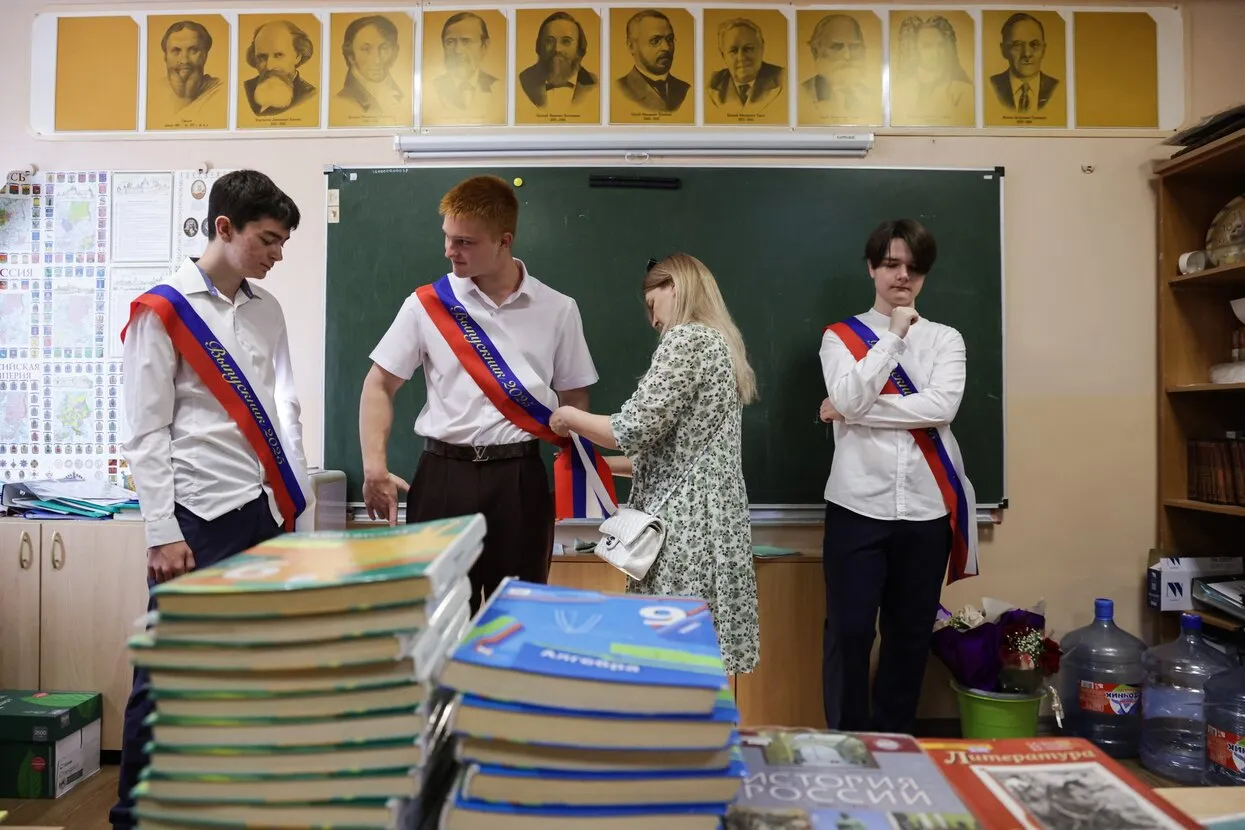
BBC investigation shows that Russia is steering more ninth-graders into trade schools — and toward the army
In recent years, Russian authorities have pushed ninth graders ever harder to enroll in vocational colleges instead of staying in school through 11th grade and going on to university, the BBC’s Russian service reports.
According to the Higher School of Economics, 2022 — the first year of Russia’s full-scale invasion of Ukraine — was the first year in which more than half of ninth graders (50.4 percent) chose college over 10th grade. The share has kept climbing since then.
The authorities are encouraging the trend. In Moscow, students applying to vocational colleges and technical schools after ninth grade now take only two exams instead of the usual four — Russian language and math — on the OGE, the standardized test given at the end of ninth grade. Moscow Mayor Sergei Sobyanin; Vyacheslav Volodin, the speaker of Russia’s lower house of parliament; and the Labor Ministry have all spoken publicly about the demand for blue-collar workers. Schools themselves increasingly steer teenagers toward colleges and technical schools. And in 2026, for the first time, the Russian social network VKontakte carried more posts promoting college enrollment than posts promoting universities.
Students can still get into university after two years of vocational college, but in practice, the BBC notes, that is harder than it is for students who finish 11th grade. Since 2025, college graduates can skip the Unified State Exam, Russia’s university entrance test, only if they apply to a similar field of study — and unlike schools, colleges do not prepare students specifically for it.
Young men who go to college also face a higher risk of being drafted. Russian law allows only one educational deferment after high school. Using it during college means it can’t be used again — enrolling in another degree program later offers no protection from the draft. That means college graduates can still be sent to war, since conscripts are often pressured into signing contracts with the Defense Ministry.
Many schools are cutting places in the upper grades — though not by choice, the BBC writes. Under new standards in force since 2022, schools must open specialized classes built around the in-depth study of particular subjects, starting in 10th grade. But doing so is “expensive and difficult,” the outlet notes. Schools often do not have enough teachers to run specialized tracks in every subject at once.
As a result, a school may offer several advanced math classes and none in, say, social studies, forcing some students who wanted that specialization to leave school after ninth grade. Schools are often vague about how the specialized classes are formed and how students are chosen for them, and they frequently will not disclose the cutoff score.
In reality, the outlet writes, the students who end up in 10th grade are not the ones set on studying but “those whose parents know how to insist, have connections, or can pay a bribe.” One teacher, who was not named, described the situation this way:
We selected the students for the specialized classes, and then the parents started stomping their feet and saying, “We’ll go to the prosecutor’s office.” And the school is forced to take the kids. We ended up with bloated classes: two-thirds of the kids aren’t ready for the track, and the kids who want to learn are the ones who suffer. In the end, it’s impossible to work, impossible to provide a decent level of education.
Schools are legally allowed to hold entrance exams for 10th grade, the BBC notes. But a full secondary education is a guaranteed right for every child, so the authorities must in any case find that child a place at another school.
Faced with these obstacles, some parents are pulling their children out of school and turning to homeschooling or private online schools. Children in these programs have no deferment from military service, though the deferment returns as soon as they enroll in university.
At Meduza, we are committed to transparency about our use of artificial intelligence in the newsroom. The story you’re reading was written by one of our living, breathing journalists and translated from Russian using an AI model configured to follow our strict editorial standards. This translation process is the result of extensive testing and refinements to ensure our English-language coverage is timely and accurate. A Meduza editor reviews every draft before publication.
If you find any errors in this translation, please contact us at reports@meduza.io.
To read Meduza’s exclusive content in English, please subscribe to our newsletter.
OGE
The basic state exam required of all ninth-grade graduates.