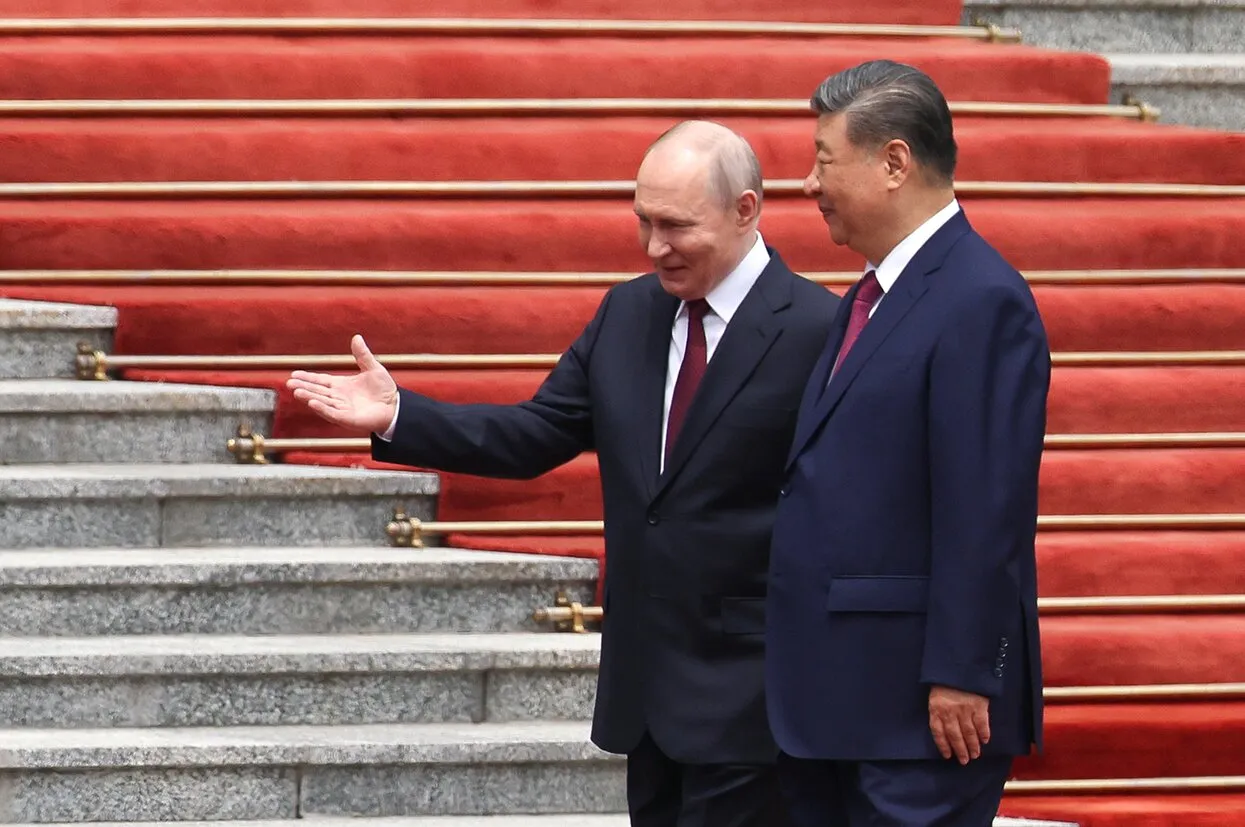
WSJ: The leader Xi Jinping once called his ‘role model’ is now Beijing’s supplicant, and China is making Putin wait for the gas deal Moscow badly needs
More than four years of war and economic isolation have shifted the balance in Russia’s relationship with China. Vladimir Putin, once a “role model” for Xi Jinping, has become a supplicant and junior partner, The Wall Street Journal reports. Both sides are working to project an image of a strong and equal alliance. But the partnership rests on a narrow foundation, the newspaper notes, and Russia and China have far more grounds for disagreement than may be apparent. Meduza recaps the key points of the piece, which explains how far the balance has tipped toward Beijing and where the friction is showing.
When Xi Jinping made his first foreign trip as China’s president in 2013, he chose Moscow. In a meeting with Vladimir Putin, he called the Russian president a “role model,” The Wall Street Journal reports, citing people familiar with the conversation. What Xi admired, those people said, was Putin’s ability to command a seat at the world’s top table while running an economy that leaned on oil and gas instead of a diversified one like America’s or China’s.
For years, Moscow and Beijing dealt with each other as near-equals. More than four years of full-scale war and economic isolation have shifted that balance, handing Xi the leverage to finish a structural shift in power that was already underway. Putin has gone from “role model” to supplicant and junior partner.
Putin’s visit to China in May only confirmed that new status. He traveled to Beijing with one ambition: securing an agreement on the Power of Siberia 2 pipeline, which Moscow badly needs. A Russian delegation flew to Beijing ahead of Putin; Gazprom chief Alexei Miller was on it.
Chinese officials made clear from the outset that they would sign only if Russia sold them gas at the same price it charges domestically — that is, below market rate. They told the Russians not to raise the pipeline again until the terms changed, people familiar with the talks told the Journal. Putin left China having signed 42 agreements and joint declarations, but the pipeline deal was not among them.
That does not mean the Moscow-Beijing partnership is on the verge of collapse. If anything, China’s support has only deepened since the invasion. Beijing buys Russian oil at a discount, supplies the components its defense industry needs, and provides the financial plumbing that lets Moscow weather Western sanctions.
The Journal notes that Xi appears to have absorbed the lesson of the 1960s, when the Soviet Union treated China as nothing more than a “younger brother.” That heavy-handedness helped fracture the alliance. For now, Xi is careful to treat Putin with respect in public even as he presses for concessions in private.
“The lesson of this relationship,” said Sergei Radchenko, a historian and professor at Johns Hopkins University, “is that you don’t use your position as the senior partner to humiliate the junior partner.” So far, he said, Xi has played along with that lesson — giving Putin room and keeping up the appearance of equality in public, even as the underlying reality has shifted decisively in China’s favor.
But the partnership rests on a narrow foundation. Russia and China are bound together more by a shared hostility toward the U.S.-led order than by common values or culture. And it’s showing signs of strain.
Trade between the two countries has doubled since the start of the war, though most of that growth came in the first years after the 2022 invasion, according to Chinese data. Chinese goods have inundated Russian producers with cars, heavy machinery, textiles, and even chicken breasts that are cheaper and often better than what Russian companies can make. The outcry from Russian business has caused political problems for the Kremlin.
Russia simply needs China much more than China needs Russia. When Xi came to Moscow in 2013, Europe was Moscow’s main economic partner, and China accounted for roughly 10 percent of Russia’s total foreign trade. That figure now stands at nearly 40 percent.
China accounts for about a third of Russia’s export revenues. Russia’s share of China’s foreign trade, by contrast, is less than 4 percent. Beijing is content with that arrangement. Chinese officials are in no hurry to take on new commitments to a pipeline that would only deepen their dependence on Russia — even though the recent U.S.-Israeli war in Iran has given them reason to reconsider the reliability of the oil and gas they get from the region.
“It’s better to still marinate the Russians,” Alexander Gabuev, director of the Berlin-based Carnegie Russia Eurasia Center, said of China’s approach to the negotiations. “Wait for the Russian economic situation to deteriorate even further — the Russians really on their knees — to subscribe to terms that are beneficial to China.”
The strategy has history on its side. The first Power of Siberia pipeline was negotiated for 15 years before Moscow and Beijing finally agreed on terms in May 2014, the Journal notes. The signing came two months after Russia’s annexation of Crimea, which threatened Moscow’s access to European financing and broke a yearslong deadlock over pricing. Russia kept its upstream assets out of Chinese hands, but Beijing won a heavily discounted rate tied to oil prices.
China’s leverage extends beyond energy. In the past year, Xi used China’s economic power to force a concession from Putin: Moscow accepted the Chinese yuan as the primary currency for a planned regional development bank covering Central Asia, known as the Shanghai Cooperation Organization Development Bank, according to Chinese government advisers and diplomats familiar with the matter.
Moscow had resisted that arrangement for more than a decade, wary of China’s expanding footprint in territory Russia has long considered its own sphere of influence. But financial isolation forced Moscow to reconsider, and Russia has signaled it is open to joining the bank as a member. In return, Moscow has sought assurances that the bank would operate outside the reach of Western sanctions.
Another source of tension between Moscow and Beijing is Russia’s deepening military entanglement with North Korea, which has sent troops to fight alongside Russian forces in Ukraine. Chinese officials have long considered Pyongyang to be within their own orbit.
Putin pushed privately for a trilateral summit among Russia, China, and North Korea, the Journal reports, citing people familiar with the matter. Beijing rejected the proposal. Instead, Xi went to Pyongyang himself in early June, his first visit in seven years. Analysts said the trip was meant to reassert that Beijing, not Moscow, remains North Korea’s principal patron.
Beijing worries that any Russian transfer of technology would improve North Korea’s nuclear or submarine capabilities and push South Korea and Japan closer to the United States — undercutting China’s attempts to exploit the friction between Seoul and Washington and draw South Korea toward its orbit.
Those concerns even prompted Putin to redraw the itinerary of his first foreign trip after his re-election in March 2024. His original plan was to visit Beijing and then go straight to Pyongyang. The Chinese asked him to put distance between the two stops, and Putin obliged, adding Vietnam to the trip as cover. A back-to-back Beijing–Pyongyang sequence would have fed exactly the “axis of authoritarians” narrative China is eager to avoid.
Beijing’s long game is intact. China is quietly building relationships inside Russia that reach well beyond Putin, cultivating officials and elites who will shape the country after he is gone. Anti-Western sentiment, some analysts say, has become so embedded in Russian society and institutions that it will outlast the man who stoked it.
“China really has a very good chance to turn Russia into a kind of giant Laos, giant Pakistan,” Gabuev said. “A country much more dependent on China, much more connected to China, much more looking up to China as a model and as a source of modernity.”
At Meduza, we are committed to transparency about our use of artificial intelligence in the newsroom. The story you’re reading was written by one of our living, breathing journalists and translated from Russian using an AI model configured to follow our strict editorial standards. This translation process is the result of extensive testing and refinements to ensure our English-language coverage is timely and accurate. A Meduza editor reviews every draft before publication.
If you find any errors in this translation, please contact us at reports@meduza.io.
To read Meduza’s exclusive content in English, please subscribe to our newsletter.
Meduza
‘Power of Siberia 2’
A pipeline that would run from Gazprom’s fields in Yamal through Western Siberia and Mongolia to northeastern China. Power of Siberia 2 could make Russia the largest supplier of gas to China. The two sides have been negotiating the launch of this project for several years.
Shanghai Cooperation Organization
Founded in 2001 by China, Russia, Kazakhstan, Tajikistan, Kyrgyzstan, and Uzbekistan. India, Pakistan, Iran, and Belarus joined later. The organization’s stated goals include strengthening regional security, combating terrorism, and developing economic cooperation and cultural ties.