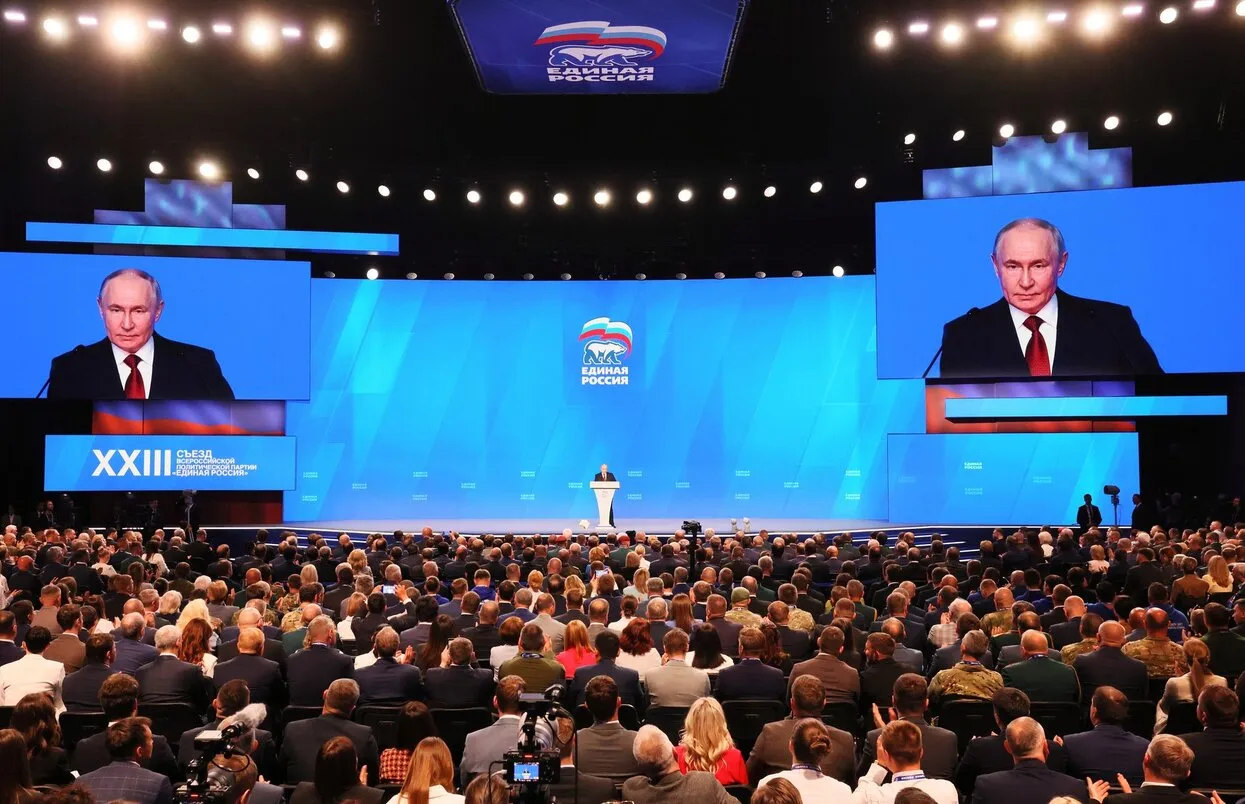
‘He’s clearly pro-war. And people are tired of the war.’ Why Russia’s ruling party left Dmitry Medvedev, its own chairman, off this September’s election list.
The main result of the United Russia party congress this weekend is that the party’s own chairman — Dmitry Medvedev, the former president and now deputy chairman of Russia’s Security Council — again failed to make the candidate list that will top the party’s ticket in September, despite a determined lobbying push.
In January, the business dailies Vedomosti and RBC reported that the presidential administration and United Russia had already agreed on a “base option” — a “top five” led by Medvedev. The outlets’ sources attributed this to the former president’s supposedly high poll numbers. Sources close to the administration told Meduza at the time that Medvedev might again fail to make the list, because he simply isn’t very popular. They pointed out that Medvedev himself badly wants to lead United Russia so he can “recapitalize his image” and then make a bid for the speakership of the State Duma, the lower house of Russia’s parliament.
Inside the administration’s political bloc, officials understood that putting Medvedev at the top of the list would make it far harder for the Kremlin to hit the performance targets (KPIs) it sets for the ruling party: “He’s clearly pro-war,” one source said. “And people are tired of the war.” As in the 2021 campaign, opposition to including Medvedev came from Vyacheslav Volodin, the speaker of the State Duma, who wants to keep his post, and from Sergei Kirienko, the head of the political bloc.
In mid-June, Meduza reported that Medvedev was actively lobbying for a top-three list headed by himself, Moscow Mayor Sergei Sobyanin, and war correspondent Yevgeny Poddubny. The Russian business daily Kommersant later reported the same plan. But sources close to the administration again told Meduza that Medvedev might not appear on the United Russia list at all — unlike Sobyanin and Poddubny, who were named among the agreed-upon candidates.
Foreign Minister Sergei Lavrov tops United Russia’s final list, followed by Sobyanin; Vladislav Golovin, head of the central staff of the pro-government youth movement Yunarmiya and a war veteran; Maria Lvova-Belova, the children’s ombudsman and wife of “Orthodox oligarch” Konstantin Malofeev; and Poddubny.
According to a source close to the administration who spoke with Meduza, the option featuring Lavrov, Lvova-Belova, and Golovin “took shape on Friday and Saturday,” with President Vladimir Putin putting together the final plan. As Meduza reported earlier, Lavrov’s and Golovin’s candidacies were not under discussion as of early June. Lvova-Belova’s name did not appear on any of the projected lists.
RBC reported midweek that Sobyanin would lead United Russia into the election. “Sobyanin was the consensus choice — for United Russia and the political bloc, for everyone except Medvedev himself, of course,” a Meduza source inside the ruling party said with a smile.
A source close to the political bloc said, “The top name is a surprise to everyone who was involved in preparing the event.” Lavrov’s candidacy, despite his weak approval ratings, drew no objections from the bloc — he will not interfere in its management of the United Russia campaign or “assert his own vision, the way Medvedev would have tried to do.”
Another source close to the presidential administration described the members of the top five other than Lavrov and Sobyanin as “nobodies who have no connection to the party to begin with.” A source within the United Russia staff added: “The Moscow mayor’s authority is a clear asset, but there’s a risk of diluting it with figures whose contributions to domestic policy and public administration aren’t obvious even to the party leadership.” Sobyanin himself, according to this source, is “to put it mildly, unhappy with the company [he’s keeping].” “He signed up for a different lineup,” the source said.
At the start of the congress, Putin delivered the opening address. He assured the audience that the elections would be held on schedule as required by law — a position championed by the administration’s political and information blocs, while security officials had been lobbying to postpone the vote (Meduza reported on that here).
Putin promised to take Russia’s economy to a new level and chided “politician-bloggers” who won’t get out from behind their messaging apps and desks. United Russia banners displayed at the congress declared it “the president’s party.” The slogan on the posters read: “Being ‘Za Putina’ [for Putin] is the bare minimum.” Meduza had previously reported that United Russia wants to build its campaign around positioning itself as “Putin’s party.”
“The absence of the party chairman at the top of the list makes that positioning easier,” a source close to the presidential administration told Meduza. “Lavrov and Sobyanin are Putin’s people, his representatives — it’s all clear.”
The source did not rule out that the Kremlin could lower the targets it set for the party now that the top-five list has been announced. Putting forward Sobyanin, a “solid administrator,” as the list’s top name could have boosted the party’s ratings or at least slowed their decline, the source said: “With Lavrov, it’s unlikely to work. Sobyanin is on the list, but he’s second — you can’t build the whole campaign around him.”
At Meduza, we are committed to transparency about our use of artificial intelligence in the newsroom. The story you’re reading was written by one of our living, breathing journalists and translated from Russian using an AI model configured to follow our strict editorial standards. This translation process is the result of extensive testing and refinements to ensure our English-language coverage is timely and accurate. A Meduza editor reviews every draft before publication.
If you find any errors in this translation, please contact us at reports@meduza.io.
To read Meduza’s exclusive content in English, please subscribe to our newsletter.
Andrey Pertsev
What is it?
As of February 2026, according to the Russian Public Opinion Research Center (VTsIOM), Sergei Lavrov’s trust rating stood at 16.1%. Respondents answered spontaneously when asked which politician they trusted. VTsIOM traditionally publishes the results of polls with spontaneous trust responses at the beginning of the month; the February poll was published on March 6. After that, the results of such surveys were not published — according to the last one, Putin’s trust rating was falling and stood at 32.1%.
What are they?
Initially, the Presidential Administration publicly indicated a desired result for United Russia of 55% with 50% turnout. Meduza’s sources in regional administrations spoke of 60% for United Russia and 55% turnout. Later, media outlets loyal to the Russian authorities reported that the Presidential Administration had lowered the desired percentage for United Russia to 50.
When did they stop including him on it?
Medvedev headed United Russia’s party list in the 2011 and 2016 elections — but not in 2022.