Why are Moscow’s air defenses struggling to stop drone attacks? And why are oil refineries so vulnerable to Ukrainian strikes?
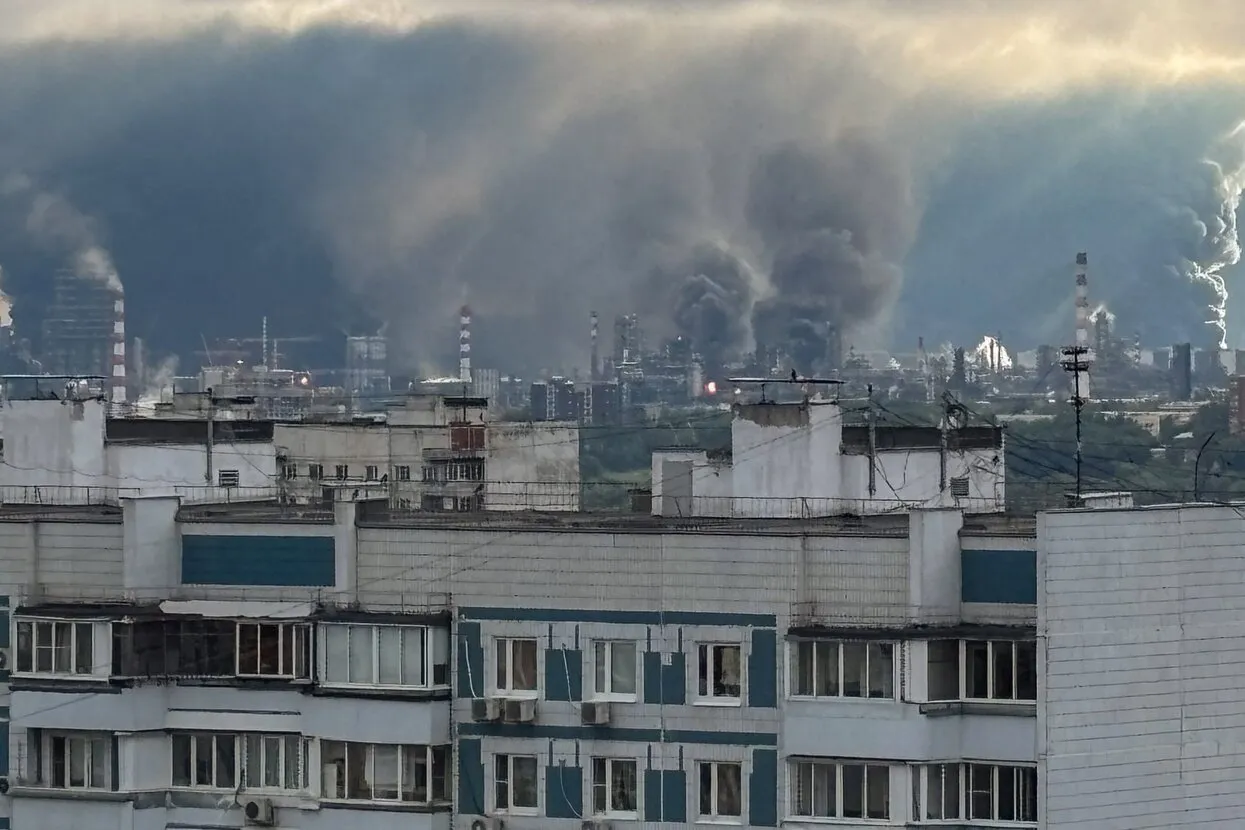
On June 16 and 18, Ukrainian drones broke through defenses in southeastern Moscow and knocked out both primary oil distillation units at the Moscow oil refinery. During the second strike, several fuel storage tanks caught fire, and smoke from the blaze blanketed the surrounding residential neighborhoods. In carrying out the attack, Ukraine’s Armed Forces achieved several objectives at once: they continued their campaign of strikes against oil refineries; demonstrated their ability to penetrate Russia’s most powerful and layered air defense zone; and produced striking footage that they showed to Western allies. The footage was equally telling for Russian officials and military commanders: even in the Moscow region, the air defense system is plainly incapable of stopping a mass strike. Ukraine’s Armed Forces have learned to assemble the forces needed to overwhelm the radars and launch systems protecting the most heavily guarded facilities. Other defensive approaches are either used in limited ways or remain in the testing phase.
How Ukrainian drones learned to penetrate Moscow’s air defenses — and what the latest strikes have cost Russia
Since the spring of 2026, Ukraine has made sequential strikes on Russian oil refining infrastructure the top priority of its air campaign. The choice was deliberate:
- Ukraine’s Armed Forces and intelligence services have a reliable supply of only one long-range strike weapon: drones of various models carrying relatively small warheads weighing several dozen kilograms. As a rule, such UAVs — which strike targets more than 500 kilometers (310 miles) away — carry warheads roughly half as powerful as those on the latest Russian Geran drones. Ukraine does not yet have enough cruise or ballistic missiles to sustain a mass air campaign.
- Warheads of several dozen kilograms are poorly suited to destroying, say, the reinforced-concrete structures of defense industry plants or large bridges. It therefore makes more sense to hit unprotected targets in open areas — targets that also carry high value for the Russian economy. Oil refineries in the European part of Russia fit those criteria precisely.
Ukraine’s previous campaign against oil refining infrastructure in the fall of 2025 showed that maximum damage requires sustained, systematic pressure. When strikes were infrequent and targeted only the most vulnerable large primary distillation units — atmospheric vacuum distillation units, or AVTs — Russia was able to restore production relatively quickly. In the spring and summer of 2026, Ukraine’s Armed Forces are striking more often and hitting a wider range of targets. In addition to AVTs and fuel storage tanks, they are hitting deep-processing units that are harder to repair and require imported spare parts. According to Bloomberg, all of this has driven gasoline output down 13% year-on-year as of late May — close to the threshold at which the country would face a fuel shortage. Since then, strikes on refineries have continued, although repairs to the damaged plants are also underway.
- The Moscow refinery belonging to Gazprom Neft had until recently suffered comparatively little from Ukrainian strikes — hit only sporadically, with long gaps between attacks. The plant sits within a powerful air defense zone and has its own point-defense systems, which are clearly more numerous than those at most other facilities.
- The difficulty of penetrating those defenses paradoxically creates not only technical challenges but political benefits for Ukraine: if Ukraine’s Armed Forces begin routinely breaking through the layered protection, it will demonstrate to Ukrainian and Russian society alike — and to the West — the weakness of the Kremlin.
The June 18 breakthrough appears to have involved a substantial drone formation. Russia’s Defense Ministry called it a record, claiming nearly a thousand UAVs were shot down — though those claims are not credible.
What can be said with certainty is that the attack was unusual.
- It made heavy use not only of the traditional long-range FP-1 and Liutyi drones but also of other systems — including the Sichen UAV, which shares the same aerodynamic configuration as the Russian Geran.
- The attack also set a record for the number of drone strikes captured on video — a fact that probably reflects not only the scale of the attack but also the fact that the aerial engagement over the refinery took place in daylight in a densely populated area.
- Video footage also captured numerous misses by interceptor missiles from the Russian surface-to-air missile systems defending the plant.
- There is not a single video showing a drone being definitively brought down by any weapon other than interceptor missiles.
In any case, Ukraine’s Armed Forces struck several units and fuel storage tanks at the refinery. Drones also came down on the grounds of the nearby Sadovod market, on apartment buildings, and on construction sites in adjacent residential neighborhoods. That last detail suggests that when Ukraine’s Armed Forces compiled the flight mission, they may have been working from outdated digital maps rather than fresh satellite imagery — maps on which new buildings and construction cranes had not been marked.
The full extent of damage to the refinery is not yet known. The Reuters news agency reported that one of the two AVT units — with a primary processing capacity of six million tons of oil per year — had been damaged as early as June 16 and was expected to be repaired within the week. But the June 18 strike hit the second unit and other facilities and pipelines at the plant. The refinery has likely halted processing entirely, at least for several days. Its longer-term fate will depend on how sustained Ukraine’s Armed Forces’ strikes prove to be.
So why has air defense stopped coping with Ukrainian attacks?
Russia began facing mass drone attacks later than Ukraine did and still lacks an integrated air defense system for countering them.
- There is no UAV detection system covering all border regions, let alone territory deeper inside the country. Ukraine, by contrast, has built a layered detection complex consisting of: 1) intelligence assets that provide warning of launches; 2) a radar network capable of tracking low-flying, slow-moving targets; and 3) a network of acoustic sensors that detect drones by engine sound.
- Russia also lacks a system for automatically sharing information between different sensors and UAV-intercept weapons.
- There is a shortage of layered, specialized drone-intercept weapons. Ukraine’s defense system involves both aviation — various types of aircraft and helicopters that can be rapidly repositioned along a drone formation’s flight path — and mobile fire teams equipped with interceptor drones incorporating machine-vision elements. These teams cover both the flight approaches of UAVs and the protection of specific facilities. Ukraine receives a significant portion of its equipment — including many radars — from the West. Even so, this defense is not absolutely effective, and beyond the Kyiv area, attacks by drones alone — even without combining them with missile strikes — still pose a serious threat.
- Russia’s armed forces rely more heavily on point defense of individual facilities, which is easier to overwhelm with a large number of targets. The backbone of that defense consists of surface-to-air missile systems (SAMs), whose numbers and production rates are limited. The air defense system was designed to repel aircraft raids and small numbers of cruise missiles. The appearance in its coverage zone of dozens of drones flying at low altitude — often without advance warning from command — complicates the task of countering attacks.
- Russian aviation participates in repelling attacks, but the assets committed are clearly insufficient. Mobile fire teams are also in short supply, and their weapons — primarily machine-gun mounts with specialized sights and man-portable SAMs — are not very effective against UAVs. Russian interceptor drones, mainly the Yolka system, are deployed at the front, where they engage small and medium-sized drones. They carry no warheads and are therefore unlikely to be suitable for destroying large UAVs weighing hundreds of kilograms.
The Russian military is developing other defensive tools and approaches, but most are still in the testing phase. Several variants of automatic turrets with rapid-fire cannons are being evaluated, including versions firing proximity-fused shells capable of destroying drones with a near-miss rather than a direct hit. Portable radars for detecting UAVs are also being produced, but there are clearly not enough of them even at the front.
Assembling these weapons into an integrated system could take many months — time during which Ukraine’s Armed Forces could further scale up drone production and acquire additional mass-strike capabilities.
At Meduza, we are committed to transparency about our use of artificial intelligence in the newsroom. The story you’re reading was written by one of our living, breathing journalists and translated from Russian using an AI model configured to follow our strict editorial standards. This translation process is the result of extensive testing and refinements to ensure our English-language coverage is timely and accurate. A Meduza editor reviews every draft before publication.
If you find any errors in this translation, please contact us at reports@meduza.io.
To read Meduza’s exclusive content in English, please subscribe to our newsletter.
The Analysis Desk
Does this matter?
Yes. Until they are repaired, the entire refinery will be shut down.
Turret
A movable mount for a weapon (usually machine guns or automatic cannons) that provides vertical and horizontal aiming.