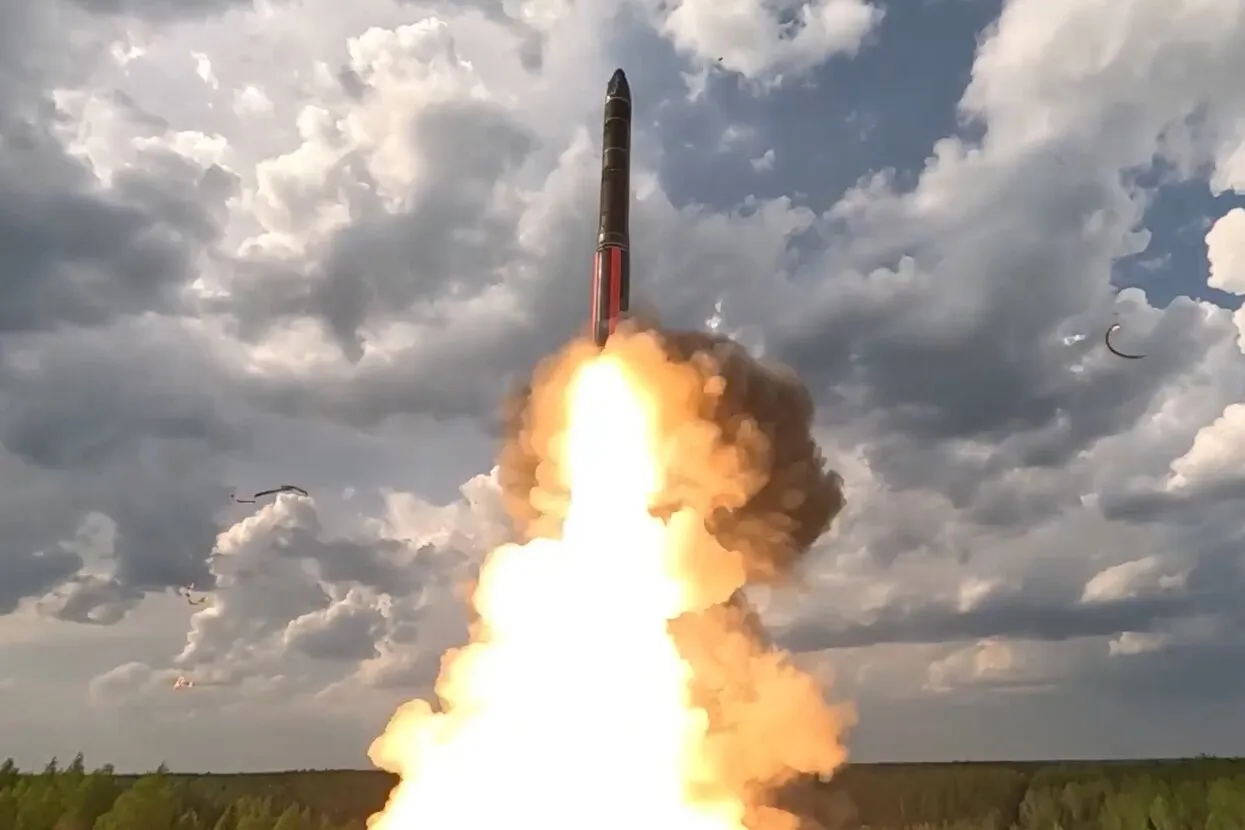
Orthodox oligarch Konstantin Malofeev presents Russia’s future scenarios at economic forum — the ‘positive’ one involves a nuclear strike
Konstantin Malofeev, the founder of the Tsargrad television channel, presented a report on scenarios for Russia’s future at the St. Petersburg International Economic Forum. He said the report was prepared by the Tsargrad Institute in collaboration with a group of “experts” that included far-right philosopher Alexander Dugin and Vologda Governor Georgy Filimonov.
The report’s authors listed the threats they believe Russia faces and divided them into five groups. Below are quotes from Malofeev’s presentation.
- Geopolitics: Russia’s destruction in war, the country’s disintegration, external governance.
- Ideology: replacement of the cultural code, revolution, conspiracy.
- Demography: societal degradation, replacement migration, population extinction.
- Economics: loss of control over resources, supply chain disruption, loss of financial sovereignty.
- Technology: critical external dependence, biological weapons and biotechnology, artificial intelligence.
The report identifies Russia’s destruction in war and biological threats such as new pandemics and bioweapons as the primary dangers.
The authors of the report outline three scenarios they believe could unfold for Russia in the coming decades: an inertial one (“Things continue as they are”), a negative one (“Russia’s enemies succeed in carrying out their strategy”), and a positive one (“We are doing everything in the best possible way”). For each, they identify two milestones: 2036 and 2050.
Here’s what each scenario envisions.
Inertial scenario
- 2036: a frozen conflict with Ukraine; no conditions for a quick victory; a new arms race.
- 2050: U.S. or Chinese hegemony; the collapse of NATO; technological control by Western artificial intelligence; growing threat of Russia’s destruction in war.
Negative scenario
- 2036: defeat in the war with Ukraine; Ukraine joins NATO; wars in South Ossetia and Transnistria; the preservation of “regional sovereignty” in a reduced form.
- 2050: the “colonization” of Russia; the complete loss of sovereignty; a unipolar world; the creation of a military bloc based on the European Union.
Positive scenario
- 2036: the use of nuclear weapons; the collapse of the European Union; the capture of Kyiv and Odesa; the full subjugation of Ukraine — either through annexation, turning into a buffer state, or the creation on its territory of a “new East Slavic state.”
- 2050: Russia ensures “global security and justice,” the formation of its own macro-region in Eurasia, and the “trinity of the Russian people.”
To achieve the positive scenario (which, again, includes a nuclear strike), Malofeev and the report’s other authors propose a list of 10 “best actions” for the Russian authorities. These include “de-Westernization,” autocracy, a cult of the family, urban depopulation, and a new Constitution.
At Meduza, we are committed to transparency about our use of artificial intelligence in the newsroom. The story you’re reading was written by one of our living, breathing journalists and translated from Russian using an AI model configured to follow our strict editorial standards. This translation process is the result of extensive testing and refinements to ensure our English-language coverage is timely and accurate. A Meduza editor reviews every draft before publication.
If you find any errors in this translation, please contact us at reports@meduza.io.
To read Meduza’s exclusive content in English, please subscribe to our newsletter.
What is this?
A nonprofit organization founded by Konstantin Malofeev. It describes itself as a “Russian scientific and expert center” that develops strategies “in key areas and spheres of governance” of the Russian Federation. The institute’s executive director is philosopher Alexander Dugin.
Почему 2036-й?
Малофеев заявил, что этот год был выбран как «год безусловного трансфера». Согласно поправкам к Конституции, принятым в 2020 году, Владимир Путин не сможет оставаться у власти после 2036 года.
What?
Yes, we were surprised too. Malofeev did not explain why he and the other authors of the report consider a nuclear strike a “positive” scenario. In his original presentation at the St. Petersburg International Economic Forum, it was part of the inertial scenario, but he later said: “We do not consider the use of nuclear weapons an inertial scenario — we consider it a positive one.”
But wait, Russia already has this
Alexander Dugin agrees. During the discussion of the report, he said: “We already have autocracy, but it has not been acknowledged. Its legitimization is proceeding slowly.”