Russia’s war reaches the sandbox as tank carousels and fighter jets take over Moscow’s playgrounds
Russian authorities are pushing propaganda and ideology into universities, schools, and kindergartens. Militarist trends have reached even playgrounds, driven by this year’s 80th anniversary of the Soviet victory over Nazi Germany. On the eve of Children’s Day, June 1, a photographer from the independent journalism collective Bereg visited Moscow’s playgrounds to document what urban childhood looks like in Russia today. Architecture journalist Asya Zolnikova spoke with playground architects and a child psychologist. Meduza is republishing the story in full.
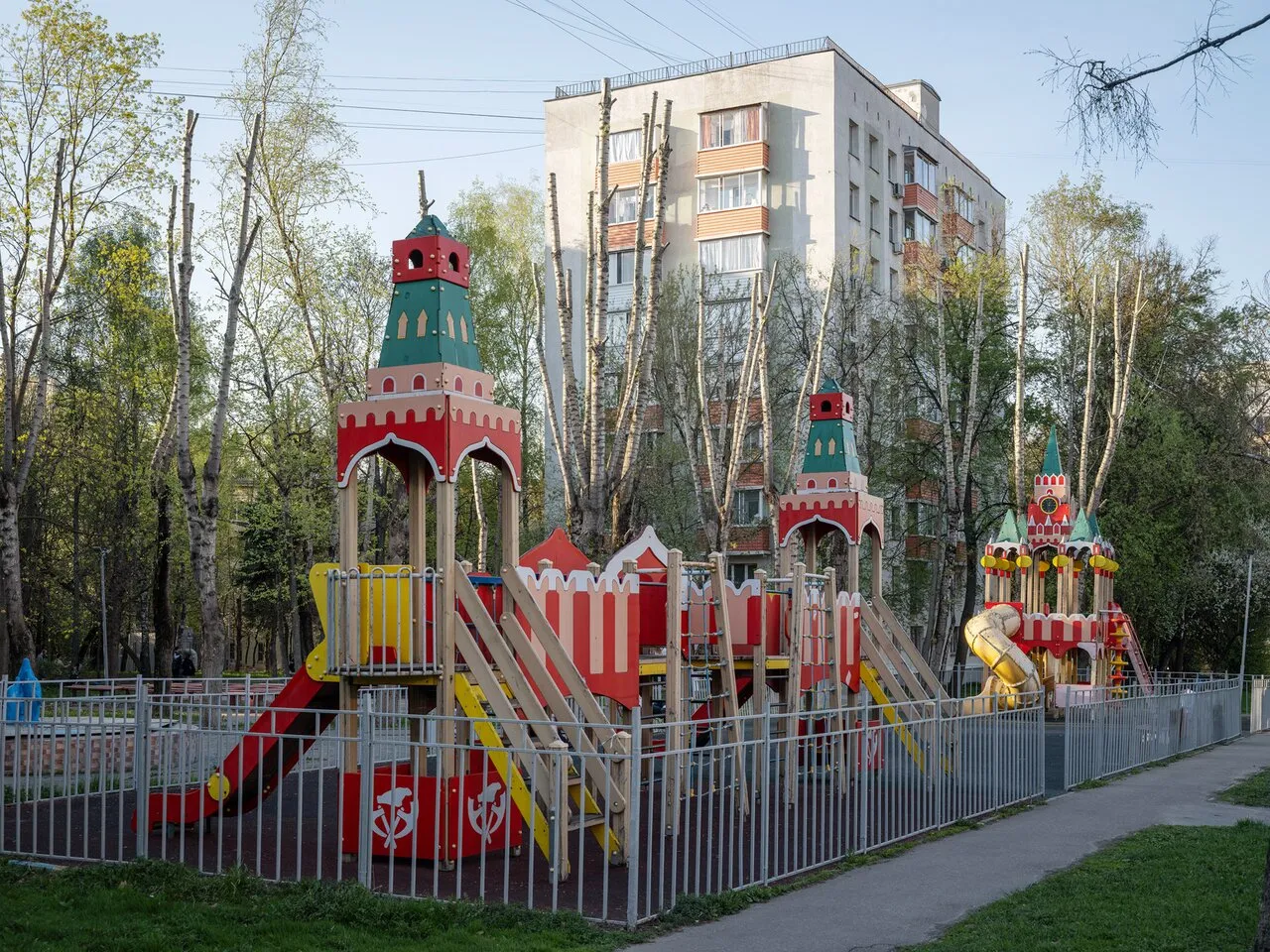
A playground in Moscow’s Cheremushki district
A playground in the VDNKh district
A playground in Yuzhnoye Butovo
Names have been changed to protect sources’ safety.
Natalya
designer of children’s play spaces
What a playground looks like depends on who is paying for it. A developer or a prominent institution has a marketing strategy and wants the playground to be image-driven. Projects at that scale bring in architects, designers, and other specialists.
When construction is funded through a municipal program — especially outside Moscow, in regions with tight budgets — the priorities shift to the practical needs of housing maintenance offices and local administrations. Patriotic-themed playgrounds may have appeared in manufacturers’ catalogs simply because they are easier to sell.
Still, Kremlin-themed play structures are not tied to the patriotic education trend, they’ve been a fixture in Russian courtyards for decades. The Kremlin is simply one design among many.
Thematic play spaces are a fine idea: they can serve as a springboard and a setting for play. Finland, Sweden, and other countries have playgrounds where children can play at being firefighters, police officers, or other workers.
There is no research I know of that definitively establishes what playgrounds should look like, or whether any particular design is better for child development than another. The most important thing is that a child be surrounded by other children to play with.
A playground in the Butyrsky district. The inscription behind the slide reads: ‘Thank you for the Victory’
The Butyrsky district
A children’s playground in the Butyrsky district
The Butyrsky district
A children’s playground in Golyanovo
Tatyana
designer of children’s play spaces
Many Russian architects draw on neuroscience, pedagogy, and other fields when designing playgrounds — an approach that meaningfully improves outcomes for children. For instance, children need to move and spin in different directions during play; vestibular stimulation promotes brain development.
A play space should also offer several distinct play scenarios: quiet or active, group or solo. A playground in the courtyard of an ordinary apartment building works best when built from as many abstract elements as possible — that way, children can reinvent it each day and won’t get bored.
A playground in a place children don’t visit every day [for example, a city center or a park] can look like a sculpture.
Moscow’s developers and city authorities have accumulated considerable experience and visual literacy. Compared to 10 to 15 years ago, they have come a long way. But the improvement hasn’t reached every courtyard.
It is hard for me to say whether Moscow has seen a significant increase in patriotic-themed playgrounds, but these photographs suggest they are the work of Zhilishchnik, the city’s housing maintenance agency — these are playgrounds renovated with state funds.
These playgrounds display a desire to plaster images and symbols everywhere — symbols that serve no function except to signal loyalty to the authorities. This clearly isn’t being done for the children’s benefit. But it earns praise from local district administrators.
A playground in Reutov, Moscow region
Maryino
A children’s playground in the Bogorodskoye area
A children’s playground in the Butyrsky district
Maria
child psychologist
A playground is, above all, a place for play, and children’s play is a bridge between physical reality and the many symbols a child projects onto the surrounding world.
Playgrounds built around a prescribed political agenda constrain play and channel it into fixed forms. If a toy car says “police” on it, the child will most likely play with it as a police car. In my view, this is an attempt to control children’s play and increase their tolerance for state symbols.
The more abstract the environment and the less it is moderated, the more opportunities children have to fill it with their own content, invent stories, and learn about themselves and the world.
Children’s “ideal” play spaces are vacant lots, alleyways, construction sites, and forests. Children are drawn to those places even at the cost of their own safety. Patriotic playgrounds will inevitably push more children “into the alleys” — especially younger adolescents, simply because they are boring.
A playground in Lyublino
A children’s playground in Chertanovo
A children’s playground in Chertanovo
A playground in Maryino
A playground in Chertanovo
At Meduza, we are committed to transparency about our use of artificial intelligence in the newsroom. The story you’re reading was written by one of our living, breathing journalists and translated from Russian using an AI model configured to follow our strict editorial standards. This translation process is the result of extensive testing and refinements to ensure our English-language coverage is timely and accurate. A Meduza editor reviews every draft before publication.
If you find any errors in this translation, please contact us at reports@meduza.io.
To read Meduza’s exclusive content in English, please subscribe to our newsletter.
Asya Zolnikova for Bereg
Can you give an example?
Natalya cites the Salyut playground by the AFA architecture bureau in Gorky Park as one such project.
GBU ‘Zhilishchnik’
A property management and municipal services organization in Moscow. It maintains apartment buildings and surrounding grounds.