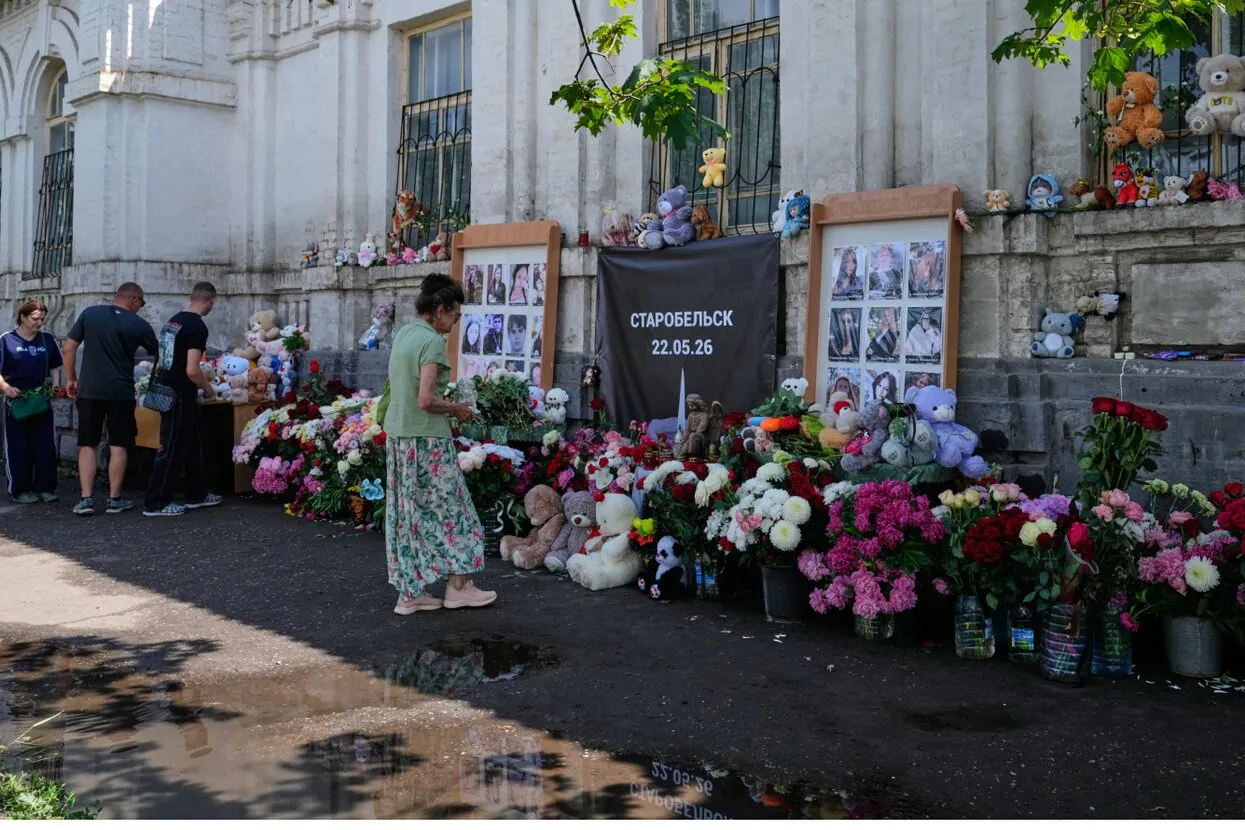
Friends of the dead dispute Ukraine’s claim that a strike on a college in occupied Luhansk targeted a Russian drone unit’s headquarters
On the night of May 21–22, Ukrainian drones struck targets in the annexed Luhansk region, hitting the Starobilsk Pedagogical College and the Vocational College of Luhansk Pedagogical University. The two colleges share a dormitory building; because the vocational college has no basement of its own, students from both schools shelter in the pedagogical college’s basement during air raid warnings. According to Russian officials, about 80 students were in a shared dormitory at the time of the attack, having returned to their rooms after an earlier alert. Twenty-one people were killed; many more were wounded. Bereg, a cooperative of independent journalists, spoke with classmates and friends of the dead.
Alina
Fourth-year student at Starobilsk Pedagogical College, friend of Veronika Dashchenko and Oksana Tereshchenko, who were killed in the attack
I’m from the Troitske district [in the Luhansk region]. The war started when I was finishing grade school. My parents and I decided I would study in Starobilsk — they didn’t want me going far, and financially they couldn’t manage anything else.
Oksana Tereshchenko — we called her Ksyusha — was from Bulhakivka in the Kreminna district. She had studied in Lysychansk before, but she was caught in shelling there once and barely got out. She transferred to our college partway through her first year. At first, not many people talked to her, since she was new. Then our class adviser suggested she become the group leader and fifth-floor dorm monitor. Ksyusha took it seriously, and she kept us in line.
Oksana Tereshchenko
“Information Support of the President of Russia” community on VKontakte
She shared a room with her younger sister Katya and with Veronika. Veronika was from Sievierodonetsk. We met when we enrolled at Starobilsk Pedagogical College, both studying to teach elementary school. We didn’t socialize much in first year, but by third year we were good friends.
Veronika was always smiling, always upbeat, always the one cracking jokes in class. I never saw her sad or crying. She was just really real with you. She played volleyball and competed in tournaments in Luhansk.
Veronika Dashchenko
Veronika Dashchenko’s VKontakte page
The three of us — me, Ksyusha, and Veronika — were close. We did our homework together. Besides studying, we hung out in the park, went to cafes and bars, but we’d be back in the dorm by nine. Ksyusha had a boyfriend; Veronika had also recently started seeing someone.
During attacks, we’d sit in the basement and talk about exams and what we were wearing to graduation. Our ceremony is June 30. Everyone had gotten used to the fact that the country is at war, and none of my friends ever brought up politics.
We didn’t talk much about the future, but none of us wanted to work in education. During our student teaching practice in lower grades, we realized how hard it was — both because of the paperwork [that teachers are required to do] and because children can be so tough. After college, Veronika and Ksyusha were planning to enroll in an online program in Sievierodonetsk. In what field — I don’t remember.
Before this [May 22], Starobilsk had been hit before. When we were in second and third year, the siren went off every hour and we were constantly stuck in the basement. It was really annoying — you couldn’t eat, couldn’t shower, couldn’t finish your work. But everyone understood it had to be that way. Students from the vocational college also came to us, since they have no basement. Still, none of us thought the basement would save anyone if [a drone] hit the dormitory building directly. Once, a drone came down in the back courtyard of the college and was disarmed [by emergency services workers].
That night, I was at the dorm. I usually go home on Thursdays, but we had a test scheduled for that Friday, so I stayed. The pedagogical college is a five-story building. The top two floors are the dormitory; floors one through three house the university and the college. Around ten in the evening the [air raid] alert started and we went down to the first floor. This year, we didn’t usually go all the way to the basement — we mostly stayed on the first floor, where the long hallways have no windows. It’s like being in a tunnel.
This time, we sat there for about two hours. We listened to explosions and heard drones flying over.
Then they let us go back to our rooms, and the dorm monitor told us not to turn on the lights and to stay quiet. We’d barely been sitting there — maybe 20 minutes — when there was another alert. We were told to stay in the fourth-floor hallways. Then a drone hit a car parked in the back courtyard of the college — it exploded. Panic broke out in the hallways and everyone ran to the first floor.
About 10 seconds later, two more drones hit. Plaster rained from the ceiling. Students started running outside, but there was a white haze [of construction dust] and not everyone could make it out. The building has two exits, and the main one is locked at night. I grabbed a first-year girl and we ran for the second exit. Whoever made it out hid in the back courtyard, behind the trees and bushes.
That’s when the drones really opened up. About 20 meters [65 feet] above us, a drone was flying and dropping its payload — firing and bombing. Black dots flew through the air and exploded. First there were two strikes on the vocational college, then on ours. Burning shrapnel flew everywhere; right in front of us, the pedagogical college caught fire. This was deliberate. They were targeting the colleges.
Ukraine's comments about the Starobilsk attack
The General Staff of the Armed Forces of Ukraine says it targets “military infrastructure and facilities used for military purposes.” Ukrainian military officials identified the target in Starobilsk as “a Rubikon unit command post” — Rubikon being the Russian Defense Ministry’s main organization for developing and deploying drones.
Kyiv dismisses the Kremlin’s claims that Ukrainian forces struck civilian infrastructure in Starobilsk as “manipulative.”
I called my parents. My dad was screaming at me to get as far from the college as I could. But we were trapped — there was an iron fence around the dorm we couldn’t get over. I had two freshmen and two sophomores with me. We sat through 16 explosions. Finally we got over the fence and ran. Some people we knew picked up me and one of the other girls; then my dad drove us home. I got out with just scratches and a bruise on my leg.
I didn’t see Ksyusha or Veronika that night. Later I was told that many people had been hurt and many were trapped under rubble. A boy from my class, Maxim Kopylov, was pulled out from under the concrete slabs — his leg had to be amputated.
At first, people in our group chat on Max were writing that Veronika and Ksyusha were alive. But the next day, our class adviser sent a voice message in tears, saying Veronika was gone. I asked about Ksyusha, and she said she had just been to the morgue and identified her too. Ksyusha had no parents — her mother had died, I think. Her younger sister Katya, a third-year student, is now in the hospital.
While some of the students were still alive under the rubble, they were sending videos to their parents, saying they could hear the rescuers. When rescuers were pulling them out, they kept having to stop work because the drones would start flying again. Not shooting — just flying overhead.
I honestly don’t know why the drones hit our college. People are writing that there were military facilities nearby, or that soldiers lived there and assembled drone parts. Even in my own town, some people are saying we need to figure out exactly what happened. That’s nonsense. There was no military anywhere near there. There are soldiers in the city — there’s a checkpoint at the entrance — but near our college? Never. I’m still scared. A strike can come anywhere, any time.
Nazar
Student at Taras Shevchenko Luhansk National University, who knew Artem Kovtun
Artem was my best friend’s cousin. Genuinely one of the nicest, calmest guys you could know — never hurt anyone, always the first to help.
Artem Kovtun
Tetyana Slipets’s VKontakte page
He was a third-year programming student and had a job with the Starobilsk city administration. He was really into sports — the last time I saw him was at the gym.
He and his girlfriend Kira were always together. They were supposed to get married this summer. Kira came to identify his body with an envelope full of cash. She said it was the money they’d been saving for the engagement.
Yulia
Third-year student at Starobilsk Vocational College of Luhansk Pedagogical University, friend of Alisa Bryukhovetska and Anna Pohribnychenko, who were killed in the attack
I’d known Alisa for two years. When everyone was moving into the Starobilsk Vocational College dorm our first year, people just went room to room saying hello. That’s how I met her.
She was from the Novopskov district, and I’m from Bilokurakyne [both in the Luhansk region]. We’d both started at the vocational college — me studying to be a cook, her studying to be a hairdresser. But she didn’t really like it. After almost two years, she transferred to Starobilsk Pedagogical College to become an elementary schoolteacher.
She was in her first year there [when she was killed]. She wanted to work with kids. She had so many plans. She’d tell me how great things were in her new dorm — she had friends there, they went out together, had fun.
Alisa Bryukhovetska
Alisa Bryukhovetska’s TikTok page
We were really close. I have so many memories of her. Alisa loved anything that gave her a rush: going fast in a car, poking around abandoned buildings — whatever you came up with, she was always game. She was kind and dependable; you could talk to her about anything, crack up laughing with her. She never said no to anyone and was always ready to help.
We hung out a lot together. The last time was in early May, in the park. The last time we actually spoke was May 16. I was home in Bilokurakyne, she was in Starobilsk. We called each other and just talked.
The morning of May 22, I was scrolling through groups when I saw the news. Then mutual friends started texting me to ask where she was, and I had nothing to tell them. Then the lists [of the dead] started going around, and I checked them all. At first, Alisa was listed as missing. Everyone held out hope until the very end that she’d turn up alive. Then the college’s group chat posted that her death had been officially confirmed. When the attack started, she tried to run outside but didn’t make it. They say she burned alive.
I didn’t know Anya [Pohribnychenko] all that long. We met by accident. She also lived in Bilokurakyne, and one day we were both at the bus station and started talking. She was in her second year at the pedagogical college, studying to be a kindergarten teacher.
Anna Pohribnychenko
Anna Pohribnychenko’s VKontakte page
After that, we kept running into each other at the bus station, riding home together, and just talking. She loved to talk — you could always find something with her. Anya was super kind, warm, genuine, bubbly. She just had so much energy, so much love.
I also found out about her death through posts online. Like Alisa, Anya was listed as missing at first. She was found later on the fifth floor — buried under a concrete slab.
Anya wanted to have her wedding this summer. Her boyfriend is in the army right now, in the Special Military Operation zone. But this awful tragedy cut all her dreams short. It’s hard for me to accept that she’s gone.
The war never really came up with either Alisa or Anya. The only thing I have left of Alisa is her hoodie.
Before the war, I’d never once been to Starobilsk. It’s a beautiful city, but now there are air raid alerts and a curfew. Usually, the siren starts going off when a drone is already in the air. Before, whenever that happened, everyone from our college was sent to the pedagogical college’s basement. That night, some of the students also went down [from the dorm] to the basement. But [I heard] that when [the Ukrainian drones] really started coming in and the building caught fire, they ran for the street — some jumped out of windows.
My college is just walls now. The pedagogical college is wrecked — some parts are more or less intact, but I’ve been told they’ll most likely never be restored.
I haven’t been back in Starobilsk since it happened, but I’m planning to go. I’m scared mostly because of what happened there, not because of another attack. But sooner or later I’ll have to go to the memorial.
Irina Novik for Bereg
Troitske, Luhansk
In 2020, the district was reorganized as Troitske Municipal District. It lies in the north of Luhansk region. The administrative center is the town of Troitske, about 220 kilometers from Luhansk.
Kreminna, Luhansk
In 2020, the territory of Kreminna district was divided between Svatove and Sievierodonetsk districts. It lies in the northwestern part of Luhansk region. Before the division, the administrative center of the district was the city of Kreminna.
Novopskov, Luhansk
In 2020, the territory of the district was absorbed into Starobilsk district. Before that, the administrative center was the town of Novopskov, about 100 kilometers from Luhansk.
Bilokurakyne
Until 2022, the town was under Ukrainian control.
Editor’s note
Starobilsk was attacked with one-way drones, which detonate on impact with their target. There is no evidence that the drones dropped munitions over the city.