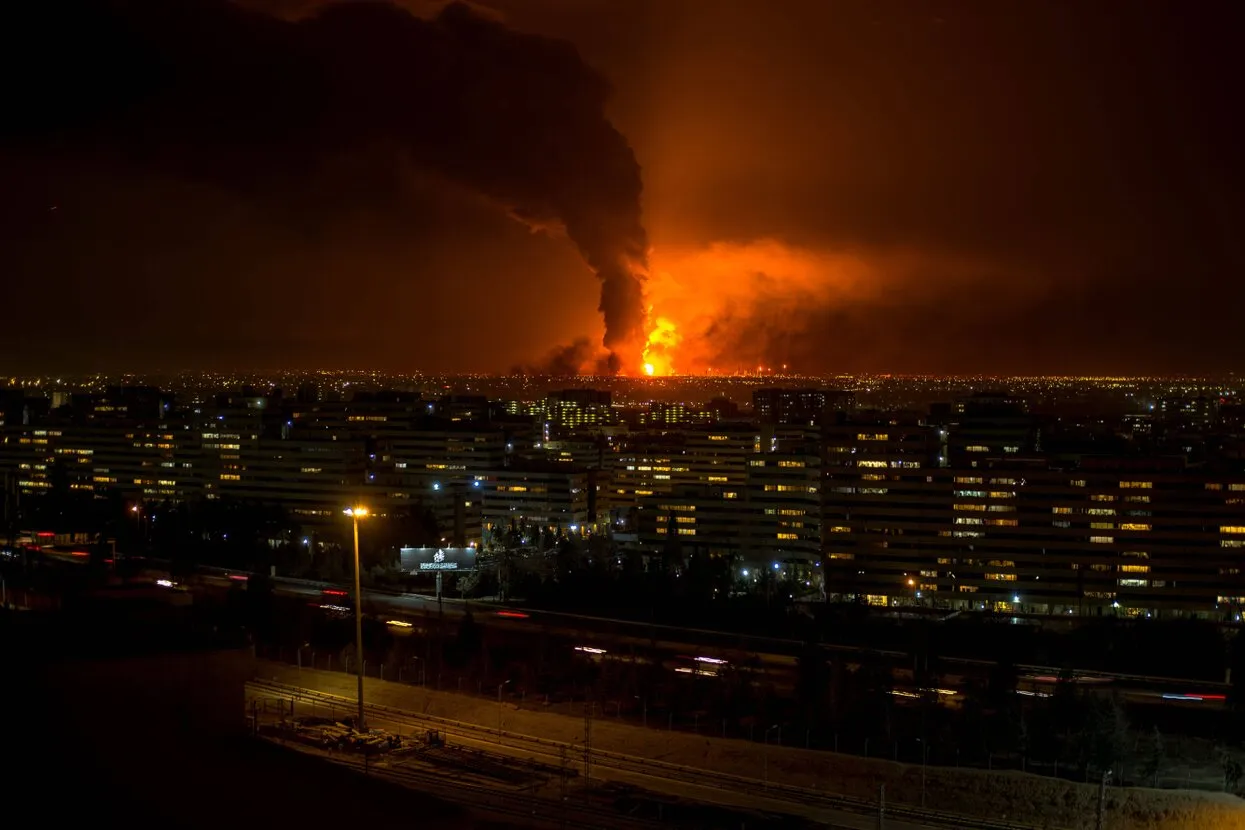
‘World War III is already underway’: Zelensky advisor Mykhailo Podolyak on what the new Middle East war means for Ukraine
When the U.S. and Israel launched a war against Iran in late February, Ukrainian President Volodymyr Zelensky warned that the new conflict could make it harder for Kyiv to obtain the missiles and other weapons it needs to defend its skies. At the same time, Ukraine itself is playing a role in the region: Kyiv has sent drone-defense experts to the Middle East to help U.S. allies in the Gulf protect themselves from Iranian strikes. To discuss how the two wars are connected, Meduza spoke with senior Ukrainian presidential adviser Mykhailo Podolyak.
Mykhailo Podolyak
— What consequences from the war between the U.S. and Israel and Iran is Kyiv expecting for Ukraine?
— If we’re talking about positive, strategic consequences, they’re possible only if the campaign to dismantle the Iranian regime is successful.
In my view, one such consequence would be the collapse of the global network of states in which Russia has acted as a kind of moderator, financing instability in different regions. I’m referring to Venezuela, Cuba, Iran, and much of the unstable Middle East. The dismantling of this entire vertical structure would sharply reduce Putin’s room for maneuver and his access to resources. In the long term, it could also push Russia out of the global energy market.
The destruction of Iran’s repressive regime is extremely important because it’s one of Russia’s key partners. Drawing on its engineering capabilities, Iran built the drone industry that Russia now relies on in its war against Ukraine. If that system is disrupted, drone production in Russia would slow down. Russia has only recently begun making some configuration changes to the Shahed drones, rebranding them as the “Geran.” But they were created by Iran. For a long time, Iran shipped drones across the Caspian Sea, after which they were assembled in Tatarstan.
Putin and the changing world order
Another possible consequence would be the final collapse of Putin’s reputation. Yes, he will still be taken into account in the Middle East. But when Russian components start turning up in the wreckage of the same Shaheds that strike places like Dubai, Abu Dhabi, Doha, or Cyprus, some countries may begin reconsidering the role Russia plays in all this — and whether it still makes sense to remain neutral [in the Russia–Ukraine war].
There are also negative consequences. One concerns the scale of internal repression in Iran and the killing of its own citizens. Just look at the most recent protests — what happened [the Iranian authorities’ reprisals against protesters] was simply unbelievable. Monsters like this must ultimately face severe punishment.
At the same time, there is an understanding that the war in Iran must reach its logical conclusion. Otherwise, it will resume in a year, because the current regime will not transform itself.
Other negative consequences of the campaign in Iran — assuming it doesn’t drag on — are short-term. They primarily concern weapons supplies. For Ukraine, the most important issue is interceptor missiles, although our missile defense systems are somewhat different. [Editor’s note: Persian Gulf states also use U.S.-manufactured Patriot systems and interceptor missiles to defend against Iranian strikes.]
Another consequence is the speculative spike in oil prices in short-term futures, which we’re already seeing. But I believe there will be a quick correction.
The Iran war and global oil prices
— Do “monsters,” as you put it, need to be punished even if that goes against international law?
— Formally, that’s a fair question. But the point is that international law was effectively killed in Ukraine on February 24, 2022. It simply no longer works.
At the same time, Russia’s invasion of Ukraine is fundamentally different from the entry of an American-Israeli coalition into Iran. Ukraine did not provoke Russia. Ukraine has no disputed territories. Ukraine never declared things like what Iran has declared: “Death to Israel,” “Death to America.” Ukraine did not build up a vast arsenal of short-, medium-, and long-range missiles or fund organizations like Hezbollah and Hamas.
Unfortunately, international law was buried in Ukraine, and the global institutions meant to enforce it were also buried beneath it. When [international law] was violated in Ukraine, Russia should have been automatically isolated, and its membership in all international organizations suspended. Its veto power in the U.N. Security Council should have been revoked or at least suspended for the duration of the aggression. None of that happened. Which means that, at that moment, everyone implicitly decided that international law is selective and ultimately meaningless.
— Regardless of Russia’s illegal invasion of Ukraine, the attack on Iran is still a violation of a country’s sovereignty. A lot of people were alarmed that Trump made such a decision.
— Humanity ultimately needs to accept that World War III is already underway. Its form has changed: there are hot zones, like the Middle East and Ukraine, as well as numerous hybrid theaters. And like any world war, it will lead to a change in the rules.
Trump, thanks to his political eccentricity, has simply accelerated many irreversible processes. For example, he is forcing Europe to become a real geopolitical actor. The approach of “Let’s sit behind a rock and hope the storm passes us by” will only lead to tragedy. More and more European countries now understand that they need to act proactively.
God willing, this war will eventually lead to a reconfiguration of international law, the global network of institutions, and their mechanisms for punishing violators. It may also remove countries like Russia from the ranks of global leaders. But for now, unfortunately, we are living inside a war.
— How big of a risk does the situation in Iran pose to Western supply of Patriot systems to Kyiv?
— There is a risk that missile deliveries will slow down, while Russia continues striking energy infrastructure, water supply systems, and now gas distribution as well. The launch systems themselves were mainly transferred to Kyiv by European countries that already had these systems deployed. European countries then purchase missiles for them from the United States through the PURL [Prioritized Ukraine Requirements List] program.
The danger is that the logistics of deliveries to Ukraine could slow down. But the war in the Middle East isn’t the only issue. These deliveries also involve lengthy discussions, fundraising, decision-making processes, and trade negotiations with the United States. In other words, many factors affect the speed of supplying this type of weaponry. I think the missile manufacturers themselves, given their dominant position in the market and the value of these systems, will be interested in increasing both production and sales.
Still, I hope that our Patriot systems — and those used by the Persian Gulf countries — have different configurations.
You’re currently reading Meduza, the world’s largest independent Russian news outlet. Every day, we bring you essential coverage from Russia and beyond. Explore our reporting here and follow us wherever you get your news.
— What do you mean by different configurations?
— Kuwait, Bahrain, and Ukraine use different versions of the Patriot system: first, second, third, and fourth generation variants.
Moreover, the Israeli and U.S. strikes have been quite effective. They are deliberately targeting missiles and their launchers and have already destroyed a significant portion of Iran’s stockpiles. The war itself may continue, but Iran’s ability to launch random strikes against different countries, as it’s doing now, could be reduced.
Of course, Iran can still use other types of weapons. But large-scale missile-and-drone attacks against neighboring Persian Gulf countries may no longer be possible.
— Will risks for Kyiv mainly arise only if the war in the Gulf drags on?
— A prolonged war would be dangerous not only for us but primarily for the region itself. It would become a question of logistics and food supply. Tourist routes [which pass through international hubs in Dubai and Doha] would effectively cease to exist, as would many oil and liquefied natural gas production operations. It would have social consequences.
That’s why a prolonged war and a long-term closure of the Strait of Hormuz would be extremely disadvantageous for everyone, including Europe. It would mean a completely different pricing structure — not only for energy, but for food as well.
Ukraine is dependent on these dynamics just like everyone else. But that would only be the case if the war continues at the same scale. If it doesn’t lead to such destructive consequences for regional logistics — and therefore for global energy markets — then the outlook for us will not be as bleak as proponents of apocalyptic scenarios like to predict.
There’s also another problem if the war in the Middle East drags on: the shift in informational and diplomatic attention away from Ukraine. A year ago, everyone focused entirely on Iran for several days, and the topic of Ukraine moved to the periphery. For now, though, I don’t see that trend emerging.
— Is Kyiv considering the unlikely but still possible scenario in which the war in Iran spreads to European countries? Would that affect Western support for Ukraine?
— The war in Iran will not spread to European countries. A single missile or drone crossing into Europe does not mean the full expansion of the conflict. Southern Europe will now need to monitor its airspace more carefully, but the war itself, in the full sense of the word, will not move there.
— You mentioned the “logical conclusion” of the war in Iran. What do you mean by that?
— A reconfiguration of the government. Specifically: abandoning the ideological doctrine of strict Islamization, opening Iran to the global energy market, a total reduction of its military complex, and ending the financing of Hezbollah.
More from Podolyak
— Do you really think that’s realistic?
— Absolutely. The ayatollah regime, which has existed for 47 years, has reached its end. It is no longer viable. The same applies to the regimes of Kim Jong Un and Putin. The fact that they still exist does not mean they can exist indefinitely. It’s a matter of resources and integration into global competitive relations. All of them are closed systems — they are not competitive.
[Iranian] society is not apathetic; it resists, and that resistance should lead to change. The same thing happened in the late 1980s in the Soviet Union. After that, irreversible processes begin. They cannot be stopped.
— The Wall Street Journal recently reported that European and Ukrainian negotiators believe Western countries’ shortage of interceptor missiles could jeopardize Kyiv’s peace talks with Moscow. After all, Western security guarantees for Ukraine include strengthening Kyiv’s air defenses. What does Ukraine’s presidential office think about this?
— Everything related to security guarantees — what they should look like, what investments will be made to ensure Ukraine has strong missile, anti-missile, and drone programs, how much it will cost, who will participate, and how the shares will be distributed — is being discussed with our partners in the United States and Europe.
If necessary, production will be expanded through investment programs.
— As I understand it, when it comes to air defense, production cannot simply be ramped up overnight. Manufacturing capacity is not so easy to scale.
— That’s correct. Production capacity has to be clearly defined: who produces how much, what will be purchased, what will be licensed for production in Ukraine or joint production, the schedule for funding, and the schedule for delivering the actual systems. All of this is currently under discussion.
— So the situation in Iran has no effect on the prospects for negotiations?
— No, other than on the logistics: right now a meeting is being postponed because, for security reasons, they have traditionally been held in Abu Dhabi.
Iran and the full-scale invasion of Ukraine
Interview by Elizaveta Antonova
Is this the case?
The PAC-3 configuration is used both by Ukraine and by Persian Gulf countries. A shortage specifically of PAC-3 interceptors could theoretically worsen if the war in the Middle East is prolonged.