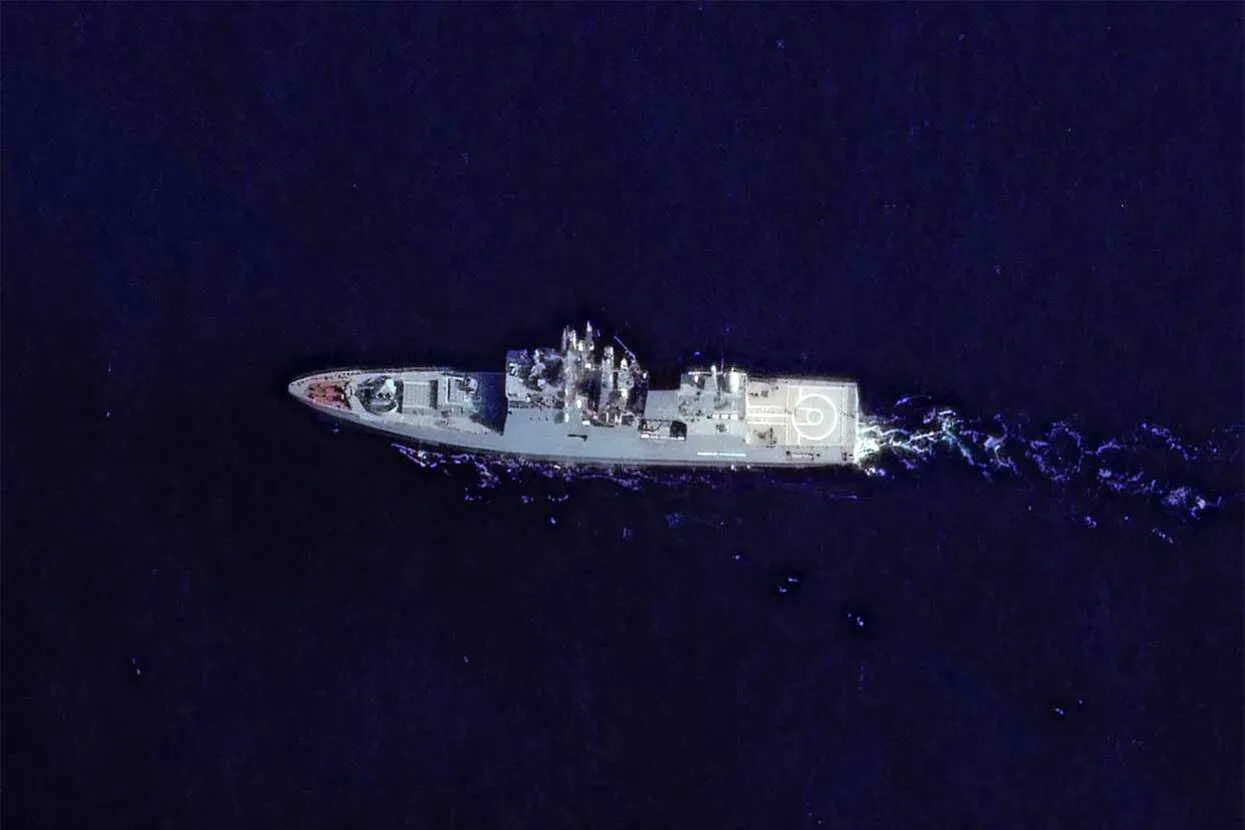
A Russian warship fired warning shots at an elderly British couple near the Isle of Wight. Now the couple says the UK is trying to hush it up.
On June 16, the Russian frigate Admiral Grigorovich fired warning shots at a small private yacht that had drawn close to it in the English Channel. No one was injured. Prime Minister Keir Starmer called the Russian sailors’ actions “reckless” but noted that the incident was unlikely to have been “malicious.” The yacht’s owners, meanwhile, said British authorities were deliberately trying to blame them to avoid further straining already tense relations with Russia.
The Admiral Grigorovich, according to BBC sources within NATO, was ordered last week to escort tankers carrying Russian oil.
After the ship was spotted in the English Channel, it was trailed by Royal Navy patrol vessels HMS Mersey and HMS Tyne.
On June 14, Britain seized a tanker believed to be part of Russia’s shadow fleet for the first time since the full-scale invasion of Ukraine. Prime Minister Keir Starmer emphasized that he personally gave the order. The ship’s captain was formally charged with violating UK sanctions.
The incident took place in international waters just under 40 kilometers (about 25 miles) from the Isle of Wight. Aboard the 12-meter (about 40-foot) yacht Bright Future was an elderly couple — Jane and Alan Kelvey, ages 69 and 71. They told the BBC and The Telegraph that they had done nothing wrong and that the Russian ship’s response was excessive.
According to the Kelveys, when the yacht drew near the Russian vessel, it sounded five blasts, after which the couple “immediately” altered course by two degrees to signal to the warship that they had seen it. That didn’t help.
Jane Kelvey told the BBC:
We immediately turned two degrees to port so they could see we had made a deliberate change of course, which meant we had seen them. Then a minute or so later they gave another five blasts on their horn, immediately followed by four to five small-arms fire. That wasn’t aimed at us — it was warning fire that went up in the air, we believe.
After the shots, Kelvey said, the couple started the engine — the yacht had been under sail until that point — and made a hard 90-degree turn. She also maintained that the yacht was not on a collision course. “As far as we were concerned, it wasn’t an incident until the gunfire started,” Jane Kelvey said. According to the Kelveys, the Russian frigate never tried to contact them, even though they were “by the radio the whole time” and would not have missed a call.
Russia’s Defense Ministry offered a different account. The ministry insisted that the crew of the Admiral Grigorovich first made repeated attempts to contact the vessel on the international radio channel, then fired signal flares and sounded warning signals. The yacht, the ministry said, failed to respond at all — only then, when the distance had closed to 150 meters (about 490 feet), did the ship open warning fire. “The crew of the frigate Admiral Grigorovich acted in strict accordance with international navigation rules and took all necessary measures to prevent an incident,” Russia’s Defense Ministry said.
Britain’s Defense Ministry, for its part, emphasized that the Admiral Grigorovich had not fired directly at the yacht. “It was an attempt to prevent a possible collision,” a ministry spokesperson said.
The Kelveys accused Britain’s Defense Ministry of echoing Russia’s account of events. Alan Kelvey said: “They’re trying to close the story down now, saying that it was foggy and they were shooting flares up. It’s rubbish.” Asked why London would do this, he replied, “It’s inflammatory, isn’t it?”
Britain’s Defense Ministry rejected the accusations. An unnamed military source told The Telegraph that if there had been any signs of dangerous or unprofessional conduct by Russian forces, London would have given it “more attention.” “We never miss an opportunity to point out that the Russians are bad,” the source said, adding that the yacht’s initial two-degree turn was probably insufficient.