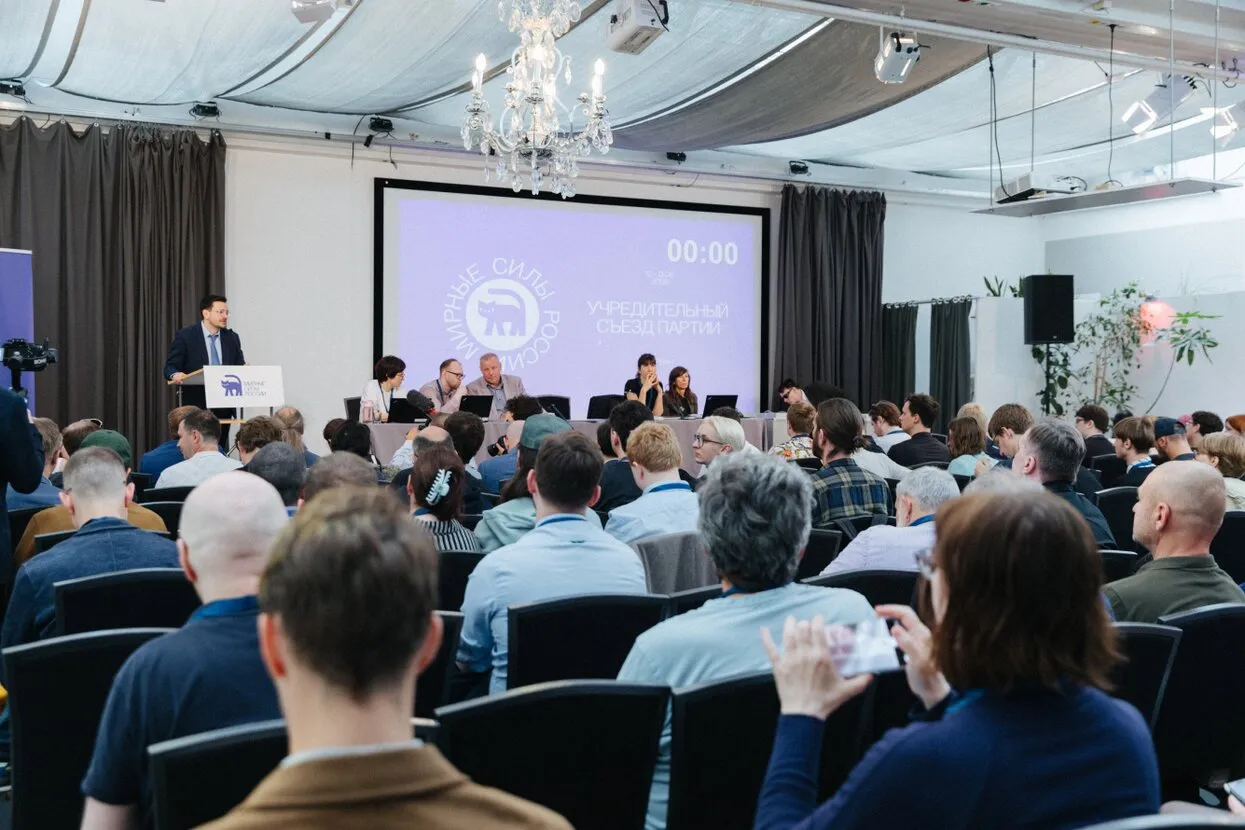
In a Berlin hotel, 111 Russian exiles spent last weekend building a political party they may never get to bring home
Warning: this article contains obscenities.
‘She jumped into politics with both feet’
Last weekend, 28-year-old Russian Maria Ivanova cried twice. First, out of fear that she wouldn’t make it onto the political council of the first political party she had ever joined. Then, from joy, when she did.
Ivanova received more votes than Sergei Gulyaev, a St. Petersburg politician with nearly 30 years of experience whom opposition leader Ilya Yashin had wanted as one of his deputies. Ivanova shared the news with her mother first.
Yashin announced he was forming a political party in March 2026. He named former St. Petersburg parliament deputy Maxim Reznik and former St. Petersburg municipal deputy Svetlana Utkina as the party’s first members.
The party’s two-day congress was timed to coincide with Russia Day, when Russians ostensibly commemorate the adoption of the Declaration of State Sovereignty of the Russian Soviet Federative Socialist Republic. The original plan was for the first day — closed to the press — to be devoted to adopting governing documents and electing leadership councils, while the second day would be open to journalists and include public remarks.
But disputes over the structure and authority of the governing councils ran long, throwing off the schedule. On the day the congress opened to journalists, delegates were still choosing Yashin’s three deputies, filling seats on the Central Political Council (CPC), and electing members of the party’s arbitration and audit wings. Forty-six people sought seats on the CPC, 16 on the arbitration council, and four on the audit council. Each candidate was given just two minutes to speak.
None of the delegates knew Maria Ivanova before the congress. She ran for every party committee to get a chance to speak from the stage.
Maria Ivanova
Meduza
Meduza
In her speech before the vote for deputy party chair, Ivanova said she had lived in Russia for 15 years, studied political science, but could not take part in politics because of her Ukrainian passport. She received Russian citizenship only in 2022, before the full-scale invasion of Ukraine. And right after it began, she left for Aachen under a German refugee program.
The congress was Ivanova’s first foray into political work — and her first public speech. From the stage, she told delegates:
Legitimacy is born of the support of one’s own people. But how can the people offer support if they don’t know whom to support? All the well-known opposition figures, sadly, are already dead… And Ilya Yashin is the only one [left alive], and right now he is forming a party, bringing us together to show that there are other politicians out there.
Ivanova later withdrew her candidacy for deputy party chair in favor of Maxim Reznik.
In her second speech — for a seat on the party council — Ivanova proposed creating a platform for debates and “investigating where Russia’s money in Europe is going and which politicians and opinion leaders are being influenced by the Putin regime.” At the end of her speech, she wanted to quote Aristotle but ran out of time.
She returned to Aristotle’s ideas when she introduced herself as a candidate for the next party institution — the audit commission. She compared Russian opposition figures in exile to ancient Greeks who had been ostracized. Ivanova paraphrased Aristotle’s idea that a person cannot exist outside the polis, then added her own thoughts:
If you exist outside the polis — that is, outside the state — then you are a superhuman. That is why I call on all of us to strive for our own superhumanness, while remaining engaged with what is happening in the world, what is happening in the country, what is happening around you and within your community.
Ivanova was elected to the CPC. Back in Aachen, she still can’t believe she “jumped into politics with both feet.”
‘We accepted almost everyone’
Ivanova found out about the party — which at that point had no name yet — from Ilya Yashin’s Instagram. To become a member, she sent an impassioned letter explaining why she wanted to join.
“I wrote about what’s most personal to me — that I’m a Ukrainian who spent her whole life in Russia, that I want to help and stand in solidarity with everyone fighting against dictatorial regimes that start wars and conflicts,” she told Meduza. Maxim Reznik called Ivanova to tell her she had been accepted into the party.
According to Yashin, the party’s founders received about 500 letters. Half the applicants lived in Russia.
Ilya Yashin
Meduza
Yashin personally invited some of the delegates — among them Russian deserter Alexander Sterladnikov, who received asylum in France and went on to found an organization called Farewell to Arms that helps other deserters.
As an honorary citizen of Paris, Yashin sometimes helps Sterladnikov persuade the French Foreign Ministry to issue a visa to other deserters. According to Yashin, it seemed important that the party include a representative of “people who have stuck their bayonets in the ground and refused to fight for Putin.” “If Putin has no soldiers, the war will end very quickly,” the politician said.
But most delegates were not there by personal invitation. “These are not my loyalists. These are people who heard my call,” Yashin explained.
According to Yashin, the 36-person organizing committee came together on a volunteer basis. “Of those activists who found out about the party and asked to join, we accepted almost everyone,” he said:
That led to debates and endless discussions — hours long, on every issue. And each member of the organizing committee had the right to invite as many delegates as they saw fit. So the delegate roster consisted of people recommended by organizing committee members.
The organizing committee began work on the party under the provisional name “Peaceful Forces of Russia” several days before the congress convened. Yashin said another name had been considered — “Peaceful Force” — but was rejected because its Russian initials produced the unfortunate abbreviation “PMS.”
Around the same time, reports surfaced of a falling-out between Yashin and Reznik, the party’s co-founder. Reznik accused his colleague of trying to build “a party for Moscow strongmen” and said he had been kicked out of the project’s working group chats while control shifted to Yashin and his inner circle. Yashin’s representatives, responding to a request from the outlet Vot Tak, said Reznik “needs treatment” for “problems with alcohol.” Reznik shot back that “after a hypertensive crisis and a minor heart attack, he had already undergone treatment.”
At the congress, Reznik continued to criticize Yashin, calling him a “usurper,” but the conflict seemed to have settled.
‘The branding wasn’t very successful’
The organizing committee got its first glimpse of the congress’s branding only two days before the event. It was designed, Yashin told Meduza, by “very prominent designers” who work with the party confidentially.
The logo turned out to be an image of a purple cat on a white background. It surprised many members of the organizing committee. “A cat with no mouth, a cat turned with its back to the name that contains the word ‘Russia’ — it goes without saying that the branding wasn’t very successful,” said one organizing committee member who spoke with Meduza.
Organizing committee members couldn’t agree on adopting the cat as the party’s provisional emblem. With the clock ticking, however, two-thirds ultimately backed it. The party’s official Peaceful Russia logo will be created and approved later by the council, Yashin said.
Ilya Yashin’s speech
Meduza
Of the party’s roughly 140 members, 111 attended the congress in Berlin. They were put up in a hotel. Those living outside the EU received help with visa paperwork, though not everyone managed to obtain travel documents in time.
Yashin said he raised money for the congress from “a couple of Russian businessmen not connected to the commodity sector who have never financed politics.” He declined to name the sponsors.
Although journalists had taken to calling the organization “Yashin’s party” before the congress, the chairmanship was put to a vote on the first day. Yashin won, receiving 68 of 111 votes.
Olga Podolskaya, a municipal deputy from Tula Oblast, finished second with 40 votes. She drew support from both seasoned politicians and young activists who had come together to oppose Yashin. (They became delegates at the invitation of Vesna movement members on the organizing committee — the same people Yashin had originally recruited.)
The same Vesna members put forward Zalina Marshenkkulova, a feminist, for chair. “I’ve known these kids forever, and now they’ve grown up and become so cool!” Marshenkkulova told Meduza. “They were like: ‘Zalina, can you be chair? Because there’s nothing but skufs around here — it’s a fucking mess!’ I said: no, that’s too much work. But I’ll probably join the organizing committee.”
Meduza
Marshenkkulova explained that she had kept her distance from opposition events for years because they were, in her words, “90 percent sexist.” “Men in suits all together,” she said of Russian opposition meetings in exile. “And they’re all like: ‘Now we’re going to decide the fate of Russia — over a cup of coffee.’ ”
As it happened, this very image was what helped Vesna members persuade the feminist to join the new party. ”‘Look, you keep saying no. Do you see what that leads to?” they told her, trying to convince Marshenkulova to run. “That got to me — they wore me down.”
She did not regret her decision: over the days of the congress, Marshenkulova witnessed how the makeup of émigré politicians was changing. “I can see that a feminist faction has emerged here, and we’re actually being taken seriously,” she said.
According to the feminist, on the first day of the congress she “nearly burst into tears twice” while witnessing “the most democratic elections I’ve ever seen in my life, with genuine pluralism of opinion.”
‘I didn’t think it would be this democratic’
The first draft of the Peaceful Russia party’s manifesto was written by Ilya Yashin and Maxim Reznik. Yashin and Reznik presented it to delegates on the first day of the congress.
Daria Serenko, coordinator of the Feminist Anti-War Resistance, described the draft editing process to Meduza as “a real battle.” According to her, the amendments process took about six hours, with delegates submitting roughly 70 in total. “Anyone could put forward an amendment, which would be put up on a large screen and voted on,” Serenko said:
The whole thing [the adoption process] was a total fucking mess. I managed to get the line removed from the manifesto saying we are a “party of healthy patriotism.” The word “patriotism” is very important to Yashin. But I moved it elsewhere so that phrasing wouldn’t be there. The last line to survive was the one saying we bear responsibility for the future of our country.
Participants at the congress also changed the name proposed by Yashin and Reznik: Peaceful Forces of Russia became Peaceful Russia.
“The word ‘force’ unsettled a lot of people, including me,” said Nikolai Platonov, a priest who attended the congress in a cassock. “I didn’t think it would be this democratic — that you could even change the name by vote. For me, all of this was a first, and it was very unexpected.”
Nikolai Platonov
Meduza
Maxim Reznik took the opposite view: the congress had fallen short on democracy. On the night of June 13, after the vote on the charter and manifesto, he found himself calling an ambulance — he’d had a heart attack, he told Meduza.
According to Reznik, he was distressed that delegates he considered allies had not supported his amendments — including one to eliminate the position of chairman and govern the party under a co-chairmanship model, as well as one to expand the authority of collegial bodies.
“It’s hard to cope with the betrayal of friends. I used to drink, but I’ve stopped. So I can’t relieve the stress with alcohol — my heart really aches,” he said.
‘It’s good that the grandpas get criticized’
Although the party’s elected chairman is visibly irritated when Peaceful Russia is called “Yashin’s party,” he nonetheless took steps beforehand to ensure his preferred candidates became his deputies.
Party rules barred campaign advocacy from the stage. So during the vote to elect three deputy chairs, delegates received flyers signed by Yashin listing his preferred candidates. The day before, the party’s youth wing had been campaigning for Natalia Podolskaya.
Yashin’s candidates included former St. Petersburg parliament deputy Sergei Gulyaev; Olga Prokopyeva, head of the human rights association Russie-Libertés; and Elena Kotenochkina, a former municipal deputy from Moscow’s Krasnoselsky district.
Ilya Yashin’s flyer
Meduza
Elena Kotenochkina
Meduza
Prokopyeva and Kotenochkina received the deputy chair positions, but Gulyaev’s candidacy did not sit well with Peaceful Russia’s youth wing. They considered him insufficiently progressive. “Some delegates see him as Yashin’s enforcer,” explained one member who voted against Gulyaev. “He’s a loyalist — he’s constantly urging people not to ‘rock the boat,’ not to bring the work to a standstill.”
Sergei Gulyaev
Meduza
As a result, Gulyaev — who didn’t even make the CPC — lost decisively to Konstantin Kosov, a former municipal deputy from Pushkin, a suburb of St. Petersburg.
Kosov could not stay for the second day of the congress because he had found work in Dresden. On Saturday, Kosov — an engineer by training — started his first shift at a factory that “produces in-demand products.” (What exactly he does there, he did not say.) Maxim Reznik, who put forward Kosov’s candidacy, recalled a campaign slogan he had coined for him in Russia: “Kostya Kosov won’t let things go sideways.”
A delegate who opposed Yashin told Meduza anonymously that on the second day of the congress, the party leader sent his new colleagues a message listing the delegates he believed should take seats on the Central Political Council. Yashin also said in the message that the list was a response to a similar list from opposition candidates who were “jointly coordinating their actions in a separate chat.”
Meduza’s source called this move a “ramming through” of the candidates Yashin needed:
As a member of that chat, I can say there was no list and there isn’t one now. Yashin got ahead of the situation by falsely claiming that the internal party opposition had its own list, then put forward a list of his own. He has contact information for all the delegates — we don’t.
Yashin described the accusations of a power grab as “the normal working atmosphere”: “These are regular young people — they’re supposed to accuse everyone of seizing power.” He is “a little worried” that the new party’s youth wing is “too fixated on procedural issues.” But Yashin hopes he can turn things around and ensure this doesn’t crowd out “substantive political work”:
And look — it’s good that the grandpas get criticized. In a political sense, I’m already a grandfather, so who else are they going to criticize? You can’t criticize Putin — you go to prison for that. Let them criticize me.
Olga Prokopyeva
Meduza
Vesna activists Bogdan Litvin (left) and Milana Shesterikova (center)
Meduza
The opposition’s principled stance on issues that others considered not worth fighting over irritated some party members.
Politicians who opposed “Yashin’s people” raised the alarm at every opportunity about signs of one-man rule within Peaceful Russia.
In his two-minute speech, journalist Yevgeny Konoplin — representing the “Russian-speaking Democrats of Saxony” (he addressed delegates as “kittens” throughout) — described, without naming names, an instructive scene from the congress:
Two men in very sharp business suits were sitting there. It was the sixth hour of adopting amendments to the charter, and they were staring at the ceiling. Then it came time to vote. And they were like: so what exactly are we supposed to do? What are we even voting for? Nobody can remember anymore — nobody’s listening. And one asks the other: what do we do? And the other says: look, whatever Ilya [Yashin] approves, let’s just go with that.
’It never hurts to dream’
After the vote, 25 people were elected to the political council. Most of the names matched Yashin’s list from the flyers. But there were exceptions.
For example, feminist Daria Serenko was elected to the political council, outpolling party co-founder Maxim Reznik. Activist Milana Shesterikova outpaced former Anti-Corruption Foundation executive director Vladimir Ashurkov, who did not attend the congress. From the stage, Shesterikova repeatedly said she had come to the congress to “annoy people.”
Daria Serenko
Meduza
Meduza
Zalina Marshenkulova introduced herself as the woman who “legalized cunnilingus in Russia.” These words won enthusiastic approval from Reznik.
While adopting the party charter, the delegates affirmed there was no place for gender discrimination. Zalina Marshenkulova asked her new colleagues their actual views on the matter — in private. “It turned out that some were quite in favor of it,” she said. “So there is still plenty of work to do, even in our own party. That is exactly what I will be working on.” With that pledge, the feminist placed fourth.
Also finishing near the top of the list were politicians focused on helping political prisoners: Sergei Davidis, who heads Memorial’s political prisoner project, and Ksenia Fadeyeva, the former head of Navalny’s Tomsk office. Support for political prisoners was among the four resolutions the congress passed.
Davidis, however, was not confident the party will be able to build fully functioning structures inside Russia that could help political prisoners — he described it as “very difficult and risky.” As an alternative, he proposed supporting grassroots initiatives and self-organization: “It’s important that when the situation changes, there isn’t a scorched earth — that all the practices, all the skills haven’t been lost, that some networks of cooperation are preserved.”
* * *
Both Reznik and Yashin have taken to calling Peaceful Russia “the party of the first flight,” by which they mean that its politicians must be ready to return to Russia the moment conditions allow. Reznik envisions the party’s future like this:
The second that door opens even a crack — and someone will have to reckon with the wreckage Putin has left behind — we need to have our foot wedged inside it. You follow? The Sword of Gryffindor has to be forged before you need it.
Both Yashin and Reznik also invoke the 1973 congress of Portuguese socialists held in West Germany, which proclaimed the Portuguese Socialist Party. It came to power after the fall of António Salazar’s regime.
“So, you know, as they say in Russia: ‘It never hurts to dream,’” Yashin told Meduza. “And as a party, that’s exactly what we’re going to do.”
Meduza
What are the others?
The party also adopted resolutions titled “On the Interests of Anti-War Russians,” “On Opposing Wars, Dictatorships, and Political Repression” (authored by Maria Ivanova), and “On the Special Electoral Operation” (drafted by Maxim Reznik; the essence of this resolution comes down to the idea of protest voting in Russian elections, the legitimacy of which party members do not recognize).
Skuf
An internet slang term for a man over 35 who holds conservative views, doesn’t take care of himself, and has no active hobbies.