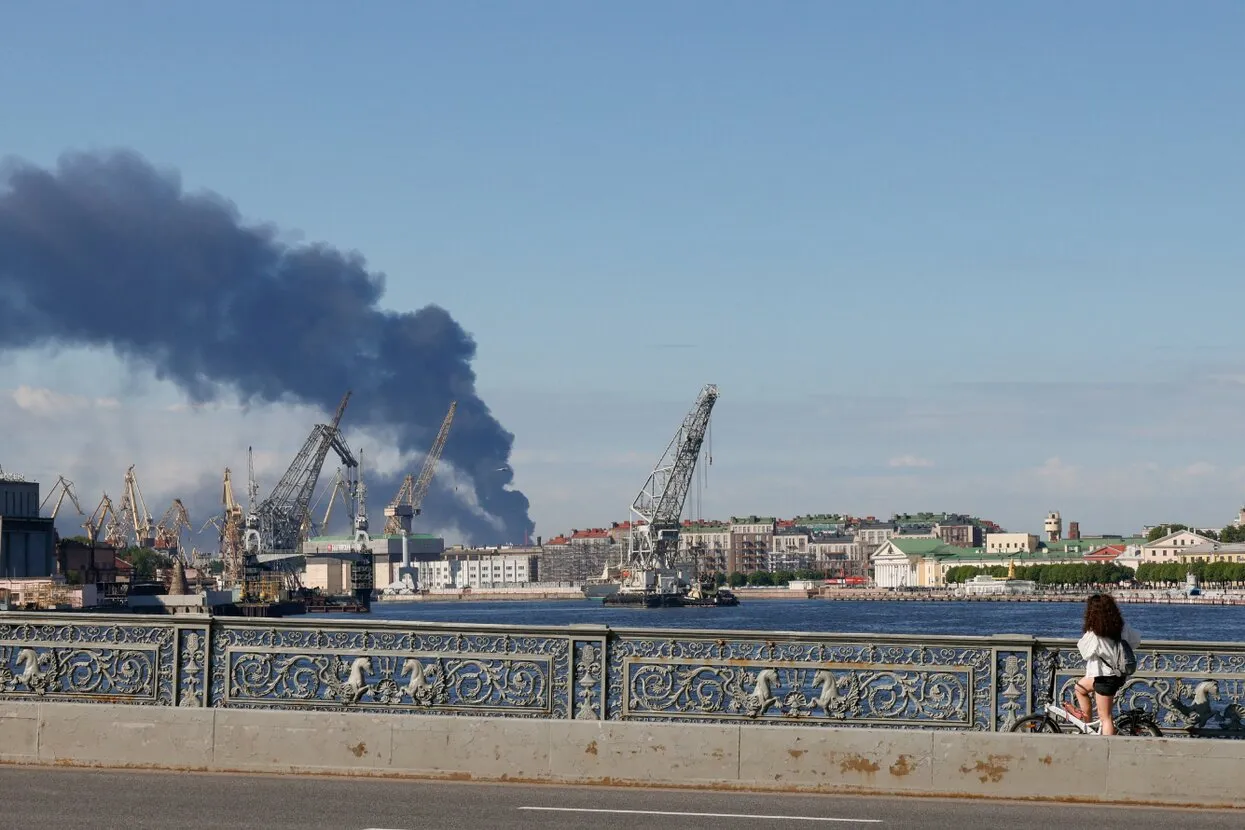
With SPIEF underway downtown, St. Petersburg’s outskirts balance summer weather and a burning oil terminal as residents try to shrug off Ukraine’s latest drone strike
On the morning of June 3, Ukraine launched a large-scale drone strike on the St. Petersburg region, injuring several people — the exact number was never disclosed — and hitting an oil terminal and infrastructure facilities in Kronstadt. The Leningrad region’s governor, Alexander Drozdenko, said 59 drones were shot down over the region that day. A correspondent for the independent journalism cooperative Bereg visited the neighborhoods hit by the strikes and filed this report from the city in the aftermath of the attack, which came on the opening day of the St. Petersburg International Economic Forum (SPIEF).
‘I thought it was a thunderstorm’
For the first time in a long time, St. Petersburg has real summer weather — 20 °C (68°F). The gray skies and cold are finally gone. The sun shines through scattered clouds, and against the sky, a column of black smoke rises from the oil terminal burning on Kanoner Island.
The city’s Kirovsky district is a patchwork. The terminal shares the landscape with steel mills, a tractor factory, the Severnaya Verf shipyard, and commercial port infrastructure. Apartment buildings — a typical Soviet-era residential neighborhood, their housing blocks engulfed in greenery — press up against the industrial zone.
Passersby are relaxed and in no hurry. Families with small children enjoy the local parks. There are no emergency services or police anywhere in sight. The column of smoke filling half the sky — which has already prompted reports of deteriorating air quality across the city — seems to go unnoticed.
In the small park at the corner of Stachek and Marshal Zhukov avenues, a woman who looks to be around 65 — blue top, denim shorts — sits on a bench with her eyes half-closed in the sun. She seems to have positioned herself deliberately, with her back to the black plumes of smoke.
An elderly man rides up to me, a portable speaker playing “Stayin’ Alive” by the Bee Gees.
“Did you hear it?” he asks, his voice calm, with a slight smile.
“Hear what?”
”Woke up at three in the morning, thought it was a thunderstorm. Kept waking up after that, but didn’t see any clouds. Turned out it was drones,” he says, and rides off.
Ukrainian drones have been reaching the St. Petersburg region for some time. Several times this spring, they struck Ust-Luga, a key Russian port on the Baltic Sea and the main maritime hub for oil exports in western Russia.
But the June 3 strikes stand out: this was the opening day of the St. Petersburg International Economic Forum (SPIEF), which draws Russian and foreign politicians, officials, businesspeople, journalists, and bloggers.
This year’s attendees include Andrew Tate Andrew Tate, the misogynist online personality charged with rape, human trafficking, and sexual exploitation of minors; and Candace Owens, the right-wing commentator known for pushing conspiracy theories — among them the false claim that Brigitte Macron, the wife of French President Emmanuel Macron, is a man.
But Tate, Owens, television host Ksenia Sobchak, far-right philosopher Alexander Dugin, designer Artemy Lebedev — who presented a project at the forum to turn the former Kresty pretrial detention center into a museum — and the rest of the guests show no sign of venturing beyond the city center. Beyond it, SPIEF barely exists; apart from the occasional promotional banner, almost nothing announces the forum is even happening.
‘The forecast said sunny all day’
In the early hours of June 3, the state news agency RIA Novosti published an interview with St. Petersburg Governor Alexander Beglov, in which he said that ahead of SPIEF, “exhaustive security measures” had been implemented:
Security forces have drawn up deployment plans for personnel and resources to ensure the safety of citizens and public order, as well as fire safety at the facilities involved in hosting SPIEF.
When the Ukrainian drones reached St. Petersburg, no alert systems went off — even though they had been tested citywide the day before. It wasn’t until early morning that Bereg’s correspondent received a text message from the Emergency Situations Ministry warning of a drone attack.
By morning, federal media were in full SPIEF coverage mode, occasionally breaking for the latest from the war in the Middle East. State television networks also ran coverage of a Ukrainian strike on a passenger bus in Yenakiieve, in the annexed Donetsk region, where eight civilians were killed.
But more independent outlets — Fontanka, Rotonda, and Ostorozhno, Petersburg — still covered the aftermath of the attack in St. Petersburg. Some even published drone videos that locals had posted to social media — even though, for journalists and residents alike, doing so has been punishable by administrative penalties or, in some cases, criminal charges since mid-January 2025.
Beyond the videos, opinions about the Ukrainian strike also began appearing in St. Petersburg’s local Telegram chats and groups (informal communities where residents exchange neighborhood news and commentary):
- “Slept right through it. Just more panic.”
- “Well, basically, yeah — strikes are just a thing now, no joke. Not worth stressing over, lol. Crazy that the forecast said sunny all day in Piter but downtown’s looking like… this.”
- “Friendly reminder: Russia has a super-weapon that can stop all these drone strikes in 20 minutes.”
- “Funny how I seem to remember this whole thing kicking off with ‘Ukraine was gonna attack us, we’re just getting there first!’ and ‘if a fight’s coming, throw the first punch’… So what the fuck are they doing bombing us? Why the fuck are we still at this going on five years? A million guys are dead because the prez decided the empire needed to expand? What the hell does it take for people to get in the streets and say enough with this war???”
By noon, the fire at the oil terminal had been extinguished. The only thing still unknown, as Fontanka noted, was the fate of some 50 cats that had been living on the terminal’s grounds.
This is why they fight?
Many of the videos of drones flying overhead that circulated online despite the authorities’ ban were filmed from windows in the Krasnoselsky district’s new residential towers, on the shore of the Gulf of Finland. Drone debris struck one building — the Pearl Cascade residential complex, a few kilometers from the oil terminal — damaging windows on the 11th floor. According to Fontanka, while the drones were overhead, residents sheltered in the building’s underground parking garage.
But normal life returned to the Krasnoselsky district fairly quickly. Passersby on the street barely talked about what had happened. Only a girl of about 12, riding a scooter, excitedly told her friends: “My mom explained — if the drones had hit a building, the whole thing would have blown up!”
Before her friends could answer, they were interrupted by a loud crash across the street, followed by men swearing. Workers at a nearby construction site dropped something large and heavy. The girls, clearly startled, dropped the subject of the drone strikes — just in case.
The road along the Dudergofsky Canal leads to the embankment of the Gulf of Finland, where the city recently unveiled a new public recreation space. Kids ran around the playground or cooled off in the water as adults stretched out in the sun, caught up with friends, or stared off into the distance.
Kronstadt is visible on the horizon. A column of smoke still rises from the island — the last reminder of the morning’s strike.
An elderly couple in tracksuits, out for a jog, stops suddenly. “How awful — something’s burning in Kronstadt,” the gray-haired man says. His companion is silent. After standing there for a couple of minutes, they sigh deeply and run on.
BBC Russia reported that the corvette Boiky, docked for repairs in Kronstadt, was damaged in the attack. The ship had previously escorted tankers in Russia’s “shadow fleet.”
On the sidelines of SPIEF, VTB Bank chief Andrei Kostin said President Vladimir Putin had already decided to sell military equipment — such as air defense systems — to private companies. Kremlin spokesman Dmitry Peskov, commenting on the Ukrainian strikes on St. Petersburg, said: “The special military operation continues so that there are no more strikes like this.”
Bereg
Further details
Wearing a T-shirt bearing his new Kresty logo, Lebedev presented plans for a cultural and historical complex — with museums, galleries, and two hotels — to open on the site of the former detention facility by 2030. The site is currently open for tours.
“Once, this was a place that took your freedom away. Now it’s a place where you find it,” Lebedev said.
During the Soviet era, Nikolai and Lev Gumilyov, Joseph Brodsky, Daniil Kharms, Nikolai Zabolotsky, and thousands of other prisoners were held at Kresty.
In which cases?
If photos or videos reveal information about the location of military installations, the operation of air defense systems, or critical infrastructure facilities, criminal charges are possible under several articles of the Russian Criminal Code — including those covering state treason, aiding terrorist activities, and spreading “fakes” about the Russian Armed Forces.