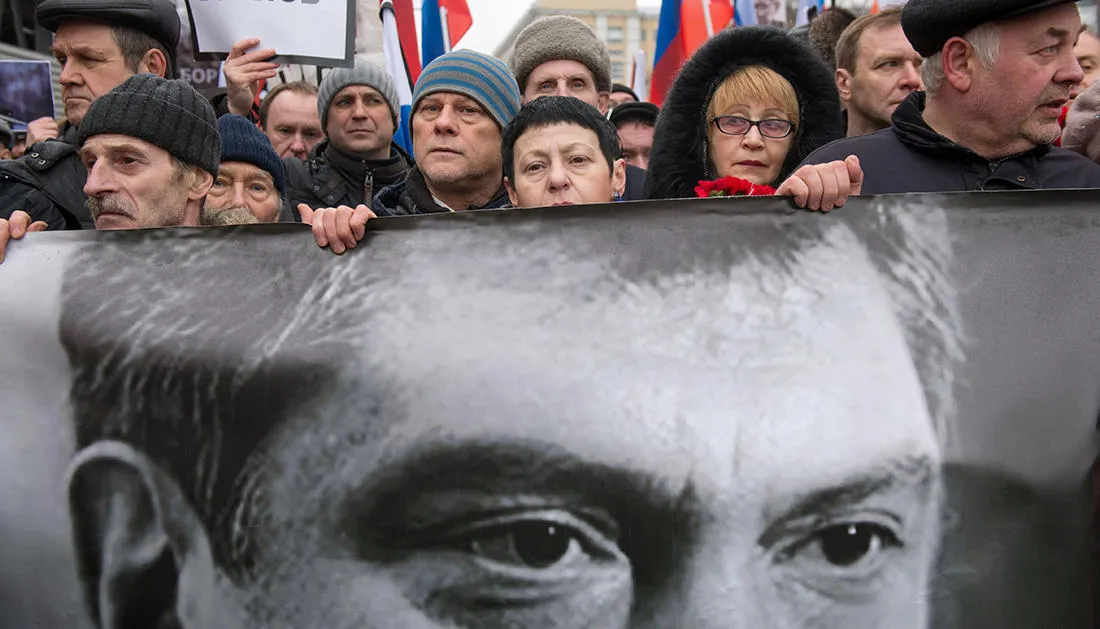
‘These bullets hit every one of us’ Moscow holds a vigil for the slain opposition leader Boris Nemtsov. Ilya Azar reports
A march was held on March 1 in Moscow in memory of opposition politician Boris Nemtsov, who was gunned down late Friday night, February 27. At least 50,000 people are estimated to have attended the vigil, which authorities unexpectedly allowed to take place in the center of Moscow. The march took place almost entirely without incident. Participants holding flowers and Russian flags marched from Moscow’s Kitai-Gorod area to the scene of Nemtsov’s murder on Bolshoy Moskvoretsky Bridge, near the Kremlin.
March 1 was originally planned to be the date of the opposition’s “anti-crisis” march, which its organizers called Vesna (Spring). Nemtsov himself was among the applicants for permission to hold the march. The city’s authorities approved the march, but required that it take place in the Maryino district, a residential area in southeast Moscow. After Nemtsov’s murder, organizers went to the mayor’s office to request permission for a vigil in the city’s center. Officials did not object.
The march began in Kitai-Gorod’s Slavyanskaya Square, where mourners formed a mass that slowly filtered through a line of metal detectors set up by police, a ubiquitous feature of any demonstration in Moscow. Volunteers handed out placards bearing slogans such as “Fight!” (a play of words on the Russian spelling of “Boris”), “There are no words,” “I’m not afraid,” and “Propaganda kills” (written on a white background enclosed by a black frame, reminiscent of the warnings on cigarette packs).
A sign, reading ‘They were afraid of you, Boris’
Photo: Maria Ionova-Gribina / Meduza
Unlike traditional opposition rallies, few participants brought any homemade signs. One marcher held a sign that read “I am Nemtsov,” while another carried a poster that read, “They were afraid of you, Boris.” One elderly man was carrying a sign reading “Boris, you’re right,” with the words “It’s time” on inscribed on the back side. I asked him what the phrase “It’s time” meant to him. “You’ve heard Boris,” he replied. “He said that it was time to drive out these people who are in power.”
Surprisingly, there were a large number of Russian national flags for an opposition rally. Despite the somber nature of the memorial procession, some activists brought the flags of their own parties. Most of these were parties that Nemtsov had also belonged to, such as Solidarity and RPR-Parnas.
Most of the march’s participants walked in silence, sometimes talking quietly with friends or neighbors in group. Many admitted that they hadn’t planned to go to the original march in Maryino, saying they felt obligated to attend, after Nemtsov’s murder.
The march was led by some of Nemtsov’s closest associates, including former Russian prime minister Mikhail Kasyanov and the head of RPR-Parnas’ Moscow branch, Ilya Yashin. Those at the front of the vigil carried a banner bearing the slogan “A Hero Never Dies,” echoing the Euromaidan demonstrations in Ukraine. Behind the banner, people held aloft portraits of Nemtsov with ribbons and the slogans “These bullets hit every one of us” and “He died for the future of Russia.”
Among the march’s famous attendees were not only politicians and activists, but also the actress Renata Litvinova, the businessman Oleg Tinkoff, the co-founder of Menatep bank and former Yukos case prisoner Platon Lebedev, and NTV-Plus commentator Alexander Shmurnov. Nemtsov’s daughter also attended the march with her grandmother.
Representatives of Civic Platform, a once more liberal political party started by billionaire Mikhail Prokhorov, also attended the march, which shocked many in light of its recent appearance at the pro-government Anti-Maidan rally on February 21. One person in the group said the same party members who attended Anti-Maidan also came to the vigil for Nemtsov.
As one might expect, the crowd actively discussed the murder of Nemtsov, mainly blaming the Kremlin or people under the influence of its increasingly sensational propaganda. Since 2014, the state-run media in Russia has been working overtime to stoke fear and hatred toward “foreign agents” and “fifth columnists.” Opposition figures like Nemtsov were often targeted with such labels.
“I think during some conversation Putin let it slip that he was getting sick of Nemtsov, and someone understood this in a literal way,” one marcher explained. “Intelligence agencies don’t need to ask anyone about anything these days.”
“By the way, Yeltsin wanted to appoint Nemtsov to be his successor,” said his friend.
“Would it have been better?” I asked.
“I don’t know, but it definitely would have been different.”
Municipal deputy Max Katz also suggested that Nemtsov might have been killed by the Kremlin or possibly supporters of “Novorossiya,” the pro-Russian separatists in eastern Ukraine.
“Nemtsov was killed because of his incompatibility with Russia. [He was so happy and] they are so melancholy,” said the writer Slava Sergeyev, waving his hand towards the Kremlin and the leaden sky looming above. “And Nemtsov was too lively—windsurfing, models, nightclubs.”
Many expressed the hope that Nemtsov’s murder would eventually end the practice of inciting hatred on federal television channels. “Nemtsov had said that this hysteria was a threat to society on his last appearance on [the radio station] Echo of Moscow,” said Viktor Sidnyev, mayor of Troitsk and one of Nemtsov’s former colleagues. “Today there is a chance to reunite a divided society.”
Photo: Maxim Shemetov / Reuters / Scanpix
The middle of the procession was noisier. Some periodically shouted “Glory to Ukraine!” though no one answered with the nationalist slogan “Glory to the heroes!” like at Maidan. Of course, there were still some fans chating “Russia without Putin,” a classic slogan from the opposition protests of 2011-2012.
“Liberty, Equality, Fraternity!” rang out from the socialists’ contingent.
“Liberty or Death!” the nationalists shouted, almost as if in reply.
There weren’t many nationalists, as several of their leaders refused to support the “fifth column,” but those who attended were among the loudest.
“Kolchak is coming, he will bring order!” members of a right-wing group shouted. Their black flags bore logos that looked like a sword piercing a peace symbol. Members of this group greeted each other by grasping elbows, a tradition often used by football hooligans. (Admiral Kolchak, a White commander in the Russian Civil War, was known for committing atrocities against civilians.)
“This is a political rally, and we are against political killings. We stand for democracy and elections, and I think Nemtsov wouldn’t mind,” one of the nationalists explained to me. In his group, people were carrying flags with the name Narodnaya Volya (The People’s Will) and a picture of a Celtic cross (a common symbol of neo-Nazis). “The Celtic cross is just for PR, so journalists will come to us,” the young man explained. Journalists weren’t the only people who noticed their cross, however. As the nationalists approached Bolshoy Moskvoretsky Bridge, where Nemtsov died, riot police placed them under arrest.
Only the leftists seemed to remember that the original theme of the March 1 protest, prior to Nemtsov’s murder, was Russia’s economic crisis. “Re-vo-lu-tion!” they chanted. “Leftists do not accept murder. Also, some people feel sympathy for Nemtsov and are opposed to this Chekist regime,” explained one of the leftist activists, referring to the preponderance of ex-KGB personnel at the highest levels of power in the Kremlin today.
Nicholai Kavkazskiy, a former prisoner in the Bolotnaya Case of 2012, explained to me that he agreed with Nemtsov’s democratic agenda and opposition to the war in Ukraine. He told me he considered the slogans and chants to be appropriate. “Since this was a political killing, it would be strange to have simply a funeral march.”
Behind the leftists and rightists marched a column of supporters for the ex-Ukrainian army pilot and Rada member Nadezhda Savchenko, who is currently imprisoned in Moscow and accused of being connected to the killings of two Russian journalists in eastern Ukraine. Savchenko has been on hunger strike for more than 75 days. The group was led by Savchenko’s lawyers Mark Feygin and Nikolai Polozov. “Send Putler’s gang to court!” members of the group chanted, combining the Russian President’s surname with Adolf Hitler’s.
Photo: Maria Ionova-Gribina / Meduza
Many marchers had a skeptical attitude towards Feygin’s noisy group. “He wouldn’t miss a single opportunity to use a public event for his own purposes,” said one participant, nodding at the lawyer who once represented the punk band Pussy Riot.
Feygin wasn’t alone, however. Many in the crowd waved Ukrainian flags and said they were “for Maidan and against war.” Whatever the case, the hunger-striking Savchenko seemed to be the vigil’s the most referenced public figure, other than Nemtsov himself.
Once they reached the bridge, the public was not allowed to lay flowers at the spot where Nemtsov died. In order to avoid a stampede, police erected barriers around the spot, so people had to throw their flowers through the fence as they passed by. Here, Mikhail Kasyanov gave a short speech, telling mourners that Nemtsov had been shot “for the truth,” laying blame on “those who, at the instigation of dark forces, say that democrats are traitors.” He also proposed renaming Bolshoy Moskvoretsky Bridge after Nemtsov.
Ilya Azar